What Is an Awning Window?
Key Takeaways
- Awning windows are top-hinged, outward-opening windows with a bottom winder, allowing easy operation even in high or hard-to-reach positions.
- Their key advantage is rain-safe ventilation — the sash deflects water, so windows can stay open during light to moderate rain.
- They seal tightly when closed and work well with double glazing, supporting good thermal and acoustic performance.
- Best suited to bathrooms, kitchens, and high-set positions, but limited airflow and outward projection mean they're not ideal everywhere.
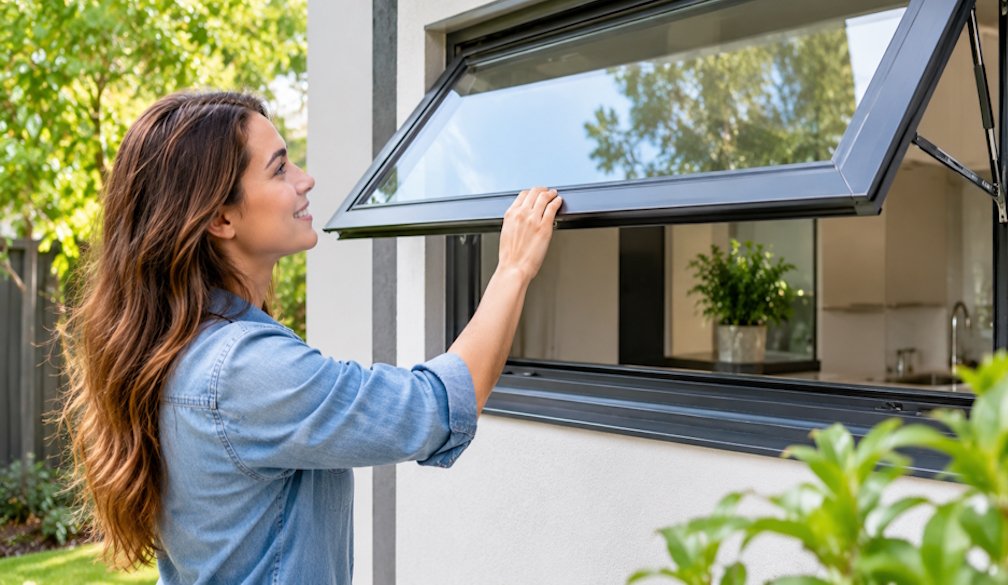
An awning window is hinged at the top and opens outward from the bottom. When open, the sash angles out like an awning over an entry, while the top edge stays fixed against the frame, which is where the name comes from.
It's one of the most common window types in Australian homes: above bathroom tiles, beside kitchen benches, in laundries and set high on bedroom walls. Its popularity is earned, because it lets fresh air in while keeping the elements out. This guide explains how awning windows work, where they suit and where they don't, so you can select the right window for each room.
If you're still weighing up your options, it helps to read across window types before committing. Our detailed guides to double-glazed casement windows and double-glazed sliding windows cover how each performs across ventilation, sealing, and energy efficiency — useful context if you're deciding which style suits each room in your home.
How an Awning Window Works
The operation is simple. The sash is hinged at the top of the frame and connected at the bottom to a winder mechanism — typically a chain winder or a lever handle that rotates to push the sash outward. You wind or push from the bottom, the sash pivots at the top, and the window opens at whatever angle you choose up to its maximum range.
This top-hinged design creates a natural weather barrier. When the sash is open, it extends outward and slightly upward, and rainfall on the glass runs down and out rather than entering the room. This is why awning windows are described as rain-safe: you can leave them open in light rain or a passing shower in a way you simply can't with a casement or sliding window.
Most awning windows are operated by a winder mechanism at the bottom of the frame. The key practical advantage of this is reach: the operation point is at the accessible base of the window, not in the centre of the glass. For windows above a kitchen bench, above a sink, or positioned high on a bathroom wall, you can open them without stretching awkwardly or leaning across a surface.
The Main Advantages of Awning Windows
Awning windows offer a combination of features that make them particularly well suited to everyday living conditions:
Ventilation in Wet Weather
This is the standout benefit and the reason awning windows dominate in Australian bathrooms and kitchens. You can maintain airflow through a rain event because the open sash deflects water away from the opening. In Australia's climate — where afternoon thunderstorms, coastal showers, and prolonged wet weather are common depending on the region — this is genuinely useful rather than just theoretically nice.
Practical Operation in Awkward Positions
Because the winder is at the bottom of the frame, awning windows are well suited to positions that would make other window types difficult to use: above benches and splashbacks, high on walls for privacy, above cabinetry, or in any confined space where you can't easily access the centre of the window.
Good Seal Performance When Closed
The top-hinge mechanism causes the sash to press against the frame when the window is closed and latched. Combined with quality weather seals, this creates a reasonably airtight closure. This is an advantage over sliding windows, where the sliding mechanism makes a fully compression-sealed closure mechanically difficult to achieve. For thermal performance and draught reduction, the awning window's closure mechanism is a positive, and multi-point locking on quality units adds security.
Suitability for Double Glazing
Awning windows are compatible with standard double-glazed units, so specifying them with energy efficient glass, such as low-e coatings, the right solar heat gain coefficient (SHGC) or acoustic laminated glass, is straightforward. Compared with single glazed windows, the upgrade keeps rooms warmer in winter and cooler in summer, so comfort improves year round, and it adds noise reduction against external noise. West-facing windows, in particular, benefit from solar-control glazing, while north-facing glass in Melbourne should admit winter sun.
Frame material matters too. Aluminium awning windows are common, but aluminium conducts heat unless it's thermally broken; uPVC frames insulate better with no thermal break needed. Most systems come in finishes from white to black. Near the coast, marine-grade hardware is worth specifying, and all windows should be tested to AS 2047.
The Main Limitations of Awning Windows
Like any window type, awning windows come with trade-offs that are important to understand before specifying them throughout a home:
Limited Opening Size Relative to Frame Size
An awning window opens to a fraction of its total frame area. The angle constrains the maximum opening the sash can achieve and the hardware range. This makes awning windows less suitable when maximum airflow is the primary goal — a fully open casement window can ventilate more aggressively because it clears the full frame width.
Outward Projection
The open sash projects outward from the wall. In positions where the outside space is well clear of the window — most typical residential installations — this isn't a problem. But above paved areas, walkways, garden beds close to the wall, or outdoor furniture placed against the house, the projecting sash can be an obstacle or a hazard.
Upper-Floor Bedroom Windows
On upper floors, openable bedroom windows 2m or more above the ground outside must have restrictors or screens limiting the opening to 125mm under the National Construction Code's fall-protection rules. Awning windows fitted with compliant restrictors work well here, but check the requirement when specifying.
Cleaning Access
The outer face of the glass is on the projecting sash, which can be moderately difficult to clean in some configurations, particularly when the window is at height. Some awning window designs allow the sash to be opened far enough to wipe the outer face from inside; others require external access. It's worth confirming the cleaning method for any awning window installed above an easily accessible height.
The Best Uses for Awning Windows
Awning windows are versatile, but they excel in specific positions and room types. Here is where they deliver the most value in Australian residential design:
Bathrooms and Wet Rooms
This is the natural home of the awning window in Australian residential design. The combination of weather-safe ventilation, easy positioning at privacy-appropriate heights (above eye level), and the ability to leave the window open during showers and through rain events makes them the default and usually best choice for bathroom ventilation. An awning window set high on a bathroom wall provides ventilation, maintains privacy, and can be left open almost continuously during warmer months.
Kitchens
Above benches, above splashbacks, and in any position where reach would be awkward, awning windows are the practical choice for the kitchen. The winder operates from bench height, so you're not leaning across the counter. Rain safety means you can leave the window open while cooking in wet weather to let steam and cooking smells out. Combined with a kitchen ventilated by both an awning window and a functioning rangehood, air quality in the kitchen is significantly better than with a fixed window or a window that must be closed in wet weather.
Laundries
Laundries generate moisture and benefit from consistent ventilation. An awning window that can be left slightly open continuously — in most weather — is ideal. Because laundries are typically internal or on secondary walls, privacy is often a consideration too, and an awning window positioned high on the wall addresses both.
Above Fixed Windows or Alongside Other Window Styles
One of the most versatile applications is pairing an awning window with a larger fixed panel. The fixed panel provides light, views, and a clean visual; the awning provides ventilation without requiring a full-width opening. This combination appears frequently in living areas and bedrooms where a large visual opening is desired but a large operational opening is unnecessary.
High-Set Positions for Privacy and Ventilation Together
For rooms where both privacy and ventilation matter — a street-facing bedroom, a bathroom adjacent to a neighbour's property, a studio or study — an awning window positioned near the ceiling provides airflow at a height where the interior is not visible from outside. This is more effective than frosted glass lower on the wall because it lets in unrestricted natural light from above.
Other Window Types to Consider
When maximum breeze capture and ventilation are the primary goals, a casement window — hinged at the side, opening fully outward — is more effective. A fully open casement clears the entire frame width and can be oriented to channel a prevailing breeze into the room. For living rooms and main bedrooms where you want to catch a summer-afternoon sea breeze, casements often outperform awnings for raw ventilation.
When unobstructed views and light are the goal, a fixed picture window or a large sliding window does a better job — and the awning's ventilation benefits aren't relevant if the primary function is visual.
When the outdoor space immediately outside the window is close to the building — a narrow side passage, a tight courtyard, close garden beds — the outward-projecting sash can be impractical or dangerous. Sliding windows, including common aluminium sliding windows and uPVC sliders, or fixed glazing may be more appropriate in these positions.
Awning vs Casement vs Sliding: A Quick Comparison
If you're comparing window types for different areas of your home, it helps to understand how each performs at a glance. The key differences come down to ventilation, usability, and the way the window interacts with the surrounding space:
- Awning windows are best for wet-weather ventilation, high or awkward positions, and rooms like bathrooms and kitchens where continuous operation in varied weather is needed.
- Casement windows are better for maximum airflow, capturing prevailing breezes, and positions where the full frame width can be opened toward an available breeze.
- Sliding windows are best for positions where outward projection isn't possible, for wide horizontal openings, and for applications like servery windows where a horizontal pass-through is the functional goal.
Awning Windows and Australian Conditions
Awning windows are one of the most climate-appropriate window types for Australian conditions, precisely because the weather is variable. Being able to maintain ventilation through afternoon showers without closing every window in the house is a significant practical advantage in coastal, subtropical, and temperate regions.
In hot climates, awning windows with appropriate solar control glazing — low-e glass, tinted glass, or double-glazed units with low SHGC ratings — manage heat gain effectively. The tight-sealing closure means the window's thermal contribution is better than that of many sliding configurations when closed.
In bushfire-prone areas, windows are subject to the site's bushfire attack level (BAL) rating. At higher BAL ratings, window opening dimensions and glazing specifications are regulated. Confirm the specific requirements for your site's BAL classification when specifying any window type.
While awning windows already offer solid sealing performance, their energy efficiency can be significantly improved with the right materials and glazing choices. For a deeper look at how modern frames and double glazing contribute to better insulation and lower energy bills, this guide on uPVC windows and doors and their energy efficiency benefits for Australian homes explains what makes the biggest difference in real-world conditions.
Choosing Awning Windows
Awning windows are popular in Australian homes for good reason. Rain-safe ventilation and a winder within easy reach solve real problems in kitchens, bathrooms and laundries that other window types don't handle as well, which makes them the perfect fit for those rooms.
They're not the right choice everywhere: airflow is limited and the sash projects outward. Review each room and select the window type that suits its job, rather than using a single style throughout, to ensure every position works well.
APS Double Glazing supplies and installs double glazed uPVC awning windows across Melbourne that save energy and keep noise out. Explore the range in our brochure (PDF), or get in touch and the team can offer suggestions for your home.
Frequently Asked Questions (FAQs)
1. What is an awning window?
An awning window is a window hinged at the top that opens outward from the bottom. The sash pivots on the top hinge and extends away from the building when opened, creating an awning-like overhang that deflects rain. It's operated by a winder mechanism typically at the bottom of the frame.
2. How does an awning window open?
By rotating a winder handle or chain at the bottom of the frame. This pushes the bottom of the sash outward while the top remains hinged, opening the window to whatever angle is set by the winder position.
3. Can awning windows stay open in the rain?
Yes, in light to moderate rain. The open sash extends outward, creating an overhang that directs rain down and away from the opening. This is one of their main practical advantages over casement and sliding windows, which must generally be closed in the rain.
4. Are awning windows good for ventilation?
Yes, for consistent everyday ventilation, particularly in rooms like bathrooms and kitchens. For maximum airflow when catching a strong breeze, casement windows are more effective because they open the full width of the frame. Awning windows are better for sustained ventilation in variable weather conditions.
5. What is the difference between awning and casement windows?
Both are hinged windows that open outward, but the hinge placement differs. Awning windows are hinged at the top and open from the bottom; casement windows are hinged at the side and open like a door. Awnings are better in the rain and for high or awkward positions; casements are better for capturing maximum breeze.
6. Where should awning windows be used?
Bathrooms, kitchens, laundries, positions above benches or splashbacks, and high-wall positions where privacy and ventilation need to coexist. They're also well-suited to pairing alongside fixed windows in living areas.
7. Are awning windows energy efficient?
They can be. The tight compression seal, when closed, gives them an advantage over sliding windows for draught reduction. Specifying them with double-glazed units and appropriate low-E or solar control coatings makes them highly energy-efficient. The glazing specification matters as much as the window type for thermal performance.
8. How much do awning windows cost in Australia?
Supply costs for a standard awning window range from roughly $250 to $800, depending on size, material, and glazing specification. Installed costs, including labour, typically range from $400 to $1,200 per window. Double-glazed or custom-configured units and premium materials sit at the higher end of those ranges.