The price of a week away in Australia
- Written by: The Times
Domestic tourism has become a more professional business, from the airlines that carry us to the caravan parks that accommodate us. For families travelling in school holidays, the biggest influence on the bill is often the one thing they cannot change.
The Australian family holiday begins with a decision at the kitchen table. Four return airfares might buy a week in Queensland, but the bags are extra and the family will need a hire car. Driving takes the airfares out of the calculation, but puts fuel and perhaps a motel stop into it. Taking the caravan means bringing a bed and a kitchen. There is still the question of what it costs to park it for a week.
Run those sums for a week in February and the answer may look quite reasonable. Run them for the first week the children are out of school and the same trip can become a different proposition.
Australia has built a domestic tourism industry that is easier to book, more polished and more varied than it used to be. Hotel and motel brands offer a degree of predictability. Caravan parks can entertain an entire family for days. Airlines put an enormous range of fares and schedules on a single screen. Yet the date a family enters at the top of that screen can matter more than any choice it makes afterwards.
The choice at the airport
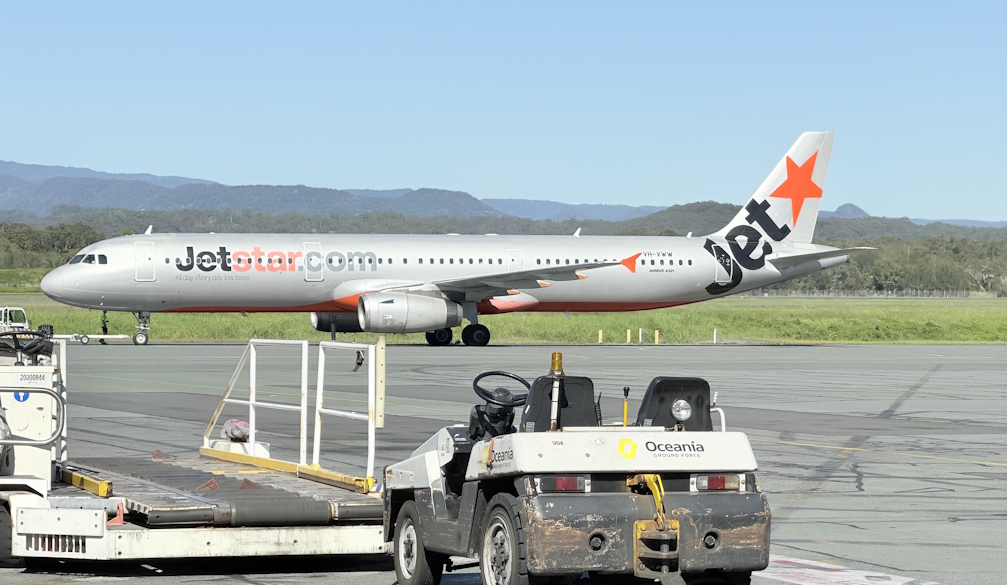
A domestic flight search can give the impression of vigorous competition. There may be half a dozen departures to choose from and several different prices for a seat on each one. On the main routes, the underlying choice is usually between two businesses. Qantas and Jetstar are part of the Qantas Group. Virgin Australia is the other national competitor.
In July 2026, the Qantas Group carried 65.2 per cent of domestic passengers in the competition regulator’s figures. Virgin carried 33.3 per cent. Together they accounted for 98.5 per cent of passengers measured. Jetstar gives travellers a lower-cost option on many routes, and the differences in baggage, flexibility and service are real. There are still only two major groups deciding where to put most of the country’s domestic seats.
Rex carried 1.5 per cent. It is now a regional airline under US owner Air T, which completed its acquisition in December 2025 with Commonwealth financing support. Rex’s survival matters to the communities it serves. The national figures make it look small, but the loss of a scheduled service can mean several extra hours on the road for someone travelling from a regional town. For a family flying between major cities, Rex’s withdrawal from intercity flying means one fewer airline competing for the booking.
There is another limit on choice that the national figures cannot show. A family may have two airlines to choose from in principle and only a few workable flights in practice. An inexpensive early departure can mean paying for airport parking or a room near the terminal. A late arrival can cost the first evening of a short break. With four tickets to buy, even a modest difference per passenger can decide whether the trip goes ahead.
The road holiday is big business
For much of the country, the practical alternative is to drive. It gives a family control over departure times and luggage, and makes it possible to stop in towns that are difficult to reach by air. A cabin with a kitchen, a tent or a caravan can also bring the food bill within reach. The family can arrive with groceries, make breakfast and decide where a meal out is worth the money.
Australians took a record 17.3 million overnight caravan and camping trips in 2025 and spent $12.6 billion on them. Nearly nine in ten nights were spent in regional Australia. That money goes well beyond the park gate. It buys fuel, groceries, meals and repairs in towns that may see much of their visitor trade concentrated into a few busy periods.
The road trip also helps explain why motels remain important. On a long drive, a motel room is often the purchase that makes the next day manageable. At that point, a family values a sensible check-in time, somewhere to park and enough beds. A familiar motel brand or booking network can make those things easier to find. At the destination, hotel groups sell a different kind of certainty, from a straightforward room to a resort with restaurants and a pool. Across both sectors, there are still independent operators whose location, service or price can make them the best choice in town.
Driving makes a wider part of the country accessible, but it does not guarantee a cheaper holiday. A family towing a caravan has fuel to buy and equipment to maintain. Hire a camper and the hire charge becomes part of the comparison. Add a motel each way and a week on a powered site at peak rates, and the road trip can cost more than the family expected when it first ruled out flying.
From a powered site to a resort
The industrialisation of the caravan park is one of the most visible changes in Australian travel. BIG4, Discovery Parks, Tasman Holiday Parks, Reflections and NRMA have helped turn a once highly local business into one where travellers can search across properties, compare accommodation types and book well ahead. Those names cover different ownership and operating arrangements. What families see is a market that looks and behaves more like the hotel industry.
At one end, there is still a place to pitch a tent or plug in a caravan. At the other are multi-bedroom villas, safari tents and enough entertainment to keep a family inside the grounds for much of the holiday. The two can sit within walking distance of each other, which is part of the appeal. Grandparents can take a villa, one family can bring the caravan and another can book a cabin. Everyone can meet at the pool.
BIG4 Sandstone Point Holiday Resort, near the bridge to Bribie Island in Queensland, is arguably the high point of that development. A family can arrive with its own caravan and spend the next morning at a water park with a tipping bucket. There are pools, mini-golf, a pump track, an arcade and a swim-up bar. Powered sites sit alongside glamping and waterfront villas. A few decades ago, most of those features would have sent a traveller looking for a very different sort of accommodation. At Sandstone Point they are reasons to book a caravan holiday.
NRMA is catching up at the resort end of the market. Treasure Island on the Gold Coast, with its pools, splash park and family activities, shows how a holiday park can compete for guests who might otherwise book a hotel. For parents, there is value in having something for the children to do without paying for a separate outing every day. For the operator, the facilities give people a reason to stay longer and make the property attractive to families who have never owned a tent or a caravan.
There is room in Australia for a park with pools and villas and for one with a clean amenities block and a short walk to the beach. Both are selling something families value. The concern is whether there are enough simple, affordable sites left in popular destinations when families are actually able to use them.
The price of a date you cannot change
Australians have paid summer rates at the coast for generations. What has changed is the reach and precision of demand pricing. An airline can sell different seats on the same flight at different fares. A hotel can raise the price of its remaining rooms as a busy weekend approaches. A holiday park can charge more for a site during school holidays and require a longer stay over its busiest dates.
The effect builds across the booking. A family may find a reasonable fare on the way out and a much dearer one coming back. The motel on the drive home may be charging a Saturday rate. The park may have sites available, but only for a longer booking than the family wants. Each business is pricing one part of the trip. The family has to pay for all of it.
Operators have a commercial reason to charge more when demand is strong. The income from Christmas or Easter helps support businesses through quieter weeks. Pools, playgrounds and landscaped grounds need maintenance whether the park is full or half empty. In a seasonal town, a few successful weeks can make a considerable difference to the year’s trading.
The unfairness lies in who has the freedom to shop around the calendar. Flexible travellers can go after the schools return and may have much of the same beach, pool or national park to themselves. Parents with school-age children generally have to choose from the same blocks of weeks. A worker whose employer closes over Christmas may face a similar constraint. Both can compare providers and destinations, but the simplest way to dodge the premium is a choice they often do not have.
Minimum stays sharpen the problem. Three nights might be within reach. A five-night minimum can put the same trip beyond the budget, even when the nightly rate looks manageable. The accommodation may be available on the dates the family wants, yet the family has to buy extra nights to get it.
Where the value still is
Package sellers such as Luxury Escapes can make some trips more affordable. Breakfast for the family, an included meal or a resort credit can be worth more than a small discount on the room itself if it replaces something the guests would otherwise buy. Packages work best when the inclusion matches the trip. If breakfast covers only two adults, the family still needs to price the children’s meals. A headline discount also loses its shine if the chosen dates carry a surcharge.
There is similar value in a cabin with a kitchen or a holiday park with activities already covered by the tariff. A higher accommodation price can sometimes buy a lower daily spend. Equally, a straightforward motel near a beach, a playground and somewhere to buy dinner may deliver the better holiday for a family that plans to spend the day outdoors.
Those are genuine choices, and the Australian industry deserves credit for providing them. The difficulty is seeing the full price soon enough. A family comparing flying and driving needs fares for everyone, bags, transport at the other end and the actual accommodation bill for its dates. A family comparing parks needs the price of the whole required stay. The cheapest flight, the lowest nightly rate and the biggest advertised package discount each answer a question smaller than the one the family is asking.
The Times View
Sandstone Point shows how good an Australian holiday park can be. The persistence of the roadside motel shows how much Australians also value a clean room and a convenient place to stop. A mature tourism industry should be able to serve both ends of that market through the weeks families can travel.
A school holiday premium is easy to explain. The harder question is how much genuine choice remains once it has been added to the flight, the room and the caravan site. An industry that has become very good at measuring demand should be equally good at showing families the full price of meeting it. And there should still be places where a family can pay for somewhere to sleep, spend the day at the beach and come home with enough money to do it again next year.