Comparing Different Types of Ground Protection Mats
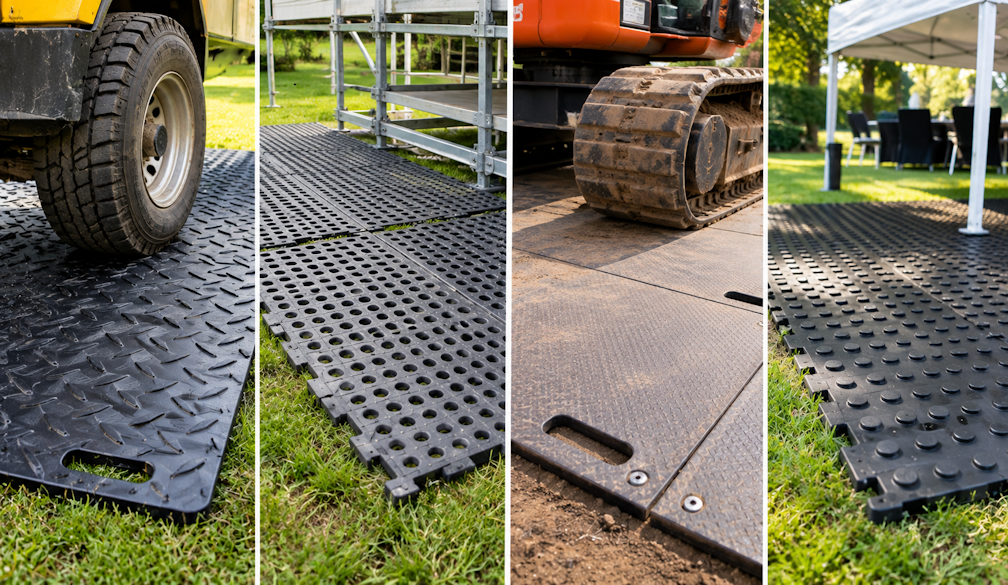
When construction vehicles need to pass through the lawn, the activity team needs to protect the site, or the equipment must enter the wet and soft area, the selection of suitable pads can help plan temporary access and reduce direct damage to the surface.
but search types of ground protection mats you will see different products such as HDPE, timber, composite, rubber, and pedestrian decking. Their use, construction, weight and installation can vary widely.
This article will compare common types and explain how to reconcile specifications and project costs.
What Are Ground Protection Mats?
Ground protection mats it is a backing plate product used to form a temporary passage or working surface. Depending on the specific design, they can be laid on lawns, soil or other areas that need protection for people, vehicles or equipment.
A proper pad system can reduce direct contact of the tire, track or sole with the ground and help distribute the load to a larger area. But it does not guarantee complete avoidance of ground compaction, rutting or lawn damage.
Temporary Access and Surface Protection
Projects may use pads for different reasons:
- Establish temporary access routes for equipment.
- Protect the lawn or finished landscape.
- Reduce the direct wear of the vehicle on wet and soft ground.
- Provide planned access areas for event personnel.
- As part of an evaluated temporary operating system.
Before comparing products, the main tasks should be identified. One product may be suitable for protecting active lawns, but not for heavy construction equipment; another 1 may be used for vehicular traffic, but not for walking or wheelchair access for visitors.
HDPE Ground Protection Mats
Typical Uses and Product Designs
High-density polyethylene, referred to as HDPE, can be used for some ground protection mats and temporary access road products. Such products may be used in construction corridors, garden work, mobile cloth evacuation and vehicle access to the lawn.
The size, thickness, surface texture, hole location and connection of HDPE mats vary from product to product. Some products are mainly for light equipment, and some are designed for higher traffic loads.
If you are planning a temporary vehicle route, you can view HDPE ground protection mat options , and confirm the applicable specifications to the supplier in conjunction with the actual equipment and on-site.
Handling, Connections, and Reuse
Some HDPE products are designed for repeated laying and removal, and may have hand-held holes or connectors. However, whether it can be handled manually should be judged according to the weight, size, site conditions and local operation requirements of the single block.
When comparing products, it is recommended to confirm:
- Monoblock dimensions, thickness and weight.
- Surface texture and intended tire, track or pedestrian use.
- Connection type and use requirements.
- Whether it is suitable for the expected turn and repeated traffic.
- Cleaning, inspection, storage and post-damage treatment.
What to Check Before Selection
HDPE does not decay due to water absorption like wood, but this does not mean that all HDPE mats are suitable for any outdoor environment or equipment.
If the pad requires long-term sun exposure, the outdoor use conditions of the product should be confirmed with the supplier. For heavy vehicles or wet and soft ground, the product specifications, vehicle load and the suitability of the ground below should be checked at the same time.
Timber Ground Protection Mats
Temporary Roads and Equipment Access
Timber mats can be used for temporary roads, construction roads or other equipment access areas. Different products may use wooden beams, boards or multi-layer structures, and the specific connection methods are different.
Some timber products are used for heavier equipment or larger work areas, but the product name itself does not indicate the applicable load. The supplier shall be required to provide the dimensions, construction, condition and intended use, and to describe the equipment intended for use.
Product Construction and Handling
Timber mats may be larger in size and weight. Project costs include not only the pad itself, but may also include transportation, mechanical handling, laying and recycling.
If the entrance to the site is narrow or there is no proper handling of equipment, the completion of site operations should be confirmed prior to procurement or leasing. The length of the route and the area to be paved will also affect the delivery and schedule.
Moisture, Inspection, and Replacement
After the wood is exposed to the humid environment, the state of the board may change. Before repeated use, the wood, joints and edges should be inspected for obvious damage, decay or structural problems.
Old pads require special attention to the actual state. Even if different products are similar in appearance, their residual availability may be different; the name at the time of purchase should not be used to judge that the old pad is still suitable for the original purpose.
Composite and Engineered Mat Systems
How Composite Products Differ
Composite mats it is a broader market category. Different products may use different materials, layers, internal structures and connection systems, so all composite mats cannot be considered to have the same weight, stiffness or load-bearing capacity.
When comparing, the supplier shall be asked about the composition, size, connection method, design purpose and use conditions of the product. Some products may facilitate the formation of a continuous temporary road; actual paving requirements shall still be subject to the specific product description.
Temporary Roads and Work Areas
Composite systems may be used for construction routes, utility access, or temporary work areas. The project should distinguish between vehicles passing by and equipment operating in a fixed position.
For example, a temporary route may need to withstand repeated vehicle traffic; a work area may need to assess equipment parking, material stacking or local support. These tasks may not necessarily adopt the same specifications.
When Site-Specific Design Is Needed
For cranes, equipment outriggers or other concentrated loads, the equipment manufacturer's requirements, ground conditions and support systems shall be confirmed. The U.S. Occupational Safety and Health Administration's requirements for applicable construction crane operations, ground conditions and necessary support materials shall jointly meet the support and flatness requirements of the equipment manufacturer.
A traffic mat is not automatically a crane pad or an engineered work platform.
When the product data does not clearly cover the intended use, or the foundation conditions are uncertain, a professional on-site assessment should be sought.
Rubber Mats and Pedestrian Turf Protection
Rubber Mat Applications
Rubber mats it can be used for some ground protection and traffic scenes, but the product structure and use are quite different. Some products are designed for pedestrians or lighter equipment, others may be used in different industrial environments.
The comparison shall confirm the weight, surface, drainage, connection method and applicable load. Don't assume that a product is suitable for a vehicle or a soft ground just because it uses rubber.
Pedestrian Decking for Events
Pedestrian decking commonly used in pedestrian areas on movable entrances, temporary trails or lawns. Surface flatness, edges, seams, non-slip and barrier-free access requirements should be considered when selecting.
If forklifts, trucks or lifting equipment are required to enter during the construction or evacuation of the event, the corresponding route and product should be separately confirmed as suitable for the vehicle. Pedestrian products and vehicle products should not be automatically interchanged.
Grass Cover Time and Surface Conditions
Temporary mulching can reduce direct trampling, but mulching can also affect the lawn's access to light, air and moisture. The National Park Service points out that the timing of the coverage of the lawn protection system needs to consider the season and related conditions.
Therefore, the installation, activities and removal time should be included in the plan, and the inspection and removal arrangements should be confirmed with the site management personnel. The same general cover period cannot be set for all grass species, products and weather.
Compare Different Types of Ground Protection Mats
The following comparison is used to help you with your selection questions; the use and capabilities of specific products still need to be verified with the supplier.
|
Product Type |
Typical Use |
Handling Consideration |
Key Limitation |
|---|---|---|---|
|
HDPE mats |
Temporary vehicle routes and surface protection |
Size and weight vary by product |
Check the specific product, load, and ground conditions |
|
Timber mats |
Temporary access or equipment areas |
Larger products may require machinery |
Inspect structure and confirm handling requirements |
|
Composite mats |
Temporary roads or work areas |
Connection and installation vary |
Composite is a broad category with different constructions |
|
Rubber mats |
Selected pedestrian or vehicle applications |
Weight and surface vary |
Confirm the product is designed for the intended traffic |
|
Pedestrian decking |
Event walkways and turf protection |
Consider layout, edges, and removal |
Do not assume it is suitable for vehicles |
|
Engineered support system |
Site-specific equipment support |
May require specialist design and installation |
Must match equipment reactions and ground conditions |
Traffic Routes vs. Concentrated Loads
Vehicle traffic usually requires consideration of equipment movements, turns and repeated passes; crane legs may generate concentrated loads in smaller areas. The support needs of the two are different.
If the project includes both vehicle routes and equipment fixed work areas, the tasks should be described separately. The fact that a product is suitable for one purpose does not mean that it is automatically suitable for the other 1.
Compare the Entire Product System
When comparing products, don't just look at a single sheet. Connections, edges, installation direction, route width and underlying ground may affect actual use.
For wet and soft ground, if significant subsidence, pad displacement or deep ruts still occur after laying, traffic should be suspended and re-evaluated. Protective pads can be part of the scheme, but are not a substitute for the judgment of the site foundation.
How to Choose Ground Protection Mats for Your Project
Equipment, Ground Conditions, and Route
Before the inquiry, organize the heaviest equipment in the project and how it is used. For multi-stage construction, vehicles, accessories and actual loads should be confirmed for different stages.
It is recommended to provide the supplier:
- Equipment model and maximum working weight.
- Contact modes such as tires, tracks or legs.
- Driving, parking or fixed support tasks.
- Ground type, humidity, slope and drainage.
- Route length, width, turning and loading and unloading positions.
- Estimated number of passes and time of use.
- Underground facilities, trees, lawns or other site restrictions.
Dimensions, Surface Grip, and Connectors
The size of the base plate will affect the number of laying, transportation and route layout; the surface texture may affect the use experience of different equipment or personnel; the connection is related to the installation method and on-site maintenance.
It should be confirmed whether the product is suitable for the expected tires, tracks and steering methods. For the event site, edges, joints and pedestrian access requirements should also be confirmed.
The bearing data provided by the supplier shall indicate the applicable conditions. When there is no corresponding information, the maximum value of the two products cannot be directly used as the only basis for comparison.
What Do Ground Protection Mats Cost Over a Project?
Purchase vs. Rental
For recurring teams, purchasing may facilitate deployment across multiple projects; for one-time or short-term projects, leasing may reduce initial investment.
However, the lease price may also include or be additional to the cost of transportation, handling, cleaning, overdue and damage. The purchase plan should consider storage, maintenance, replacement and final disposal.
Transport, Installation, Cleaning, and Storage
A product with a lower unit price does not necessarily result in a lower total project cost. For example, a single heavier pad may require additional handling equipment, while a re-used system may require cleaning, inspection, and warehousing.
When comparing quotations, confirm that:
- The route or area that needs to be covered.
- Number of backing plates, connectors and spare parts.
- Delivery and recycling distance.
- Loading and unloading equipment and site personnel.
- Cleaning, damage and replacement responsibility.
- The cost of storage or disposal after the end of the project.
Estimate Cost per Use
For self-owned pads that you plan to reuse, you can first create a budget comparison using the following formula:
Cost per use = (Purchase cost + Transport cost + Cleaning cost + Storage cost + Disposal cost − Residual value) / Number of uses
Assume that the total purchase and related costs of a set of pads are $1,500, not included in the residual value, plan to use 15 times then the example cost per use is $100.
This figure is only an illustration of the calculation method, not a market quote or product life commitment. If only 5 times are actually used and the expense assumption remains the same, the single cost will become $300. You should recalculate using your own quote, estimated usage and maintenance costs.
Lease options should be compared separately by lease term, transportation, cleaning and other contract costs.
Choose Ground Protection Mats Around the Actual Task
compare different types of ground protection mats determine who will use the channel, what support the ground can provide, and what the project needs to protect. Then compare the product structure, handling, connection, inspection and complete project costs.
If you are selecting a pad for a construction, garden or activity project, you can Okay Plastic's ground protection solutions understand the relevant products and provide the equipment list, route and site photos to the supplier for further verification of applicable specifications.