

How to Choose a Robot Mower for Small Gardens, Townhouse Yards, and Courtyards
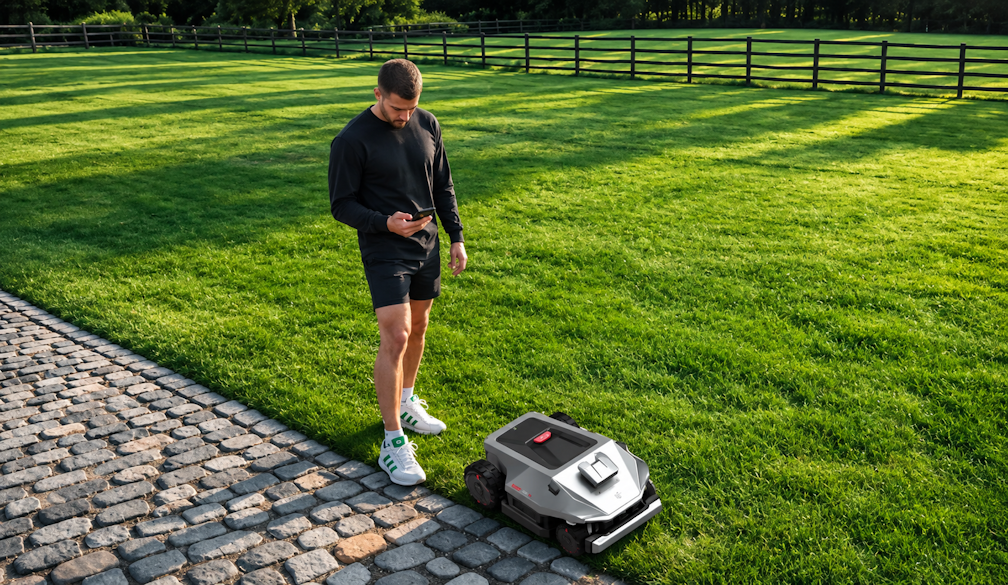
Maintaining a small lawn may seem straightforward, but compact outdoor spaces can present unique challenges for homeowners. Townhouse yards, enclosed gardens, and shared courtyards often feature narrow passages, irregular boundaries, landscaping obstacles, and limited turning space.
Robot lawn mowers offer an automated approach to routine grass maintenance. However, not every model is suited to these environments. Factors such as navigation technology, cutting width, obstacle detection, slope capability, and installation requirements can all influence how well a mower performs in a small residential setting.
Rather than focusing solely on brand names or product rankings, understanding these features can help homeowners evaluate different models based on their actual yard conditions.
1. Navigation Technology and Boundary Requirements
One of the first considerations when choosing a robotic mower is how it identifies and navigates the lawn.
Traditional robotic mowers commonly use perimeter wires installed around the cutting area. These wires establish the operating boundary and help prevent the mower from entering flower beds, pathways, or other restricted areas.
More recent models offer wire-free navigation. Depending on the system, these mowers may use satellite positioning, cameras, sensors, or combinations of different technologies to identify lawn boundaries and navigate their surroundings.
Wire-free systems can reduce the need for physical installation work, which may be useful in established gardens or properties where modifying the landscape is undesirable.
However, wire-free navigation does not automatically guarantee better performance. Satellite signal quality, tree coverage, building interference, and the complexity of the garden layout can all affect navigation accuracy.
Before choosing a model, homeowners should check whether its navigation system is suitable for their specific outdoor environment.
2. Size, Maneuverability, and Narrow Passages
Small gardens are not necessarily easy to maintain with automated equipment.
A compact townhouse lawn may include narrow corridors between buildings, sharp corners, small grass sections, and obstacles such as garden furniture or trees.
In these environments, the physical dimensions of the mower and its steering capabilities matter.
Important factors include:
- Overall mower width and length.
- Minimum passage width required for operation.
- Turning radius and maneuverability.
- Ability to navigate irregular lawn boundaries.
- Cutting performance near fences and garden edges.
Homeowners should also consider whether the mower can move between separate lawn sections without manual assistance.
A model designed for open lawns may require more intervention when operating in a garden with multiple narrow passages or disconnected grass areas.
3. Obstacle Detection and Navigation Sensors
Residential gardens frequently contain temporary and permanent obstacles.
These may include outdoor furniture, children's toys, garden decorations, trees, irrigation equipment, and other objects that can interfere with mowing operations.
Different robotic mowers use different obstacle-detection technologies. Some rely primarily on physical sensors, while others incorporate cameras or more advanced vision-based systems.
For example, the GOKO M6 robot mower is described by its manufacturer as incorporating QuadVision obstacle avoidance and CyberNav Fusion navigation technology.
These features provide an example of how manufacturers are combining visual recognition and navigation systems in newer robotic mower designs.
When evaluating this type of technology, buyers should look beyond feature names and consider practical questions:
- What types of obstacles can the system recognize?
- Does obstacle detection work in different lighting conditions?
- Can the mower respond appropriately to unexpected objects?
- How does it behave around narrow garden features?
- Are there limitations described in the manufacturer's operating documentation?
Actual performance should be assessed using product specifications, independent testing, and the conditions in which the mower will operate.
4. Terrain, Slopes, and Ground Conditions
Not all small gardens have completely flat surfaces.
Older residential properties may include uneven lawns, sloping sections, exposed roots, paving transitions, or changes in ground elevation.
For these properties, wheel configuration, traction, ground clearance, and suspension design can affect mowing performance.
Some robotic mowers are designed primarily for relatively level lawns, while other models incorporate all-wheel-drive configurations or specialized suspension systems for more challenging terrain.
The GOKO M6, for instance, is described as having a four-wheel-drive configuration and adaptive suspension.
These specifications are relevant when comparing models for gardens with uneven surfaces. However, drivetrain configuration alone does not establish how steep a slope the mower can safely handle.
Buyers should check the manufacturer's specified maximum gradient and distinguish between climbing capability and the ability to cut grass consistently on a slope.
Wet grass, loose soil, and uneven ground can also influence traction.
5. Battery Capacity, Cutting Width, and Operating Time
Battery performance is another important consideration, particularly for properties with several separate lawn sections.
A mower with a larger battery may offer longer operating periods, but battery capacity should be considered alongside cutting width, motor efficiency, lawn conditions, and charging time.
For a compact garden, a smaller cutting width may be sufficient and could make it easier to navigate narrow spaces.
When comparing models, consider:
- Battery capacity and estimated operating time.
- Charging time between mowing sessions.
- Cutting width and adjustable cutting height.
- Recommended lawn coverage.
- Automatic charging and scheduling functions.
Manufacturers may provide estimated coverage figures, but these should be interpreted in the context of the property layout and actual mowing conditions.
A simple rectangular lawn may require less operating time than a similarly sized garden divided by pathways, trees, and landscaping features.
6. Noise, Scheduling, and Residential Compatibility
Noise is particularly relevant in townhouse developments and densely populated residential areas.
Although robotic mowers generally operate differently from conventional walk-behind lawn mowers, their noise levels vary by model.
Homeowners should check published noise specifications and consider when mowing will take place.
App-based scheduling can also help coordinate mowing sessions with household routines and neighborhood expectations.
For shared courtyards or properties managed by homeowners' associations (HOAs), it is worth reviewing community landscaping rules before purchasing equipment.
Requirements may address operating hours, equipment noise, access to shared spaces, and responsibility for lawn maintenance.
Wire-free operation may simplify installation in some situations, but it does not automatically establish compliance with HOA rules. Approval requirements should always be checked with the relevant property manager or association.
7. Maintenance, Support, and Long-Term Ownership
The purchase price is only one part of the overall cost of owning a robotic mower.
Regular maintenance may include blade replacement, cleaning, wheel inspection, battery care, and software updates.
Homeowners should also consider the availability of replacement parts, warranty coverage, technical support, and local servicing.
For properties with complex layouts, the availability of installation assistance and troubleshooting support may be particularly important.
Before making a purchase, compare the manufacturer's maintenance recommendations and warranty terms rather than relying solely on advertised features.
What Should Homeowners Prioritize?
The most suitable robotic mower depends on the specific characteristics of the lawn.
For a simple, flat townhouse yard, basic navigation and a suitable cutting capacity may be sufficient.
For gardens with narrow passages, maneuverability and obstacle detection deserve more attention.
For uneven terrain, traction and slope specifications become more important.
For established courtyards where installing perimeter wires is difficult, wire-free navigation may be worth considering, provided the surrounding environment supports reliable positioning.
There is no single set of specifications that makes a mower suitable for every small garden. Evaluating the property first can help homeowners avoid paying for capabilities they may not need.
Frequently Asked Questions
Do all robotic mowers require boundary wires?
No. Some models use perimeter wires, while others use wire-free navigation technologies. The installation requirements depend on the model and its navigation system.
Are wire-free robotic mowers suitable for enclosed courtyards?
They may be suitable, but performance depends on the navigation technology and surrounding environment. Tall buildings, dense tree coverage, and limited satellite visibility can affect certain positioning systems.
Can robotic mowers operate on sloping lawns?
Some models are designed for sloped terrain, but their capabilities vary. Buyers should check the manufacturer's maximum slope specifications and consider ground conditions.
What features matter most for a small townhouse garden?
Navigation accuracy, compact dimensions, turning ability, obstacle detection, cutting width, and noise levels are useful starting points.
Do homeowners need HOA approval before installing a robotic mower?
Requirements vary between communities. Homeowners should review applicable landscaping and equipment regulations before installation, particularly when the mower will operate in shared spaces.
Conclusion
Choosing a robotic mower for a small garden involves more than comparing advertised lawn coverage or looking at product rankings.
Navigation technology, physical dimensions, obstacle detection, terrain compatibility, battery performance, and maintenance requirements all contribute to the suitability of a model.
By evaluating these factors against the actual layout and conditions of their property, homeowners can make a more informed decision and identify equipment that meets their maintenance needs without unnecessary complexity.