Google AI
The Times Australia
Business and Money

Today's Measuring What Matters statement is just a first step – now we have to turn goals into action

  • Written by: Warwick Smith, Research economist, The University of Melbourne
Today's Measuring What Matters statement is just a first step – now we have to turn goals into action

Today’s release of the Commonwealth Treasury’s Measuring What Matters[1] statement is an important step towards better government decision-making and a shared vision for the Australia we want, but it’s only the first step.

Treasurer Jim Chalmers has long talked about broadening[2] our measures of success beyond the traditional ones of Gross Domestic Product (GDP), inflation and unemployment.

The wellbeing framework[3] announced today is an attempt to bring those ideas into being. The need for different economic thinking is demonstrated in many ways, including the current housing crisis, worsening climate change, the loss of biodiversity and increases in financial stress and mental illness.

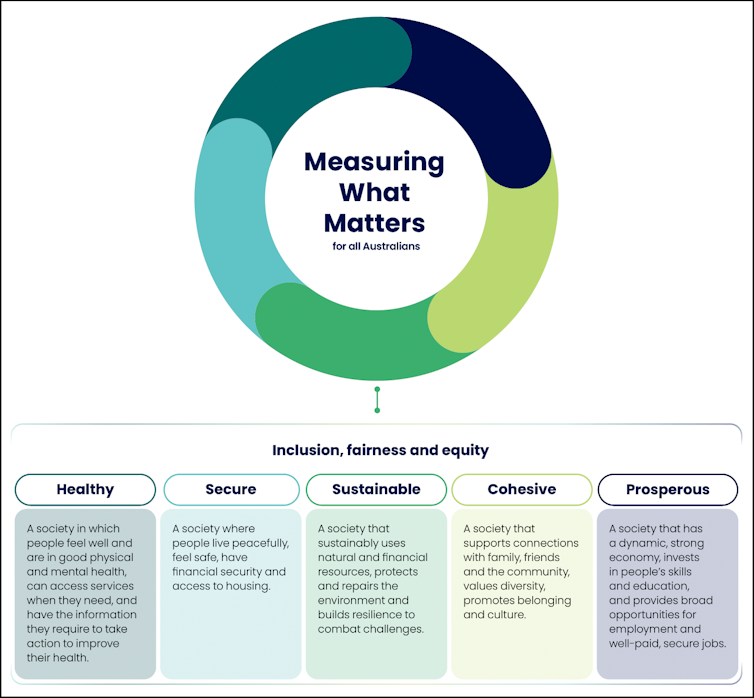
The new framework consists of a dashboard of 50 indicators, grouped under five themes, which seek to broaden our collective ambition beyond things such as GDP.
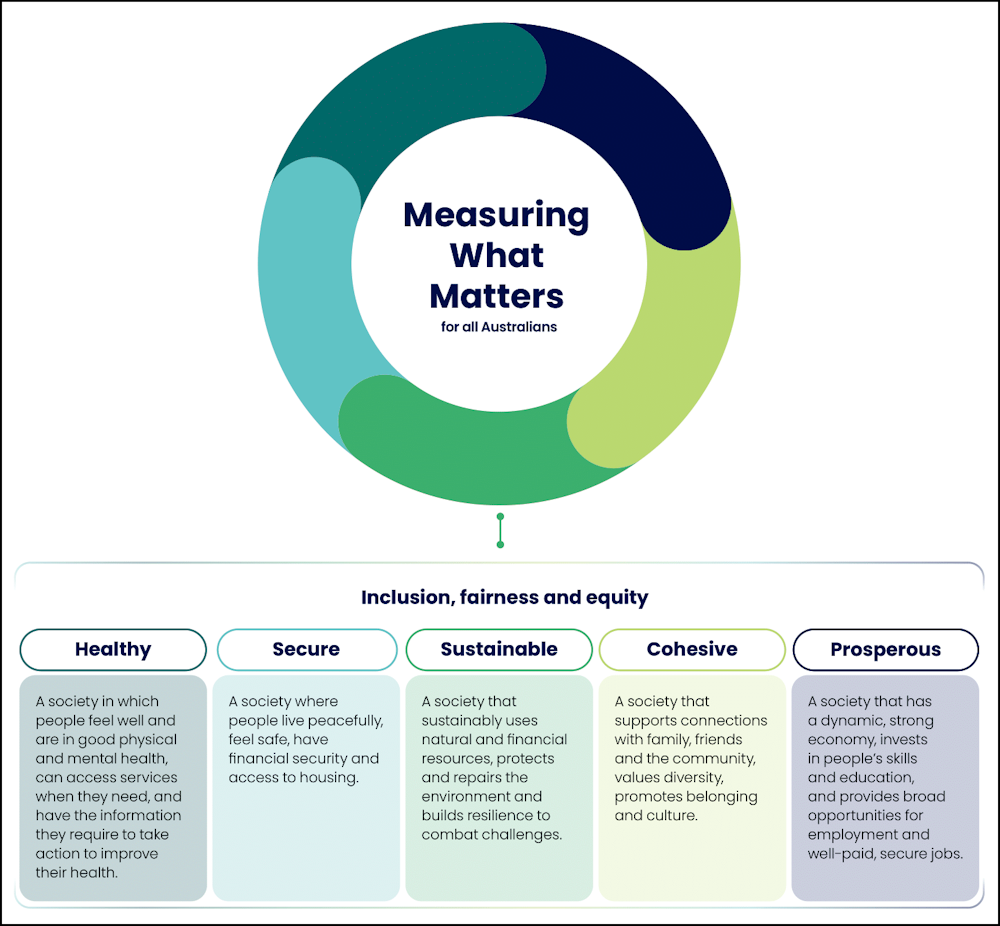
Measuring What Matters, Commonwealth Treasury[4] Developing a wellbeing framework brings Australia into line with many forward-thinking democracies, including the five members of the Wellbeing Economy[5] government partnership: Finland, Iceland, New Zealand, Scotland and Wales. But creating such an economy requires more than a dashboard. The Wellbeing Economy Alliance[6], a global collaboration of people and organisations working for a wellbeing economy, has developed five “tests” of a genuine wellbeing economy: Does the economy provide everyone with what is needed to live a life of dignity and purpose? Does the economy restore, protect, and cherish the natural environment and is the economy guided by the principles of interconnection and indivisibility of human, animal, plant, and environmental health? Does the economy value activities and behaviours by their contribution to social and ecological wellbeing? Is the economy designed to ensure a just distribution of income, wealth, power, and time? Is the shape and form of the economy locally rooted and determined by people’s active voices? From metrics to meaningful change Encouragingly, the statement says measurement is only the beginning[7]. It says the next step will be integrating the framework into decision making. Consistent with our international counterparts, we will be looking for opportunities to embed the Framework into government decision-making. This will involve guidance for agencies to inform policy development and evaluation. This won’t be easy. While the metrics in the framework will be useful for tracking progress and sparking action aimed at reversing negative trends and building on successes, international examples[8] tell us it’s hard to use a framework built from 50 different metrics to work out what to do. It can turn compliance into a box-ticking exercise, when what’s really needed is a paradigm shift. Read more: Beyond GDP: Chalmers' historic moment to build wellbeing[9] Learning from others’ failures and successes Wales found a way around this through a national conversation that eventually led to the Wellbeing of Future Generations (Wales) Act 2015[10]. That act requires public bodies to use sustainable development as guiding principle and to work to achieve seven goals that reflect the values and aspirations of the Welsh people. Those goals include prosperity, resilience, health, equality, global responsibility, cultural vibrancy and connection – not dissimilar to the themes in Measuring What Matters. Where the Welsh goals differ from those in Australia’s Measuring What Matters statement is that they have a democratic mandate, and all Welsh public authorities are legally obligated to work towards achieving all of them. Inaugural Welsh Future Generations Commissioner Sophie Howe.Realising the potential of Measuring What Matters will require the support and vigilance of the Australian people. Australians, and the government, will need to be willing to experiment and sometimes fail. It took Wales three attempts at developing a wellbeing framework before it landed on the Wellbeing of Future Generations Act. Read more: 'Wellbeing’ will give future budgets more rigour than any before[11] It is encouraging that treasury and the treasurer are openly saying that what was released on Friday is only the start of a conversation about measures of progress. Measuring what matters, when the people have been robustly engaged in defining what matters, is a vital precondition for the economic system change Australia needs. Read more: Australians' national wellbeing shows a glass half full: Measuring What Matters report[12] References^ Measuring What Matters (treasury.gov.au)^ broadening (theconversation.com)^ wellbeing framework (treasury.gov.au)^ Measuring What Matters, Commonwealth Treasury (treasury.gov.au)^ Wellbeing Economy (wellbeingeconomy.org)^ Wellbeing Economy Alliance (weall.org)^ only the beginning (treasury.gov.au)^ international examples (cpd.org.au)^ Beyond GDP: Chalmers' historic moment to build wellbeing (theconversation.com)^ Wellbeing of Future Generations (Wales) Act 2015 (www.gov.wales)^ 'Wellbeing’ will give future budgets more rigour than any before (theconversation.com)^ Australians' national wellbeing shows a glass half full: Measuring What Matters report (theconversation.com)Authors: Warwick Smith, Research economist, The University of Melbourne

Read more https://theconversation.com/todays-measuring-what-matters-statement-is-just-a-first-step-now-we-have-to-turn-goals-into-action-209879

Business Times

American Business Leaders Went to China: That Market Is Vital for…

When Donald Trump arrived in China accompanied by a powerful entourage of American business leaders, the symbolism was unmi...

Where Our Batteries Come From: Battery making is big business

Batteries are now so deeply embedded in modern life that most people rarely stop to think about them. They power: elect...

Commonwealth Bank’s Share Price Rollercoaster

What It Reveals About Confidence in Australia’s Banking Sector For years, the share price of Commonwealth Bank has been vi...

The Times Features

Restaurants Are Packed Again — So Why Are Australians S…

Australians still love dining out. Despite years of inflation, rising interest rates, higher rents...

Real Estate and the Federal Budget: Early Signs Emergin…

Australia’s federal budget has landed, and while economists, investors and political strategists c...

The Modern Causes of Back Pain and What You Can Do

Key Highlights Modern lifestyles are a major contributor to ongoing back painPosture, movement, a...

What to Know About Adding Natural Oils to Your Wellness…

Key Highlights Natural oils are commonly used to support everyday wellbeingConsistency and qualit...

How Online Mental Health Support Is Changing Access to …

Key Highlights Online mental health services are improving accessibility for many individualsFlex...

Why every drop counts

Accurate water measurement and confidence in Sustainable Diversion Limits (SDLs) are essential to ...

Dining Out Is Expensive. Buying High Quality Meat and F…

For many Australians, dining out has quietly shifted from a weekly habit to an occasional indulgen...

REFLECTIONS: A Legacy in the Rain at Carla Zampatti AFW…

Words & Photography by Cesar Ocampo There is a specific kind of magic that happens when high fa...

Where Our Batteries Come From: Battery making is big bu…

Batteries are now so deeply embedded in modern life that most people rarely stop to think about th...