You better hope your work cleaner is one of the few who has time to do a thorough job
- Written by: Shelley Marshall, Associate Professor and Director of the RMIT Business and Human Rights Centre, RMIT University
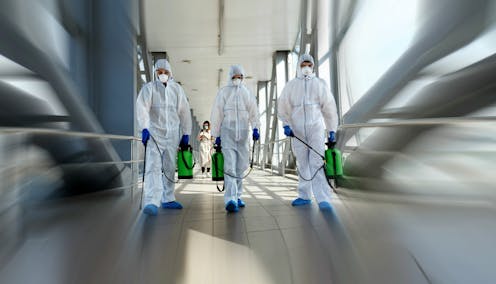
As many of us gingerly return to our workplaces, we are relying on cleaners to keep us safe.
Employers have extra concerns. High quality cleaning is the key to shielding them from liability should their workers contract COVID-19 and they run the risk of having to shut their workplaces down again.
SafeWork Australia and its state counterparts have prepared guidelines[1] for keeping workplaces safe.
They recommend cleaning at least daily[2], and in some circumstances more frequently.
Two surveys paint very different pictures of how it is being done.
One is alarming.
Much workplace cleaning is rushed and poorly resourced
A survey of 500 cleaners conducted by the United Workers Union in May found that 91%[3] always, often or sometimes have to rush because they didn’t have enough time. 80% said they didn’t have enough equipment to do a quality job.
The findings are consistent with two other investigations not conducted by unions, a 2018 Senate inquiry report[4] and a 2018 Fair Work Ombudsman report[5].
The Fair Work Ombudsman found it was
not uncommon for cleaners to report that they do not consider they are afforded sufficient time to complete all the required specifications to a high level
Despite the rhetoric about cleaners being “essential workers”, they are often not treated well.
Three quarters of the union’s respondents reported that did not have enough personal protective equipment (PPE) to do their job safely, putting them at risk if COVID-19 is present in a workplace.
Many face barriers to taking sick leave[6] when they are unwell, forcing them to continue working or lose pay.
The minimum award rate for cleaners is $20.82 per hour, although many don’t get paid that much[7].
Read more: We've let wage exploitation become the default experience of migrant workers[8]
One third of cleaning companies audited by the Fair Work Ombudsman in 2016 were found to be underpaying[9] their workers.
A further inquiry into the exploitation of cleaners in Tasmania in 2018 found underpayment at 90%[10] of Woolworths sites.
Most cleaning workers are migrants on temporary visas who are vulnerable to exploitation[11] and face risks if they speak up.
A second survey of paints a much better picture.
Yet some of it is excellent
A survey of cleaners working in buildings certified by the Cleaning Accountability Framework in April found 94%[12] felt adequate precautions are being taken to protect their health and safety, 92% were given enough personal protective equipment, 97% were being provided with enough chemicals and equipment and 84% were able to take paid sick leave.
The Cleaning Accountability Framework[13] is an independent not-for-profit entity comprised of representatives from across the cleaning supply chain, including property investors, owners and managers, cleaning companies, employee representatives and industry associations. It aims to promote and recognise best practice.
The vast difference points to a way forward.
Though the SafeWork guidelines[14] heap the burden of keeping workplaces safe on employers, most employers do not have an employment relationship with their cleaners.
Know your cleaners
The 2018 Senate Inquiry[15] was “deeply concerned by the trend in contracting out cleaning services through convoluted supply chains with murky lines of responsibility”.
It found contracting out was rife across all sectors, including the public service. Many employers don’t even see those who clean their workplace, let alone supervise them, as cleaning generally takes place out of office hours, making it difficult to check whether the cleaning is being done in accordance with guidelines.
It would help if the guidelines took account of the reality that cleaning is often outsourced and subcontracted.
Read more: What's the school cleaner's name? How kids, not just cleaners, are paying the price of outsourcing[16]
And cooperative arrangements between building owners, cleaning contractors and building tenants could go a long way towards lifting standards, making sure that the people responsible for the workplace know whether cleaners are getting paid enough and being given enough equipment, training and time to provide it.
“Smiley face” monitoring systems aren’t enough in the time of COVID-19.
Employers whose employees contract COVID-19 because of poor cleaning practices face serious risks[17]. Cleaners who contract COVID-19 or are injured because of poor conditions are likely to be considered their responsibility[18], even if they don’t employ them directly.
The best response is to take that responsibility seriously, more closely enforcing contracts, and if necessary varying their terms, to allow for extra, safe and adequately paid and resourced cleaning.
This piece was co-authored with Dr Miriam Thompson[19]
References
- ^ guidelines (www.safeworkaustralia.gov.au)
- ^ daily (www.safeworkaustralia.gov.au)
- ^ 91% (www.unitedworkers.org.au)
- ^ Senate inquiry report (www.aph.gov.au)
- ^ Fair Work Ombudsman report (www.fairwork.gov.au)
- ^ sick leave (www.cleaningaccountability.org.au)
- ^ don’t get paid that much (www.abc.net.au)
- ^ We've let wage exploitation become the default experience of migrant workers (theconversation.com)
- ^ underpaying (www.fairwork.gov.au)
- ^ 90% (www.fairwork.gov.au)
- ^ exploitation (theconversation.com)
- ^ 94% (www.cleaningaccountability.org.au)
- ^ Cleaning Accountability Framework (www.cleaningaccountability.org.au)
- ^ SafeWork guidelines (www.safeworkaustralia.gov.au)
- ^ 2018 Senate Inquiry (www.aph.gov.au)
- ^ What's the school cleaner's name? How kids, not just cleaners, are paying the price of outsourcing (theconversation.com)
- ^ serious risks (www.smh.com.au)
- ^ their responsibility (www.worksafe.vic.gov.au)
- ^ Dr Miriam Thompson (www.linkedin.com)
Authors: Shelley Marshall, Associate Professor and Director of the RMIT Business and Human Rights Centre, RMIT University