

Will Roe v Wade be overturned, and what would this mean? The US abortion debate explained
- Written by: Prudence Flowers, Senior Lecturer in US History, College of Humanities, Arts, and Social Sciences, Flinders University
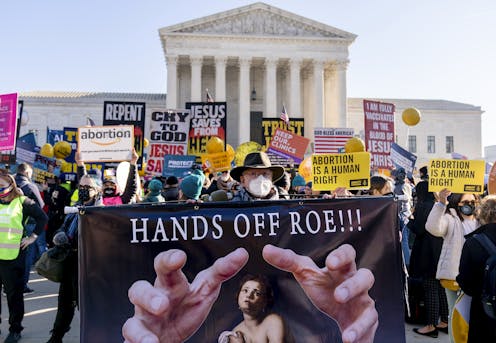
Last week, the US Supreme Court heard oral arguments in a case that is the most significant threat to abortion rights in the US in decades.
The case, Dobbs v Jackson Women’s Health Organization[1], centres on a 2018 Mississippi law[2] banning abortion after 15 weeks except in “medical emergencies or for severe fetal abnormality”.
It is part of a wave of state abortion bans passed since the 2016 US presidential election that take aim at Roe v Wade[3], the landmark 1973 Supreme Court decision that guaranteed abortion as a constitutional right.
So, what is this Mississippi challenge based on and could it eventually lead to the overturning of Roe v Wade?
Two issues at stake in the Mississippi case
The Supreme Court, which likely won’t make a decision in the case until mid-2022, is faced with two key issues.
One of the central elements of Roe is that the state and federal governments cannot ban abortion before viability, the point at which a fetus can theoretically survive outside the pregnant person’s body (defined as approximately 23-24 weeks gestation).
The Mississippi ban falls well short of the viability threshold. As such, the Supreme Court is now considering whether all pre-viability bans on elective abortions are unconstitutional[4].
Read more: Supreme Court signals shift on abortion – but will it strike down Roe or leave it to states to decide when 'personhood' occurs?[5]
The second issue is respect for legal precedent. Since the Supreme Court was established in 1789, it has reversed its own constitutional precedents[6] only 145 times, or in 0.5% of cases.
Roe v Wade, decided 48 years ago, is sometimes described as a “super precedent[7]” decision, because the Supreme Court has repeatedly reaffirmed it.
Constitutional scholar Michael Gerhardt[8] defines “super precedents” as
constitutional decisions in which public institutions have heavily invested, repeatedly relied, and consistently supported over a significant period of time.
Conservatives, including several on the Supreme Court, reject the inclusion of Roe v Wade in this definition.
Why does the court’s makeup now matter?
In oral arguments, Mississippi’s lawyers invited the Supreme Court to use this case to overturn Roe v Wade. Anti-abortion lawyers and activists are optimistic their arguments will fall on receptive ears.
In 2016, Donald Trump, like every Republican presidential candidate dating back to Ronald Reagan, campaigned on a promise to appoint “pro-life judges[9]” to the Supreme Court.
Despite serving only one term in office, Trump was able to deliver. He appointed Neil Gorsuch[10] in 2017, Brett Kavanaugh[11] in 2018, and Amy Coney Barrett[12] in 2020 to fill Supreme Court vacancies. Conservatives on the bench now have a 6-3 majority.
While conservative Chief Justice John Roberts is no supporter of abortion rights, he has been a swing vote on a range of issues and has an established interest in protecting the reputation of the Supreme Court. However, after Barrett was sworn in, conservatives no longer needed to appeal to him to form a majority.
And while Kavanaugh[13] claimed in his confirmation hearings to believe Roe v Wade was “settled as a precedent of the Supreme Court”, last week in oral arguments he read from a list of Supreme Court cases that overturned precedent.
Read more: Who is US Supreme Court nominee Brett Kavanaugh, and where does he stand on abortion?[14]
How states have chipped away at abortion access
Abortion rights have survived serious attacks before.
In Planned Parenthood v Casey (1992)[15], three appointees of Republican presidents sided with two liberal justices to uphold Roe v Wade, arguing “liberty finds no refuge in a jurisprudence of doubt[16].”
That judgement reiterated the viability threshold for legal abortions, but allowed states to pass restrictions as long as they did not place an “undue burden” on the right to an abortion.
Since the 1990s, anti-abortion lawmakers have pushed to find the limits of an “undue burden,” pursuing laws and test cases that erode abortion access.
Many states now mandate[17] 24- or 72-hour waiting periods, ultrasounds, parental consent requirements for teenagers and counselling that repeats anti-abortion claims.
Since 2010, conservative states have also passed hundreds of targeted regulation of abortion provision (TRAP) laws[18], which place prohibitive and medically unnecessary restrictions[19] on doctors and clinics that provide abortion care.
This anti-abortion strategy of chipping away at Roe v Wade has been extraordinarily successful.
Between 2011–16, over 160 abortion providers closed or stopped offering terminations, the largest rate of closures[20] since 1973. Multiple states, including Mississippi, have one remaining abortion clinic[21] in operation.
New strategy: more aggressive challenges to Roe v Wade
After Trump’s victory, opponents of abortion shifted to a more aggressive strategy of directly challenging Roe v Wade.
Most of these recent laws, such as Alabama’s 2019 near-total abortion ban[22], have been blocked by the lower courts.
A new Texas law banning abortion after six weeks[23] is currently in effect while the Supreme Court considers whether its unique enforcement mechanism[24], which allows private citizens to sue anyone they think has broken the law, can be challenged in the courts.
Read more: Jim Crow tactics reborn in Texas abortion law, deputizing citizens to enforce legally suspect provisions[25]
And the partisan makeup of the current Supreme Court makes it almost certain that Mississippi’s law will stand.
What is not clear is whether the justices will restrict themselves to the question of fetal viability or whether they will completely overturn Roe v Wade, allowing states to ban abortion at will.
If the Supreme Court allows the states to ban abortion before viability, this will have a significant impact on the small number of pregnant people who seek abortions in the second trimester.
Generally, these people have either received a devastating[26] medical[27] diagnosis[28] or they have complex personal circumstances[29], including domestic violence, mental illness, and/or drug addiction. These patients, as well as the doctors that provide this care, are highly stigmatised.
The long-term effects of overturning Roe v Wade
If Roe v Wade is overturned and abortion rights are returned to the states, access to abortion will effectively be a geographical lottery[30].
Twenty-two states have laws that could be used to ban or severely restrict abortion, while 15 states and the District of Columbia have laws that protect the right to abortion.
Abortion is a routine, common type of reproductive health care. Approximately one in four American women[31] will have an abortion before they are 45.
Despite the political controversy and polarising rhetoric, polling this year[32] indicated that 80% of Americans support abortion in all or most cases, and at least 60% support Roe v Wade.
However, while abortion is common, three-quarters of US abortion patients are low income[33] and more than half are people of colour[34]. They already face significant financial and logistical barriers in accessing this essential health care.
If Roe v Wade is overturned, abortion will still be safely and legally accessible for those who can afford it. The devastating consequences of such a decision will fall primarily on the shoulders of those least able to bear it.
References
- ^ Dobbs v Jackson Women’s Health Organization (www.scotusblog.com)
- ^ 2018 Mississippi law (www.nytimes.com)
- ^ Roe v Wade (en.wikipedia.org)
- ^ all pre-viability bans on elective abortions are unconstitutional (www.supremecourt.gov)
- ^ Supreme Court signals shift on abortion – but will it strike down Roe or leave it to states to decide when 'personhood' occurs? (theconversation.com)
- ^ reversed its own constitutional precedents (theconversation.com)
- ^ super precedent (scholarship.law.unc.edu)
- ^ Michael Gerhardt (constitutioncenter.org)
- ^ pro-life judges (www.nbcnews.com)
- ^ Neil Gorsuch (www.nytimes.com)
- ^ Brett Kavanaugh (www.nytimes.com)
- ^ Amy Coney Barrett (theconversation.com)
- ^ Kavanaugh (www.washingtonpost.com)
- ^ Who is US Supreme Court nominee Brett Kavanaugh, and where does he stand on abortion? (theconversation.com)
- ^ Planned Parenthood v Casey (1992) (en.wikipedia.org)
- ^ liberty finds no refuge in a jurisprudence of doubt (supreme.justia.com)
- ^ mandate (www.guttmacher.org)
- ^ targeted regulation of abortion provision (TRAP) laws (www.guttmacher.org)
- ^ place prohibitive and medically unnecessary restrictions (reproductiverights.org)
- ^ largest rate of closures (www.bloomberg.com)
- ^ one remaining abortion clinic (edition.cnn.com)
- ^ near-total abortion ban (time.com)
- ^ banning abortion after six weeks (www.texastribune.org)
- ^ unique enforcement mechanism (www.texastribune.org)
- ^ Jim Crow tactics reborn in Texas abortion law, deputizing citizens to enforce legally suspect provisions (theconversation.com)
- ^ devastating (www.denverpost.com)
- ^ medical (www.nytimes.com)
- ^ diagnosis (www.usatoday.com)
- ^ complex personal circumstances (onlinelibrary.wiley.com)
- ^ geographical lottery (www.guttmacher.org)
- ^ one in four American women (www.guttmacher.org)
- ^ polling this year (www.forbes.com)
- ^ low income (www.guttmacher.org)
- ^ people of colour (www.guttmacher.org)