Secrecy surrounding Djokovic's medical exemption means star can expect a hostile reception on centre court
- Written by: Daryl Adair, Associate Professor of Sport Management, University of Technology Sydney
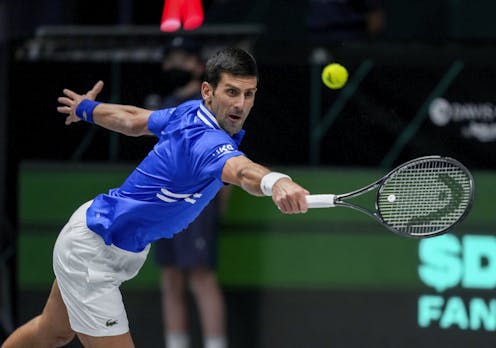
Novak Djokovic, nine times Australian Open tennis champion, has confirmed via social media[1] – after much speculation – that he will indeed be competing in the 2022 tournament.
The sticking point[2] for him was the Victorian government’s requirement that all players be vaccinated, in the interests of reducing public transmission of COVID-19[3].
A noted anti-vaxxer[4], Djokovic submitted a request for a medical exemption to the vaccine mandate, which has now been approved. In tennis parlance, a COVID wildcard will jettison Djokovic to Melbourne.
Djokovic’s rocky history with COVID-19
In June 2020, Djokovic contrived a tournament, the Adria Tour[5], in the Balkans, as a response to the cancellation of many tennis events during the pandemic. It was organised by the Novak Djokovic Foundation, as a “charity tour to help the coronavirus victims”[6].
However, players and officials did not wear masks or socially distance – it was instead a party atmosphere. No surprise, then, that COVID broke out[7] among attendees. Djokovic and his wife Jelena were among those infected, with the tournament abandoned before it reached the finals.
Read more: Vaccinated or not, Novak Djokovic should be able to play at the Australian Open[8]
Being young and healthy, Djokovic’s body handled the virus[9] in a way that others – the elderly and immune-compromised – often do not. Six months later, he competed at the 2021 Australian Open, although was annoyed at having to follow quarantine protocols[10]. The imposition did not impede the Serb’s on-court performance, for he left Melbourne with yet another major singles title.
For the 2022 tournament, lengthy quarantine is not required for fully vaccinated players and officials. Yet, for Djokovic, the requirement to be vaccinated – as a condition of entry – was something he objected to. His father, speaking to Serbian media, described the rule as tantamount to “blackmail”[11].
Given that Djokovic has had COVID, what is the case for requiring him (and others) to be vaccinated?
In general, antibodies produced naturally[12] to fight COVID are effective in healthy patients, but their longevity is uncertain[13]. By contrast, the antibody responses through vaccinations[14] – with boosters – are better understood.
The dual goal, of course, is to optimise personal protection and reduce the risk of transmission. So, this is about the health of the wider community, with individuals expected to commit to a greater good. After all, an unvaccinated person is “roughly 20 times more likely to give you COVID”[15] than someone who has been fully jabbed.
How are medical exemptions assessed?
So, what is the process for assessing a medical exemption[16] for a COVID-19 vaccine? Applications are first assessed by “an expert panel of doctors specialising in immunology, infectious diseases and general practice[17]”. Assuming they see merit in the submission, a second review is conducted by a government-appointed expert panel, known as the independent Medical Exemption Review Panel (IMERP)[18]. This panel’s job is to establish that the application meets the Australian Technical Advisory Group on Immunisation (ATAGI) guidelines on medical exemptions to vaccination.
ATAGI has two guideline categories:
The first of these speaks to an individual having experienced a significant medical challenge, such as serious illness or surgery, that is likely to be temporary and can be reviewed six months later.
The second speaks to “medication contraindications” to “a component” of one of more of the three vaccines available in Australia, leading either to “anaphylaxis” or a “serious adverse event”. Those seeking an exemption for either of these scenarios need to “produce evidence provided by a medical practitioner[19]”.
Shrouded in secrecy
So, how is it that one of the world’s fittest athletes has been granted a COVID-19 vaccine medical exemption? By design, the public cannot know. Nor, it seems, can those who adjudicated on the medical merits of Djokovic’s case. That is because exemption submissions were “blinded”, which means those evaluating the application (should) have no idea whom they were assessing, and thus could be medically objective.
Tennis Australia’s chief executive Craig Tiley revealed 26 athletes had applied for exemptions for the Australian Open this year, “and a handful of those have been granted[20]”.
The decision was supported by the Victorian Department of Health as it was confirmed those given exemptions have a “genuine medical condition[21]”.
Read more: Self-entitled prima donnas or do they have a point? Why Australian Open tennis players find hard lockdown so tough[22]
Of course, the public cannot automatically know who these individuals are because that information is protected by privacy conventions and laws around personal health data[23].
In Djokovic’s case, though, he has indirectly revealed he is unvaccinated, given he has a medical exemption that permits him to travel to Australia and play at the open. This means Djokovic also has the same quarantine status[24] as someone who is fully vaccinated. All that is required of him is a COVID-19 test within 24 hours[25] of arriving in Australia and to isolate at his hotel until receipt of a negative result. He must then repeat that process 5-7 days after entering the country.
Other than avoiding “high-risk settings[26]”, such as schools and aged-care homes, Djokovic is free to go about his business. In that sense, it is game, set and match to the Joker.
But how the medical exemption sits with the Australian public is combustible[27]. Many are infuriated by what they see as Djokovic’s hubris in seeking an exemption and, given his power and celebrity status in tennis, their lack of confidence that the correct medical decision was made.
Djokovic could, of course, choose to be candid with the Australian public, explaining to them the medical calamity that allows him to meet the exemption guidelines. But that would invite debate about the scientific merits of his case, so that seems unlikely.
As ever, Djokovic has positioned himself as a maverick, a sceptic of medicine and science while an advocate of alternative therapies, such as his belief in the transformative power of celery juice[28] and the capacity of water to “react with human emotions[29]”.
“#Novax Djokovic” will have many human emotions to contend with when he walks onto centre court later this month.
References
- ^ social media (twitter.com)
- ^ sticking point (www.abc.net.au)
- ^ transmission of COVID-19 (theconversation.com)
- ^ anti-vaxxer (www.huffpost.com)
- ^ Adria Tour (www.theage.com.au)
- ^ charity tour to help the coronavirus victims” (www.essentiallysports.com)
- ^ COVID broke out (www.abc.net.au)
- ^ Vaccinated or not, Novak Djokovic should be able to play at the Australian Open (theconversation.com)
- ^ handled the virus (people.com)
- ^ quarantine protocols (7news.com.au)
- ^ tantamount to “blackmail” (www.abc.net.au)
- ^ antibodies produced naturally (www.acsh.org)
- ^ longevity is uncertain (uspharmacist.com)
- ^ antibody responses through vaccinations (www.acsh.org)
- ^ “roughly 20 times more likely to give you COVID” (theconversation.com)
- ^ medical exemption (theconversation.com)
- ^ an expert panel of doctors specialising in immunology, infectious diseases and general practice (www.lawinsport.com)
- ^ the independent Medical Exemption Review Panel (IMERP) (www.lawinsport.com)
- ^ produce evidence provided by a medical practitioner (www.legislation.gov.au)
- ^ and a handful of those have been granted (www.beinsports.com)
- ^ genuine medical condition (uk.sports.yahoo.com)
- ^ Self-entitled prima donnas or do they have a point? Why Australian Open tennis players find hard lockdown so tough (theconversation.com)
- ^ personal health data (www.betterhealth.vic.gov.au)
- ^ same quarantine status (www.coronavirus.vic.gov.au)
- ^ COVID-19 test within 24 hours (www.qantas.com)
- ^ high-risk settings (www.coronavirus.vic.gov.au)
- ^ combustible (twitter.com)
- ^ celery juice (thenewdaily.com.au)
- ^ react with human emotions (www.hindustantimes.com)