



He who lives by the Brexit sword, dies by the Brexit sword
- Written by: Ben Wellings, Senior Lecturer in Politics and International Relations, Monash University
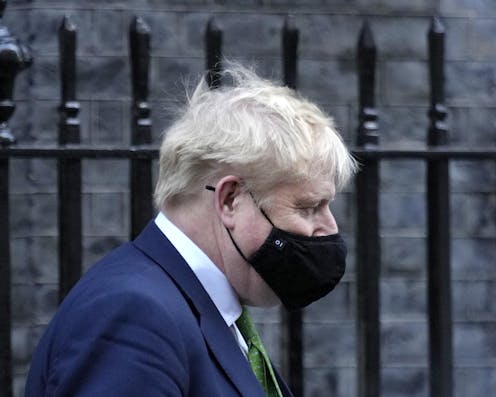
Boris Johnson’s time as the United Kingdom’s prime minister is under immediate threat. Johnson, who likes a classical analogy, will know that civil servant Sue Grey’s imminent report into the “Partygate” scandal[1] is the bureaucratic equivalent of the Sword of Damocles hanging over his head.
Johnson has been gravely damaged by the revelations of recent weeks that he attended gatherings and parties his own government had banned during the COVID lockdown of 2020, while some Britons’ loved ones died alone.
Significantly, pressure on Johnson is mounting from within his own party. During an acrimonious prime minister’s questions on Wednesday, David Davis, a former Tory minister and arch-Brexiteer, told Johnson “in the name of God, go![2]”
Yet, for all the public anger about Johnson’s lack of leadership during the pandemic and inability to grasp the need for full contrition about “Partygate”, his weakened position actually has a lot more to do with the aftershocks of Brexit in three major ways.
Fear of a crumbling ‘Red Wall’
The first is the extent to which Brexit contributed to Johnson’s election victory in December 2019.
The commanding majority he secured in that election – a major political achievement – enabled Britain to withdraw from the European Union. Much of this success was attributed to a swing in support from so-called “Red Wall[3]” constituencies in the north and Midlands parts of England, which had a history of voting Labour and switched their allegiance to the Conservatives.
Read more: Boris Johnson polling is now so bad that it makes sense for Conservative MPs to get rid of him[4]
The twin sources of this historic switch were believed to be a desire to complete Brexit and a hostility towards Labour’s left-wing leader Jeremy Corbyn.
The problem for Johnson is the perception, among the new cohort of Conservative MPs elected in the “Red Wall” constituencies, that their newfound support among voters may be fragile.
With Brexit now done and Corbyn no longer Labour leader, many are asking themselves whether these voters will now revert back to Labour[5]. The fear of an embarrassingly short parliamentary career may be convincing many to consider giving Johnson the push.
A ‘technopopulist’ who could bring the party down
The second Brexit-related weakness concerns Johnson’s style of leadership itself and the part this played in the Conservatives’ 2019 election win.
This style has been described by political scientists Chris Bickerton and Carlo Invernizzi Accetti as “technopopulism[6]”. That is to say Johnson is a leader who both appears to reject “normal” politics, while at the same time professing an unorthodox competence to get things – like Brexit – done.
This was a major part of his appeal to Conservatives who elected him party leader in 2019 and voters who made him prime minster later that year.
Yet, this now leaves him vulnerable. There’s a big question many Conservatives may be asking themselves: was the 2019 election Johnson’s victory, or the party’s more broadly?
If they feel it was Johnson’s victory, they could decide to eject him before he permanently contaminates the Conservative brand ahead of local elections in May and a general election two years from now.
Johnson’s populist nod and wink that “I am with them but not of them” could now come back to bite as Conservative politicians decide whether to amputate the Johnsonian rot to save the Conservative body.
Read more: Boris Johnson's big election victory: academics on what it means for the UK and Brexit[7]
In doing so, they will be in tune with public opinion[8]. Johnson’s chaotic leadership style was always linked with a sense of self-advancement. If this was visible to some during Brexit, it became even more evident during the pandemic.
During 2020, the Conservative leadership invoked the second world war “Spirit of the Blitz[9]” to make it through the darkest days of the pandemic.
From the perspective of 2022 and the “Partygate” scandal, another wartime analogy looks more apt – “lions led by donkeys[10]”. This is a popular memory of the first world war in which stoical British soldiers were led to their deaths by incompetent commanders[11].
Brexit is only half-baked
Lastly, Johnson’s position has been weakened because, despite the rhetoric, Brexit is only half-done.
Johnson is a famous over-promiser. He told parliament in 2017 that Brexit meant Britain could have its cake and eat it[12]. The reality is the Brexit cake is half-baked (in both senses of the word).
For one, the status of Northern Ireland as a full part of the UK is still in the balance because the EU-UK border question has yet to be resolved.
Read more: State of Stormont: can Northern Ireland trust in Truss?[13]
Second, it is hard to see what material benefit Brexit has brought the UK. Admittedly, the pandemic has clouded the ability to make firm judgements about the UK economy. However, it is hard to imagine, amid all the shortages of food and truck drivers, that a free-trade agreement with Australia[14] is giving UK citizens much more than they had when Britain was part of the EU.
This means true believers in Brexit might like someone like Foreign Secretary Liz Truss as PM to fully realise what they perceive as the real benefits[15] of the decision to leave the EU.
Who might replace Johnson?
Truss, currently in Australia for the annual Australia-UK ministerial meetings, is probably considering her position, along with other potential contenders[16] to replace Johnson: Chancellor of the Exchequer Rishi Sunak, Home Secretary Priti Patel, Health Secretary Sajid Javid, Business Secretary Kwasi Kwarteng, Education Secretary Nadhim Zahawi and former Foreign Secretary Jeremy Hunt, who was defeated by Johnson in the 2019 Conservative leadership contest[17].
Former Conservative MP Enoch Powell, hero of the Conservative right and a vociferous critic of the UK’s entry into the European Economic Community in the 1970s, once said all political lives end in failure[18].
Johnson’s downfall would be a case of the revolution eating itself. The irony is the man who promised to get Brexit done, may well get done in by Brexit.
References
- ^ Sue Grey’s imminent report into the “Partygate” scandal (www.mirror.co.uk)
- ^ in the name of God, go! (www.youtube.com)
- ^ Red Wall (www.bbc.com)
- ^ Boris Johnson polling is now so bad that it makes sense for Conservative MPs to get rid of him (theconversation.com)
- ^ whether these voters will now revert back to Labour (www.independent.co.uk)
- ^ technopopulism (oxford.universitypressscholarship.com)
- ^ Boris Johnson's big election victory: academics on what it means for the UK and Brexit (theconversation.com)
- ^ in tune with public opinion (yougov.co.uk)
- ^ Spirit of the Blitz (www.economist.com)
- ^ lions led by donkeys (www.nationalarchives.gov.uk)
- ^ incompetent commanders (www.poetryfoundation.org)
- ^ have its cake and eat it (www.politico.eu)
- ^ State of Stormont: can Northern Ireland trust in Truss? (theconversation.com)
- ^ free-trade agreement with Australia (www.dfat.gov.au)
- ^ to fully realise what they perceive as the real benefits (www.dailymail.co.uk)
- ^ other potential contenders (www.theguardian.com)
- ^ 2019 Conservative leadership contest (theconversation.com)
- ^ all political lives end in failure (www.oxfordreference.com)










