
Emissions projections indicate Australia won't need carryover credits to meet Paris targets
- Written by: The Conversation
Australia is on track to meet its 2030 Paris climate targets without resorting to carryover credits and could exceed them with the aid of the recently-announced technology roadmap, according to projections to be released on Thursday.
Australia has pledged to reduce emissions by 26-28% on 2005 levels by 2030.
The annual update of emissions projections shows that to meet the 26% cut, without using carryover credits, a further reduction of 56 million tonnes would be needed over the decade to 2030.
 image. Author provided
To reach the higher target of a 28% cut without the credits, a reduction of 123 million tonnes would be required over the decade.
Neither of these scenarios includes the technology investment roadmap – which is the government’s policy to support new and emerging energy technologies to a price that is comparable with higher emitting alternatives.
The Minister for Emissions Reduction, Angus Taylor, said if the roadmap was taken into account, “Australia is projected to beat its 2030 target by 145 million tonnes”.
This would be without relying on the credits which have been gained from exceeding earlier targets.
“Under this scenario, Australia’s emissions are projected to be 29% below 2005 levels by 2030,” Taylor said.
Scott Morrison has flagged the government won’t use the carryovers if they are not necessary to meet Australia’s commitments.
He is set to confirm this when he addresses a Pacific Islands Forum virtual climate summit on Friday. This precedes the Climate Ambition Summit hosted by Britain, France and the United Nations at the weekend to mark the fifth anniversary of the Paris accord.
The Pacific summit is aimed at putting pressure on the weekend meeting, which is being called “the sprint to Glasgow”, the delayed climate conference to be held in a year’s time.
There has been argy bargy over whether Morrison could get a speaking role at the weekend meeting, where leaders are being asked to make new commitments. As of Wednesday, he was not expected to be a speaker.
The update in the Australia’s emissions projections 2020 report shows Australia’s position against the 2030 target has improved by more than 300 million tonnes since the 2019 projections, and by 639 million tonnes since 2018.
The improvement since 2018 is equivalent to taking all of the country’s passenger vehicles off the road for 15 years.
Emissions are projected to decline to 478 million tonnes in 2030 which is 22% below 2005 levels. Incorporating the technology investment roadmap, emissions are forecast to be 436 million tonnes in 2030 – 29% below 2005 levels.
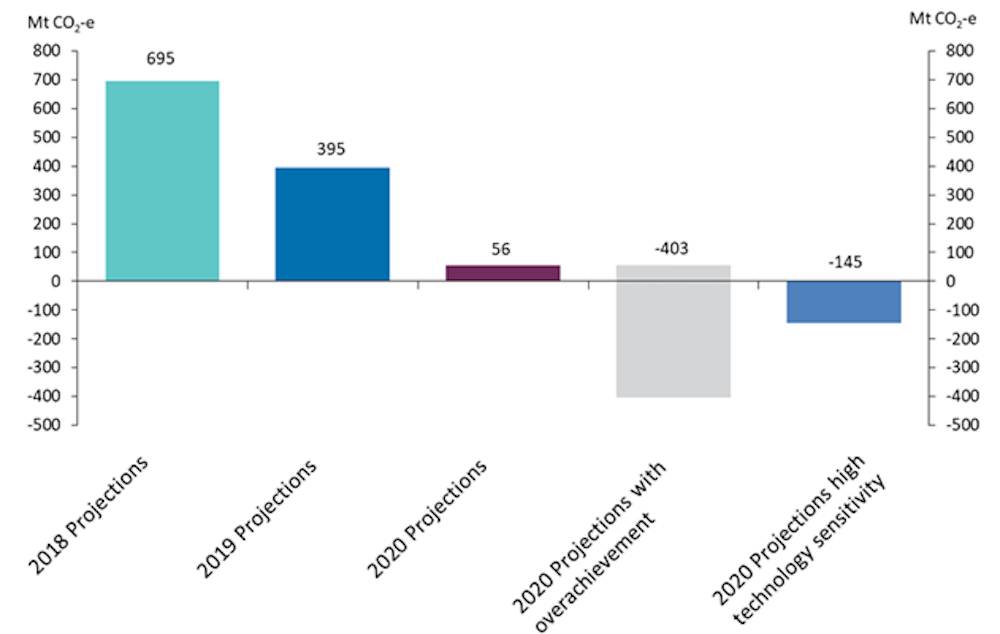 image.
The update says the downward revision in the 2020 projections reflects:
-
the inclusion of new measures to speed up the development and deployment of low emissions technologies in the recent budget
-
a further reduction in projected emissions from the electricity sector due to continued strong uptake of renewables – especially small and mid-scale solar – by households and businesses; and
-
the temporary effect of COVID-related restrictions on the economy.