PolyU scientists harness quantum microprocessor chips for revolutionary molecular spectroscopy simulation
HONG KONG SAR - Media OutReach Newswire - 19 August 2024 – Quantum simulation enables scientists to simulate and study complex systems that are challenging or even impossible using classical computers across various fields, including financial modelling, cybersecurity, pharmaceutical discoveries, AI and machine learning.
For instance, exploring molecular vibronic spectra is critical in understanding the molecular properties in molecular design and analysis. However, it remains a long-standing computationally difficult problem that cannot be efficiently solved using traditional super-computers. Researchers are diligently working on quantum computers and algorithms to simulate molecular vibronic spectra. However, they are limited to simple molecule structures, as they struggle with low accuracy and inherent noise.
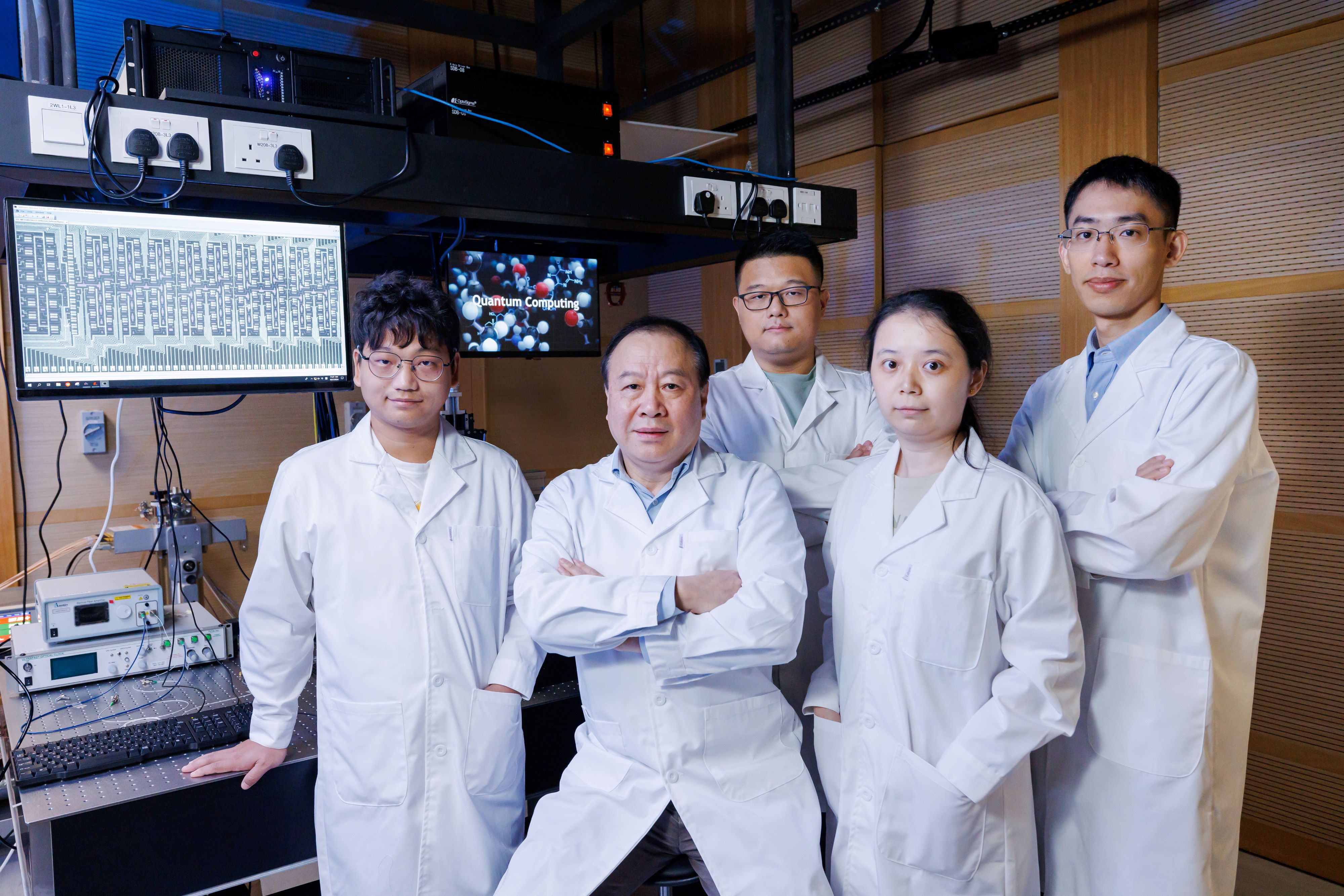
Engineering researchers at The Hong Kong Polytechnic University (PolyU) have successfully developed a quantum microprocessor chip for molecular spectroscopy simulation of actual large-structured and complex molecules, a world-first achievement. Capturing these quantum effects accurately requires meticulously developed simulations that account for quantum superposition and entanglement, which are computationally intensive to model classically. The research is published in Nature Communications, in a paper titled "Large-scale photonic network with squeezed vacuum states for molecular vibronic spectroscopy." This cutting-edge technology paves the way to solving complicated quantum chemistry problems, including quantum computational applications which are beyond the capabilities of classical computers.
The research team is led by Professor LIU Ai-Qun, a Chair Professor of Quantum Engineering and Science and Director of the Institute for Quantum Technology (IQT), and a Global STEM Scholar, together with the main project driver, Dr ZHU Hui Hui, Postdoctoral Research Fellow of the Department of Electrical and Electronic Engineering and the first author of the research paper. Other collaborators are from Nanyang Technological University, City University of Hong Kong, Beijing Institute of Technology, Southern University of Science and Technology, the Institute of Microelectronics and Chalmers University of Technology in Sweden.
Dr Zhu's team have experimentally demonstrated a large-scale quantum microprocessor chip and introduced a nontrivial theoretical model employing a linear photonic network and squeezed vacuum quantum light sources to simulate molecular vibronic spectra. The 16-qubit quantum microprocessor chip is fabricated and integrated into a single chip. A complete system has been developed, including the hardware integration of optical–electrical–thermal packaging for the quantum photonic microprocessor chip and electrical control module, software development for device drivers, user interface and underlying quantum algorithms which are fully programmable. The quantum computer system developed provides a fundamental building block for further applications.
The quantum microprocessor can be applied to solving complex tasks, such as simulating large protein structures or optimising molecular reactions with significantly improved speed and accuracy. Dr Zhu said, "Our approach could yield an early class of practical molecular simulations that operate beyond classical limits and hold promise for achieving quantum speed-ups in relevant quantum chemistry applications."
Quantum technologies are crucial in scientific fields, including material science, chemistry and condensed matter physics. As an attractive hardware platform, the quantum microprocessor chips present a promising technological alternative for quantum information processing.
The research findings and the resulting integrated quantum microprocessor chip developed open significant new avenues for numerous practical applications. These applications include solving molecular docking problems and leveraging quantum machine learning techniques like graph classification. Professor Liu said, "Our research is inspired by the potential real-world impact of quantum simulation technologies. In the next phase of our work, we aim to scale up the microprocessor and tackle more intricate applications that could benefit society and industry."
The team has introduced a groundbreaking development in quantum technology, which can be considered "a game changer." They have successfully tackled the highly challenging task of molecular spectroscope simulation using a quantum computing microprocessor. Their research marks a significant advancement in quantum technology and its potential quantum computing applications.
Hashtag: #PolyU
The issuer is solely responsible for the content of this announcement.