A sign of healthy democracy or a 'rudderless' nation? How crossing the floor has changed
- Written by: Camilla Nelson, Associate Professor in Media, University of Notre Dame Australia
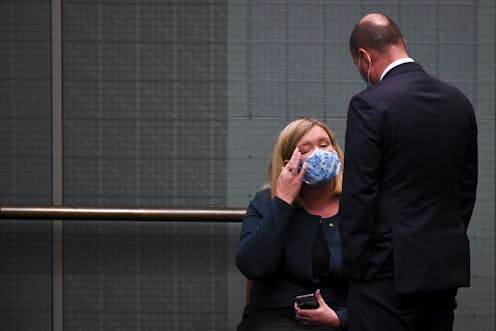
The final days of parliament for 2021 have been marked by a spate of floor crossings.
This includes Tasmanian Liberal Bridget Archer[1] who backed Independent Helen Haines’ integrity commission bill and conservative Coalition MPs[2] voting in favour of a One Nation bill against vaccine mandates. Meanwhile, a group of moderate Liberals[3] spoke out against the the religious discrimination bill, to support LGBTIQA+ rights.
The media have seized on these incidents as a sign of worrying political instability, or rather “a state of chaos[4]”, in a “rudderless[5]” nation.
But this wasn’t always the case. Elected officials crossing the floor on matters of principle used to be seen as a reassuring sign of the health of Australian democracy. What happened?
Missen in action
As part of research I am doing on children rights, I came across former Liberal Alan Missen[6], who sat in the Senate from 1974 to 1986.
Missen crossed the floor on no less than 41 occasions, mostly in support of civil liberties and human rights, during his parliamentary career.
This was reported matter-of-factly, with headlines reading “6 cross floor[7]” or “3 cross floor[8]”. Floor crossing in 1977 over “immoral and illogical” policy on East Timor was also soberly reported[9].
In media accounts[10] of these debates, floor crossing was not equated with instability – as “shambolic[11]”, as one journalist wrote last week. The media assumed elected officials only crossed the floor on questions of principle.
Or as Archer put it[12], “I don’t take this decision lightly at all. I take this decision very seriously”.
Floor crossing has declined
According to a 2020 study[13] by the Parliamentary Library, there has been a recent decline in floor crossing. In the last 15 years, crossing the floor has not changed the outcome of a single bill or resolution.
Between 1950 and 2019, approximately 23% of MPs and senators crossed the floor at some point in their parliamentary careers, including 295 individual floor crossers. This includes 185 individual Liberals, and 80 Nationals. Only 29 Labor politicians crossed the floor in the period covered by the study, which is perhaps unsurprising, given Labor actively discourages the practice.
Read more: Who decides when parliament sits and what happens if it doesn't?[14]
The last Labor MP to cross the floor was Harry Quick[15], who (although a division had not been called), asked that his name be recorded in Hansard as dissenting to draconian anti-terrorism laws in 2004. In the Hawke years, two Labor MPs crossed the floor. Both were promptly suspended from the party.
Harold Holt saw the greatest number of floor crossings compared to any recent Australian prime minister – with 11% of all divisions featuring single or multiple crossings of the floor. Holt is followed by prime ministers John Gorton (7% of divisions) and Robert Menzies (5% of divisions).
In a candid interview in 2005, Fraser told the ABC that even when the Liberals had the numbers in the Senate, they couldn’t be counted on as an “automatic majority”.
What happened?
Floor crossing fell into political disrepute in tandem with John Howard’s rise to power. Though Howard pictured himself as an heir to Menzies, this picture did not include Menzies tolerance for dissent in the ranks of his own party.
Under Howard, MPs crossed the floor in only nine divisions, or 0.3%. In comparison, 0.6% crossed the floor under Tony Abbott, and 3% under Malcolm Turnbull.
This shift was largely a product of the infamous “kneecapping” pre-selections of the late 1980s and 90s, with the right pushing out the so called “wets[16]” or moderates.
Perhaps the most famous of these revolts were those led by Ian Macphee – who crossed the floor in support of the Hawke government’s non-discriminatory immigration policy in 1988. As Macphee later recounted[17]: “most of us [who crossed the floor] lost our party preselection the following year”.
From then on, floor crossing was largely confined to maverick right-wingers and Nationals, such as Barnaby Joyce and Bob Katter.
Perhaps this is how media perceptions of dissent changed. Floor crossing appeared to be a madcap stunt, rather than an ethical stance.
Until principled MPs such as Archer decided they would cross the floor on questions of integrity.
References
- ^ Bridget Archer (www.theguardian.com)
- ^ conservative Coalition MPs (www.themandarin.com.au)
- ^ moderate Liberals (www.smh.com.au)
- ^ a state of chaos (www.news.com.au)
- ^ rudderless (www.theage.com.au)
- ^ Liberal Alan Missen (adb.anu.edu.au)
- ^ 6 cross floor (trove.nla.gov.au)
- ^ 3 cross floor (trove.nla.gov.au)
- ^ soberly reported (trove.nla.gov.au)
- ^ accounts (trove.nla.gov.au)
- ^ shambolic (www.news.com.au)
- ^ put it (www.theguardian.com)
- ^ study (mail.google.com)
- ^ Who decides when parliament sits and what happens if it doesn't? (theconversation.com)
- ^ Harry Quick (www.aph.gov.au)
- ^ wets (www.smh.com.au)
- ^ later recounted (www.aph.gov.au)