Spare a thought for air-conditioning repair people. As the planet warms, they're really up against it
- Written by: Chantel Carr, ARC DECRA Fellow, School of Geography and Sustainable Communities, University of Wollongong
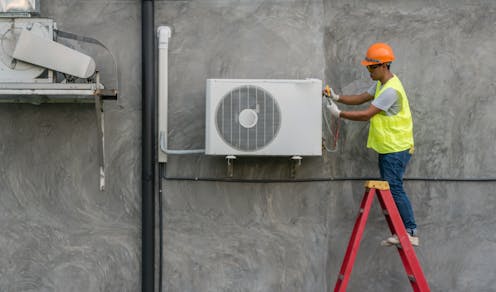
More frequent and extreme weather associated with climate change is creating uncertainty across society. In particular, it raises challenges[1] for the workers required to fix and maintain things. In a warming world this includes equipment such as air-conditioning and refrigeration.
These workers are essential for helping society adapt to climate change. Air-conditioning provides the space cooling that supports our everyday lives. Refrigeration underpins global food supply chains[2], health care, agriculture and more.
Despite the significance of this workforce, it remains largely under the radar. These workers face difficulties such as heat stress and skills shortages. They also play an important role in climate mitigation by installing more efficient appliances – work that is largely undervalued.
Next week’s national jobs and skills summit[3] will focus, among other issues, on the energy transition. But it should also consider other workers at the frontline of climate change.
‘Work up on the roof which is 60℃’
My research looks at the work of skilled trades, particularly in the area of repair and maintenance. Along with a team of engineers and social scientists[4] at the University of Wollongong, I have been researching the air-conditioning and refrigeration sector.
The team was commissioned by the Department of Industry, Science, Energy and Resources to research maintenance practices in commercial office buildings. Many issues we found were also common across other building types, including hotels, aged-care facilities and shopping centres.
The study[5] comprised a large industry survey, 70 in-depth interviews, and four focus groups with building contractors and facilities managers. Our team also accompanied workers as they responded to service calls and undertook routine maintenance in buildings.
Read more: The UK just hit 40℃ for the first time. It's a stark reminder of the deadly heat awaiting Australia[6]
The installation, maintenance and repair of domestic and commercial refrigeration and air-conditioning helps provide cooling and comfortable indoor environments – an increasingly challenging task as average global temperatures rise[7].
Australia’s building stock is ill-equipped for climate change. Much of it is poorly insulated, and relies on[8] electrical appliances to stay warm or cool.
This puts air-conditioning workers at the centre of climate adaptation – a job not without risk. Heat stress is already an issue for Australian workers, affecting not just their health and safety[9] but also productivity[10].
As one professional in the air-conditioning industry explained:
Call someone out when it’s 40℃ […] all of a sudden the (contractor) is going to go work up on the roof which is 60℃, which is probably a workplace health and safety issue that no one knows about because it’s hidden.
Maintenance: it actually matters
Together, air-conditioning and refrigeration account for about 17%[11] of global energy consumption. The industry’s workers can help address this by educating consumers about, and installing, more efficient appliances. The timely maintenance of air-conditioning and fridges can also reduce system energy consumption.
However, building owners are not always convinced of the need to upgrade equipment or carry out preventative maintenance. For example, it’s estimated up to 80,000[12] commercial buildings in Australia need energy efficiency upgrades – many of them due to air-conditioning systems that are decades old.
Industry contractors told us cooling and ventilation systems are frequently “run to fail”, consuming excess energy and increasing the risk of overloading the broader electricity network. As one worker said:
if we unpack this problem properly, and got preventative maintenance done two months out before summer, we get… all the peak demand issues get reduced, we get reliability.
Upgrading air-conditioning and refrigeration systems is a significant economic and environmental opportunity. But this requires workers, and the sector has struggled to recruit.
Industry figures suggest about 1,600 people each year[13] start an apprenticeship or traineeship in the refrigeration and air-conditioning trade across Australia. But fewer than half complete the training, pointing to attrition problems.
The industry needs a strong pipeline of skilled workers. Any workforce shortages could seriously inhibit Australia’s capacity to adapt to and mitigate climate change.
Helping people and the planet
There’s an urgent need to look more closely at the skills required to deliver the energy transition and help humans survive on a warmer planet.
Workers in air-conditioning and refrigeration are just a few of the many skilled professionals we’ll lean on heavily in the coming years and decades. Helping these workers meet the challenges ahead should be a national priority – and doing so will help both people and the planet.
Read more: It’ll be impossible to replace fossil fuels with renewables by 2050, unless we cut our energy consumption[14]
References
- ^ challenges (journals.sagepub.com)
- ^ food supply chains (www.unido.org)
- ^ jobs and skills summit (treasury.gov.au)
- ^ engineers and social scientists (betterwaystowork.com.au)
- ^ The study (journals.sagepub.com)
- ^ The UK just hit 40℃ for the first time. It's a stark reminder of the deadly heat awaiting Australia (theconversation.com)
- ^ rise (theconversation.com)
- ^ relies on (theconversation.com)
- ^ health and safety (ehjournal.biomedcentral.com)
- ^ productivity (www3.nd.edu)
- ^ about 17% (iifiir.org)
- ^ 80,000 (new.gbca.org.au)
- ^ each year (nationalindustryinsights.aisc.net.au)
- ^ It’ll be impossible to replace fossil fuels with renewables by 2050, unless we cut our energy consumption (theconversation.com)