Who is Rishi Sunak, the new UK prime minister?
- Written by: Ben Wellings, Senior Lecturer in Politics and International Relations, Monash University
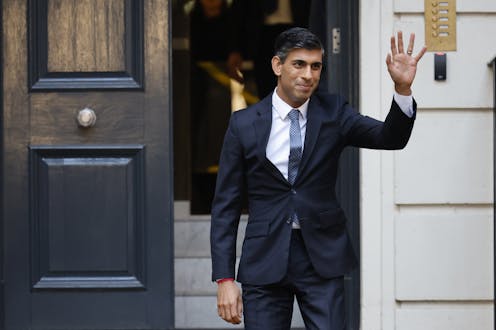
When Rishi Sunak was elected by Conservative MPs as their new leader and hence prime minister of the United Kingdom, the British nation breathed a sigh of relief: thank God it wasn’t Boris Johnson[1].
Had Johnson been re-elected leader it would have had serious consequences, not just for the Conservatives, but in the real world too.
Only the most obtuse political observer could have failed to see that the optics of cutting short your Caribbean holiday to try to resolve a cost of living crisis was not good politics. It sounds hard to believe, but this was not obvious to everyone.
Johnson garnered public support from some of the Brexiteer old guard like Jacob Rees-Mogg and in the pro-Boris media[2].
But in characteristic fashion, Johnson exaggerated his chances. This latest act of self-promotion backfired and he withdrew from the leadership race on Sunday (regretably having missed half his holiday). Nevertheless, the fact that many Conservatives seriously thought a chaotic government could be brought under control by someone known for chaotic management, shows how deep the ideological divisions within the party have become.
With the third contender, Penny Mordaunt, falling just shy of the 100 MPs’ votes[3] needed to send the leadership contest to a vote of the grassroots party members – a fate to be avoided at all costs after they forfeited the confidence of MPs by installing Truss – Rishi Sunak will become the next prime minister of the UK.
Sunak’s elevation is a socially significant moment. He is the first British Asian, or any person of colour, to become PM. Much of the credit can go to David Cameron’s attempts to modernise the Conservative party in the mid-2000s. The Conservatives have done a better job than other parties in putting more women and people of colour into positions of political influence and power. In a system that only had its first openly Catholic prime minister[4] in 2019, Sunak is the first Hindu to assume that role.
But the significance of the first person of colour as British Prime Minister will probably get lost in the class dynamics of this political moment.
Like Johnson, Sunak isn’t short of a bob or two[5]. This will make the economic politics of Sunak’s tenure difficult. Having a multi-millionaire telling the nation to tighten its belts and make sacrifices to its already declining living standards won’t go down well.
Read more: It matters that Rishi Sunak has become the UK’s first prime minister of Indian descent[6]
And like Johnson, Sunak also went to an elite private school. In Sunak’s case it was Winchester rather than Eton, just for a bit of variety. This will matter for perceptions of the new PM among the wider electorate. The Conservatives are seen as a party of – and for – the wealthy. They increasingly appear as a small, ageing and out of touch privileged class unable to see the true extent of the crisis that their choices in government have exacerbated.
Sunak’s in-tray is bulging. The cost of living and energy crises will be the foremost political and economic challenges, but the B-word (Brexit) still casts a shadow. It has not lived up to the over-inflated expectations of its most ardent boosters. Increasing numbers of voters think it was wrong to leave[7] the EU. How Sunak manages this coming “winter of discontent[8]” will define his premiership.
However, the policy levers he has at his disposal have been discredited by the Truss-onomics episode. Truss’s long-term legacy may well be the conclusion that neoliberal economics worked well in theory, but not in practice.
Sunak will probably enjoy a longer honeymoon period than his predecessor. His election has calmed one part of the Conservatives’ core constituency: the bond markets. However, his future with the electorate is less secure. For better or worse, leaders influence how people choose to vote; or at least parties behave as if this were true. His legitimacy with the electorate is not as strong as it could be given that he is the third Conservative leader and PM since the last election in 2019.
Read more: There’s something wrong with British politics. It’s called the Conservative Party[9]
Calls for a general election are growing. Presumably, with the Conservatives so far behind in the polls[10], Sunak will try to hold on as long as possible. But this may only prolong the pain and defer a significant loss of seats whenever the next election arrives.
This all feels a bit like rearranging the deckchairs on the Titanic. Part of the difficulty for the Conservatives points to a growing structural problem for centre-right parties: intra-party ideological divisions. This issue has weakened the centre left for a couple of decades. These parties saw their support base split between tertiary-educated urban dwellers interested in post-material issues, and blue-collar supporters from declining manufacturing industries with some residual, but weakening, loyalty to social democracy.
Now such divisions seem to be affecting the right of politics too. As we saw in the 2022 federal election in Australia, the right’s traditional support base is split between affluent moderates concerned about climate change, and older social conservatives concerned about immigration. This appears to be happening in the UK too.
This internal division can be exploited by the opposition as we saw with the fracking vote[11]. On paper, Sunak should feel secure with a 71-seat majority in a 650-seat parliament. But the Conservatives have lost confidence. The party is behaving like one that has only the slimmest of majorities and is on its way out. Sunak’s premiership may well be a case of the band playing on.
References
- ^ thank God it wasn’t Boris Johnson (www.manchestereveningnews.co.uk)
- ^ pro-Boris media (www.theguardian.com)
- ^ falling just shy of the 100 MPs’ votes (www.bloomberg.com)
- ^ first openly Catholic prime minister (www.irishnews.com)
- ^ short of a bob or two (www.washingtonpost.com)
- ^ It matters that Rishi Sunak has become the UK’s first prime minister of Indian descent (theconversation.com)
- ^ wrong to leave (whatukthinks.org)
- ^ winter of discontent (academic.oup.com)
- ^ There’s something wrong with British politics. It’s called the Conservative Party (theconversation.com)
- ^ so far behind in the polls (www.politics.co.uk)
- ^ fracking vote (www.theguardian.com)
Read more https://theconversation.com/who-is-rishi-sunak-the-new-uk-prime-minister-193104