With campus numbers plummeting due to online learning, do we need two categories of university degree?
- Written by: Ananish Chaudhuri, Professor of Behavioural and Experimental Economics, University of Auckland
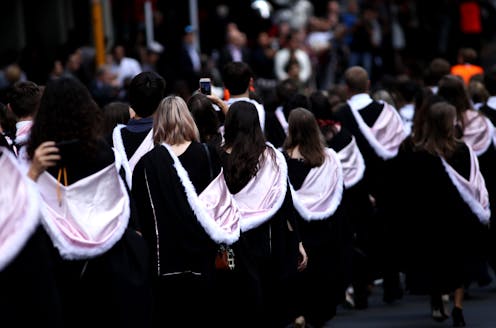
As recent headlines[1] have made clear, New Zealand universities are in an existential crisis for a variety of reasons, including a sharp drop in international student numbers and chronic underfunding.
But there is another crisis lurking – the disappearance of students from our classrooms following the pandemic. This was happening already, but with the COVID-related shutdown and move toward online delivery of courses, the process has accelerated massively.
Lecturers, even great ones, see barely a fifth of students showing up. And it’s not a random fifth – some students routinely attend while many others never do.
Some will be working, too. Even with subsidised education, course costs can still be prohibitively high. To make ends meet, others stay at home to avoid long and expensive commutes.
Faced with this reality, universities are striving to improve accessibility by putting more material online, including exams, and cutting down face-to-face teaching time. This is based partly on the belief that the so-called “sage on stage” lecture method is outdated.
But this is a fallacy. Some sages have unique insights to offer, which can’t always be broken down into bite-sized YouTube videos, especially for technical material.
More importantly, the ability to sit still for an hour and absorb complex material is a skill students need to learn. In the workplace, meetings often happen early in the morning and are not recorded to be watched later at double speed.
Social skills in the real world
Part of the problem can be traced back to when universities began to consider students as “customers” and education as a transaction between them and their lecturers.
Yet students are better seen as the “products” of the university. We take them (mostly) from high school and aim to send them out into the world as informed citizens with real-world skills.
Read more: Starved of funds and vision, struggling universities put NZ’s entire research strategy at risk[2]
And while cognitive abilities such as reading, writing and maths matter, so too do social skills such as empathy, resilience and an ability to work in diverse groups and with diverse views.
Using survey data and information about the education and careers of more than 10,000 Americans, Harvard professor of political economy David Deming[3] showed the surprising impact[4] of those social skills on career development.
If you keep cognitive skills constant, those with higher social skills are more likely to have a full-time job and earn more. More importantly, the two are complementary. Among those who already have advanced degrees, the earnings are higher for those with measurably better social skills.
The returns from investing in social skills have increased over the past few decades. They will possibly increase even more, as artificial intelligence begins to perform many jobs, even white-collar ones.
Read more: Studying can be a costly choice. Universities should address young people’s financial literacy gaps[5]
Universities play a crucial role in developing these skills. But the emerging two groups of students – on campus and off – are not getting the same education. The increasing emphasis on online instruction and exams is devaluing degrees.
Employers may be taking note. As a recent Harvard Business Review article[6] points out, US companies are relying less on degrees and more on their own tests for “hard” skills and competencies. But they may also be using a degree as evidence a candidate has the “soft” social skills they’re looking for too. In which case, the distinction between in-person and online learning becomes significant.
A two-tier system
This suggests we may need to distinguish between online and on-campus students in each of our courses. The course content will be the same, but the assessment methods will be different.
Online students can take tests, quizzes and exams remotely. Some of this may also be available to on-campus students. But on-campus students will be expected to come to lectures regularly, ask questions, write, speak and engage in interactive tasks, including group work.
Would students sign up for on-campus courses but simply not attend? This could be prevented by making sure each student completes tasks that earn participation marks that count toward on-campus credits. If they fail to do so, they will automatically become online students.
Read more: 7 ways to reduce the learning loss caused by the pandemic[7]
Is this unfair to online students? Not necessarily. Many with jobs may prefer it. In any event, they will have to consider whether the benefits of coming to campus are worth it in terms of job prospects or earning potential.
As it stands, the current system designed to cater to online students is failing those who want to show up for lectures. And regardless of grades, how do I write a letter of reference for a student I have never met in person?
If things continue this way, very soon we won’t have any students in our classrooms and our universities and polytechnics will become truly online institutions. This will be catastrophic for society.
References
- ^ recent headlines (www.newshub.co.nz)
- ^ Starved of funds and vision, struggling universities put NZ’s entire research strategy at risk (theconversation.com)
- ^ David Deming (www.hks.harvard.edu)
- ^ surprising impact (academic.oup.com)
- ^ Studying can be a costly choice. Universities should address young people’s financial literacy gaps (theconversation.com)
- ^ Harvard Business Review article (hbr.org)
- ^ 7 ways to reduce the learning loss caused by the pandemic (theconversation.com)