Life in plastic, it's fantastic? How Barbie reimagines a childhood icon through a feminist lens
- Written by: Jennifer Stokes, Senior Lecturer in Digital and Information Literacy (Education Futures), University of South Australia
This article contains spoilers.
Finally, the highly anticipated Barbie feature has landed.
Barbie is a fabulous spectacle, offering nostalgic delights to audiences, reflexive nods for film buffs and turning a feminist lens on the world’s most famous doll.
Most excitingly, Barbie is an intersectional[1] and liberal feminist[2] comedy, sitting alongside mainstream successes Legally Blonde (2001)[3] and Mean Girls (2004)[4].
Much like Barbie, the protagonists in both films ultimately embrace their intellect as a source of strength and a voice for change – and pink as a colour of strength.
Read more: Explainer: what does 'intersectionality' mean?[5]
Liberal feminism
In contrast to radical feminism[6], which throws out existing systems to start afresh, liberal feminism[7] works to effect change within systems. Liberal feminists work towards gender equality through raising awareness and political action.
Barbie sits in this second camp: a meta-commentary of Greta Gerwig and Margot Robbie’s work within the film industry, where both have moved from acting towards production roles. This is an industry where powerful roles are still dominated by men[8], and women’s[9] and LGBTQI+[10] voices are often sidelined.
Robbie’s early career was dominated by roles as the blonde starlet in films like Wolf of Wall Street (2013). In Suicide Squad (2016), her broken-doll Harley Quinn engaged audiences and outshone The Joker.
In the sequel, Birds of Prey (2020), Robbie (now working as producer) engaged director Cathy Yan to show Harley’s perspective. Here, Harley was empowered to reject her toxic ex, gather a squad of supportive girlfriends, and even subvert fight scenes through gestures of feminine support by offering a hair-tie[11].
Strong female characters
Gerwig’s films have often explored how strong female characters overcome challenges on their journey to adulthood.
In Little Women (2019), Gerwig gives her characters greater agency than previous adaptations. Amy analyses marriage as an “economic proposition[12]”. Jo negotiates a strong book contract, while also accepting editorial direction to choose a marketable ending of marriage – or death – for her female protagonist.
Much like Robbie’s Harley Quinn and Gerwig’s March sisters, this Barbie challenges expectations that little girls conform to preset moulds of being a woman. It is a critique of dolls as representations of idealised femininity.
By airing diverse voices, Gerwig conveys the strength and contradictions within female experiences. The film reflects how women might effect change within capitalist structures through political power and actively working to counter patriarchal discourses.
This Barbie doesn’t need to tear everything down and start again, instead she works with a collective to restore Barbieland and commits to individual action in the Real World.
Facing the real world
In Barbieland, life seems perfect. The diverse Barbies believe they have empowered women everywhere through choice (a goal Barbie creator Ruth Handler espoused[13]).
Things go awry when Robbie’s “Stereotypical Barbie” starts having thoughts of death. Her heart-shaped breakfast waffle is burnt, her morning shower cold and her feet fall flat.
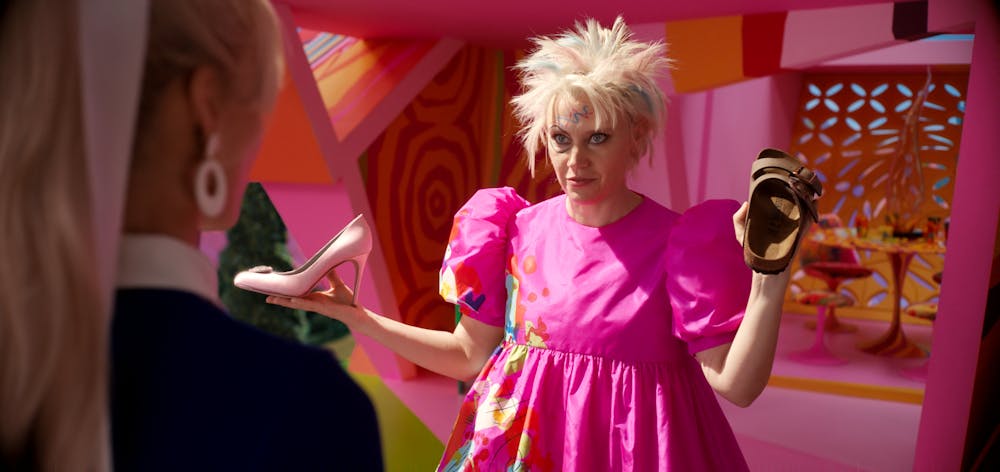
Weird Barbie (Kate McKinnon) advises dark thoughts have opened a portal to her owner and offers a Matrix-style choice[14] between a pretty heel (Barbieland) and a brown Birkenstock (the Real World).
In the Real World (Los Angeles), Barbie and Ken experience confronting ideas. Barbie meets her owner, teenaged Sasha (Ariana Greenblatt), who denounces Barbie’s negative impact on women. Ken finds out about the patriarchy – and wants it for himself.
In LA, Barbie visits a construction site for “uplifting female energy”, but she is surprised by the all-male crew. One leers “I wanna see what’s under that”; she truthfully responds “Oh, I don’t have a vagina”.
At Mattel, Barbie accepts a glass of water. Tipping the glass, she splashes herself and laughs “there’s usually nothing in here”.
Witnessing male dominance in the Real World, Ken introduces patriarchy to Barbieland, creating a bro-topia where Barbies are subservient to Kens. Scenes of Kens man-splaining to Barbies highlight the folly of assuming women don’t grasp technology or cinema, offering humourous meta-commentary in a film created by strong women.
Doing the imagining
“I created you, so you wouldn’t have an ending,” Ruth’s ghost (Rhea Perlman) tells Barbie.
Feminist film theory critiques the male gaze[15], which renders women in film as objects to be gazed upon for the pleasure of male viewers.
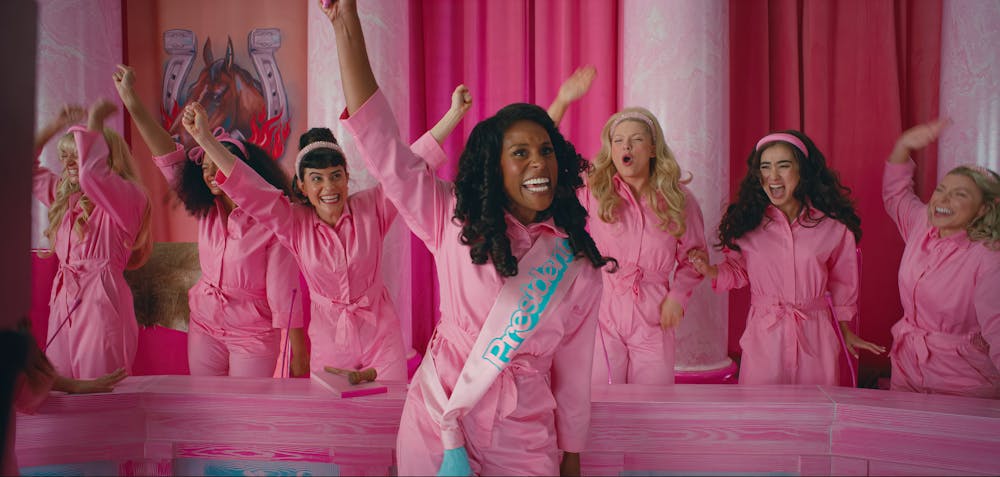 These Barbies are beautiful, but not sexualised. They control their narrative.
Warner Bros. Pictures
These Barbies are beautiful, but not sexualised. They control their narrative.
Warner Bros. Pictures
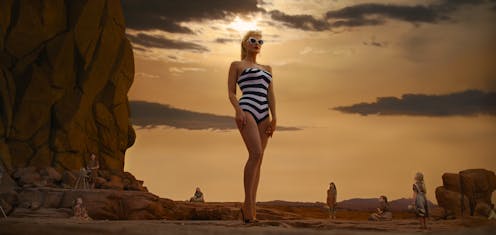
Robbie’s Barbie works to escape the role of object, both literally and through the cinematography. She is beautiful, but not sexualised. She controls her narrative.
When Barbie finds her friends brainwashed, she falls into despair. Lost, she cries out she doesn’t even feel pretty. The narrator (Helen Mirren) drily notes the filmmakers needed to cast someone other than Robbie to make this point.
Gerwig’s Barbie recognises identity and gender are complex and messy. Sasha’s mother Gloria (America Ferrara) brings the Barbies back by voicing the contradictions women experience everyday. Even Ruth’s ghost fends off comments about perfection, noting her own double mastectomy and tax evasion[16].
These Barbies have agency, yet Barbie ultimately recognises the agency of a doll is limited.
Supported by Ruth’s ghost, Barbie expresses the desire to be not “just the idea”, but the one “doing the imagining”.
Much like Gerwig and Robbie, Barbie opts for the role of active changemaker, working to shift the system from within.
In bringing Barbie to life, Gerwig, Robbie and their team created a smart, enjoyable, feminist film. Barbie’s story doesn’t end with marriage or death; she steps into her future in pink Birkenstocks.
References
- ^ intersectional (theconversation.com)
- ^ liberal feminist (simplysociology.com)
- ^ Legally Blonde (2001) (www.imdb.com)
- ^ Mean Girls (2004) (www.imdb.com)
- ^ Explainer: what does 'intersectionality' mean? (theconversation.com)
- ^ radical feminism (www.theguardian.com)
- ^ liberal feminism (simplysociology.com)
- ^ powerful roles are still dominated by men (www.bbc.com)
- ^ women’s (theconversation.com)
- ^ LGBTQI+ (www.starobserver.com.au)
- ^ even subvert fight scenes through gestures of feminine support by offering a hair-tie (time.com)
- ^ economic proposition (www.youtube.com)
- ^ espoused (graziadaily.co.uk)
- ^ Matrix-style choice (en.wikipedia.org)
- ^ critiques the male gaze (www.filminquiry.com)
- ^ double mastectomy and tax evasion (www.theguardian.com)