will the Great Koala National Park actually save koalas?
- Written by: Tim Cadman, Adjunct Senior Research Fellow with the Law Futures Centre and the Institute for Ethics, Governance and Law, Griffith University
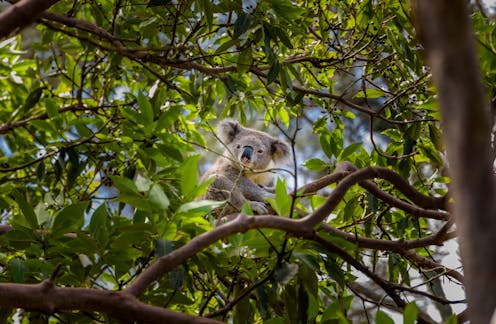
It’s a visionary idea: a national park for koalas. Conceived over a decade ago[1], the idea gained prominence after Labor took the idea to three successive elections in New South Wales. Now they’re in office and have finally begun putting commitment to action.
The original idea is simple: a park stretching from Grafton to Kempsey in northern NSW, drawing in over 300,000 hectares of state forest and existing national parks. Covering prime koala habitat, the park would be a safe haven for the now-threatened koala[2] as its numbers on the east coast dwindle.
But will it be enough to save the koala from extinction?
A park with logging and plantations?
Since the idea was canvassed, the megafires of the 2019–2020 summer have affected more than a third of the proposed park, and killed many hundreds[3] – or even thousands – of koalas. Even so, policy is driven by the original park boundaries and koala population data collected before the fires.

When you see the phrase “state forest” on a map, it means logging is usually allowed. In National Parks, of course, it’s not.
The Great Koala National Park covers a number of state forests, where logging has continued.
In 2018, the previous state government extended the state’s Regional Forest Agreement logging laws for another twenty years[5]. But this extension did not consider the impacts of climate change on forest management, meaning logging levels were not reduced to reflect changing environmental conditions.
In fact, the government went the other way, loosening logging rules to permit larger trees to be cut while koala management prescriptions were weakened. The removal of natural habitat trees up to 140cm diameter were permitted. If a koala was sighted in a tree, that tree could still be removed if the koala moved on.
Despite ongoing calls from scientists[6] and citizens, the current state government has allowed logging in the proposed park to continue largely unchecked.
Even when the government has intervened, it has been too little, too late. The recent suspension of logging[7] of 8,000 hectares of forest in so-called koala “hubs”[8] with high population density will not be enough to offset the damage from ongoing logging. Worse, some of the hubs have already been logged[9].
When you look at the provisional park boundary[10] – which includes the hubs – you can see all plantations inside the park are excluded.
Read more: Friday essay: the koala – when it's smart to be slow[11]
This, too, doesn’t make much sense. That’s because koalas, as eucalyptus leaf-eating specialists, actually like hardwood plantations. Similarly, many areas now zoned as plantation were never actually logged and replanted. Instead, they’re a mix of original native forest and regrowth[12], or mixed species of local stock indistinguishable from the natural forests of the region.
These plantations are mostly on prime soils on the coast and consist of moist eucalypt forest and rainforest – ideal food and habitat for the koalas.
But when these areas are clearfelled, they are usually replaced with monoculture coastal blackbutt, which koalas do not like to eat.
As a result, these plantation areas – whether real or just on the map – are critical to the integrity of the park. Koalas cannot read maps, and do not understand human zoning. If their habitat in plantations is cleared, they die – just as we’ve seen in Victoria, where deaths of koalas in blue gum plantations have made national news[13].
Bring the plantations into the park
As Victoria and Western Australia fast-track the end of native forest logging, New South Wales has so far not followed suit.
But this may change, as efforts grow within the federal Labor party[14] to end native forest logging altogether.
If this happens, where will we get timber from? The obvious answer is from plantations. The problem for the NSW Labor government is that the plantations on the mid north coast are prime koala habitat.
For a koala-protecting National Park to actually protect koalas, it must be based on the identification and reservation of high value habitat – such as hardwood plantations.
If we leave all plantations out, some of the best habitat in the park will continue to be logged. Without plantations, the park will be filled with holes, severing critical corridors and hampering the movement of koalas.
 Logging continues in state forests slated for the koala-protecting park.
AAP
Logging continues in state forests slated for the koala-protecting park.
AAP
What should we do?
We have to restore the areas lost to logging and the Black Summer bushfires and flag more forested areas for inclusion – especially unburnt habitat.
And the government has to end logging within the proposed park area. If we want a viable alternative, the government should begin new plantations outside the park area and buy out existing logging contracts inside the park. Logging and koalas do not mix.
 Inside the proposed park, many areas of prime koala habitat have already been logged. This shows Tuckers Nob State Forest after logging.
Google/Airbus, CC BY-ND[15]
Inside the proposed park, many areas of prime koala habitat have already been logged. This shows Tuckers Nob State Forest after logging.
Google/Airbus, CC BY-ND[15]
We should give up on the idea of protecting koala “hubs”. Instead, we should prioritise the protection of koala populations unaffected by fire and in untouched forest areas wherever they are, whether inside or outside of these hubs.
Every bit of habitat on public land should be ruled in, as this is what counts, not zoning. Local communities – not just the forest industry and environment groups – need to be included in negotiations. The government should also consider community efforts to seek World Heritage protection[16] for these forests.
If the proposed park is to live up to the “Great” in its name, it has to be as big and as well connected as possible. Ruling out some of the best koala habitat in the area is not a great place to start.
Read more: Proposed NSW logging laws value timber over environmental protection[17]
References
- ^ over a decade ago (www.couriermail.com.au)
- ^ now-threatened koala (www.dcceew.gov.au)
- ^ killed many hundreds (theconversation.com)
- ^ CC BY-ND (creativecommons.org)
- ^ another twenty years (theconversation.com)
- ^ ongoing calls from scientists (timcadman.wordpress.com)
- ^ recent suspension of logging (www.abc.net.au)
- ^ so-called koala “hubs” (www.epa.nsw.gov.au)
- ^ already been logged (www.theguardian.com)
- ^ provisional park boundary (wnc.maps.arcgis.com)
- ^ Friday essay: the koala – when it's smart to be slow (theconversation.com)
- ^ original native forest and regrowth (timcadman.wordpress.com)
- ^ national news (www.abc.net.au)
- ^ within the federal Labor party (www.theguardian.com)
- ^ CC BY-ND (creativecommons.org)
- ^ World Heritage protection (greaterkoalapark.org)
- ^ Proposed NSW logging laws value timber over environmental protection (theconversation.com)