The Times Australia
Google AI
The Times World News

.

Interest rates will eventually fall but it's a bit early for mortgagees to break out the champagne

  • Written by John Hawkins, Senior Lecturer, Canberra School of Politics, Economics and Society, University of Canberra
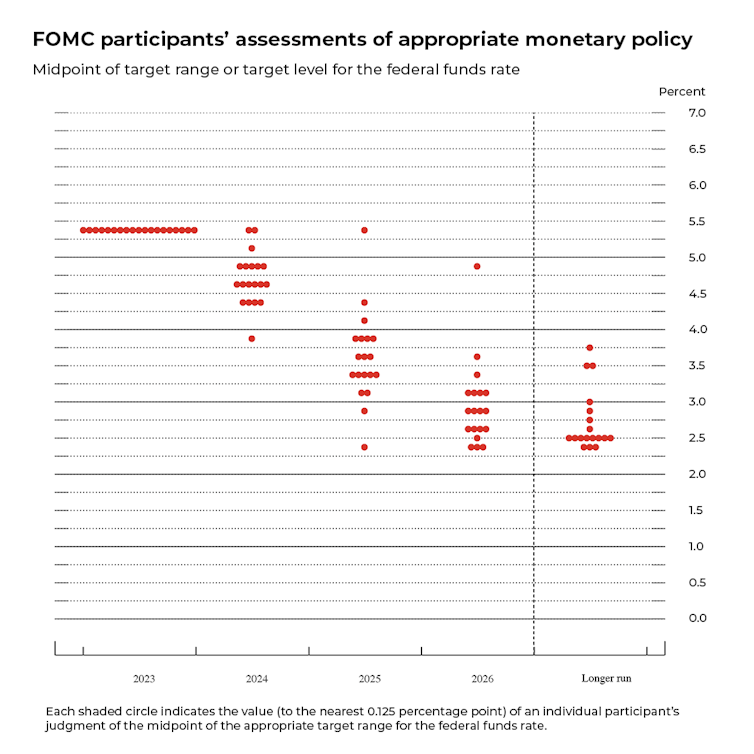
FOMC participants’ assessments of appropriate monetary policy

Suddenly the talk in global financial markets[1] has spun from “when will interest rates next rise?” to “how soon before they fall?”.

Some commentators are flagging the shift as a “pivot party[2]”.

This change has been most prominent in the United States. It was prompted by the Federal Reserve, the US equivalent of the Reserve Bank of Australia, releasing its latest “dot chart”. This shows most members of its policy-setting Federal Open Market Committee expect their interest rate would be lower by the end of 2024.

FOMC participants’ assessments of appropriate monetary policy
US Federal Reserve, CC BY-SA[3][4] The recent review of the Reserve Bank[5] in Australia wanted more transparency. But, after the whacking former Governor Phil Lowe got when he wrongly predicted rates would stay low until “at least” 2024, I doubt his successor Michele Bullock will be keen to publish a similar chart. Even so, financial markets in Australia are also now implying interest rates will fall over the course of next year. The latest indicators The Australian economy has continued to slow according to the latest national accounts[6]. Consumer spending did not increase at all in the September quarter, despite an increase in population. Exports contracted. Overall GDP grew by a mere 0.2%. The news from the labour market[7] was mixed. There was a solid rise in employment in November. The hours worked data, however, have been basically flat for the past six months. The government maintained fiscal discipline in the mid-year[8] budget update released last week. They saved rather than spent almost all the extra revenue from higher than expected commodity prices. The minutes[9] of the Reserve’s latest meeting on December 5 show the board noted “encouraging signs of progress” in returning inflation to the target. Subsequent events have suggested inflation will likely continue on its downward trajectory, which means the Reserve has increased interest rates enough. Another development since the Reserve last met is an update of the Statement on the Conduct of Monetary Policy[10] between Treasurer Jim Chalmers and the board. This sets out the common understanding between them about Australia’s monetary policy framework. Much of this statement carries over the existing framework. The bank’s primary tool is its cash rate target and it is varied to achieve a medium-term inflation target of 2-3%. Employment considerations influence how quickly it is regained when shocks move inflation away from it. The statement explicitly refers to the midpoint of the target, reflecting a suggestion in the recent Reserve Bank review[11]. Some commentators have interpreted[12] this as indicating the bank cannot cut rates as its forecast for inflation[13] only has it reaching the top, not the middle, of the range by the end of 2025. Read more: The 7 charts that show Australians struggling as saving falls to near zero[14] I disagree. The bank has always aimed at the midpoint of the target as the most likely way to ensure inflation averages within it. If the board was happy at its December meeting to have reached 3% by the end of 2025 on its way to achieving 2.5% later, there is no reason for it to change this view in February. So what will the Reserve Bank do? On balance, the economic news does not suggest the Reserve Bank will feel a need to raise rates in February. But with inflation still high, and plenty of uncertainty, they are unlikely to cut rates any time soon. The bank does not generally make sharp U-turns with the average gap between the last interest rate increase in a cycle and the first cut being ten months. At its next meeting, on February 5-6[15], the Reserve board may have a new member, deputy governor Andrew Hauser[16], and a new adviser, chief economist Sarah Hunter[17]. They share a British background so will be familiar with the Bank of England model, which influenced the Reserve Bank review[18]. The impact of (eventual) lower interest rates The movements in the Reserve Bank’s interest rate matters most to the third of households with a mortgage. Most of these have variable rate loans where the interest rate closely follows that set by the Reserve. An interest rate cut would ease the cost-of-living pressures they have been facing. A household with the average loan size of around A$600,000[19] would have seen their monthly repayments rise by almost $1,700 since early 2022. This would drop by $100 if rates were cut by 0.25%. While the impact on mortgagees always gets the most attention, interest rates affect other members of the community too. Read more: Will the RBA raise rates again? Unless prices surge over summer, it's looking less likely[20] Lower interest rates mean a lower income to retirees dependent on interest on their savings. They tend to boost the prices of assets such as shares and houses. They encourage borrowing and spending and reduce incentives to save. They tend to lower the exchange rate, making imports more expensive for Australians but our exports cheaper to foreigners. The net impact is generally to lower unemployment. A lot of people are therefore looking forward to an interest rate cut. But they should not be holding their breath. Financial markets may be getting prematurely excited. The last thing the Reserve Bank would want is to find themselves having lowered rates too quickly and see inflation turn back up, necessitating the interest rate cut to be reversed. More likely, they will wait for inflation to drop much closer to their target before there is any easing of interest rates.

References

  1. ^ global financial markets (www.ft.com)
  2. ^ pivot party (www.youtube.com)
  3. ^ US Federal Reserve (www.federalreserve.gov)
  4. ^ CC BY-SA (creativecommons.org)
  5. ^ review of the Reserve Bank (rbareview.gov.au)
  6. ^ national accounts (www.abs.gov.au)
  7. ^ news from the labour market (www.abs.gov.au)
  8. ^ mid-year (theconversation.com)
  9. ^ minutes (www.rba.gov.au)
  10. ^ Statement on the Conduct of Monetary Policy (www.rba.gov.au)
  11. ^ Reserve Bank review (rbareview.gov.au)
  12. ^ commentators have interpreted (www.afr.com)
  13. ^ forecast for inflation (www.rba.gov.au)
  14. ^ The 7 charts that show Australians struggling as saving falls to near zero (theconversation.com)
  15. ^ February 5-6 (www.rba.gov.au)
  16. ^ Andrew Hauser (theconversation.com)
  17. ^ Sarah Hunter (www.rba.gov.au)
  18. ^ Reserve Bank review (www.theguardian.com)
  19. ^ average loan size of around A$600,000 (www.abs.gov.au)
  20. ^ Will the RBA raise rates again? Unless prices surge over summer, it's looking less likely (theconversation.com)


Read more https://theconversation.com/interest-rates-will-eventually-fall-but-its-a-bit-early-for-mortgagees-to-break-out-the-champagne-220038

Times Magazine

Worried AI means you won’t get a job when you graduate? Here’s what the research says

The head of the International Monetary Fund, Kristalina Georgieva, has warned[1] young people ...

How Managed IT Support Improves Security, Uptime, And Productivity

Managed IT support is a comprehensive, subscription model approach to running and protecting your ...

AI is failing ‘Humanity’s Last Exam’. So what does that mean for machine intelligence?

How do you translate ancient Palmyrene script from a Roman tombstone? How many paired tendons ...

Does Cloud Accounting Provide Adequate Security for Australian Businesses?

Today, many Australian businesses rely on cloud accounting platforms to manage their finances. Bec...

Freak Weather Spikes ‘Allergic Disease’ and Eczema As Temperatures Dip

“Allergic disease” and eczema cases are spiking due to the current freak weather as the Bureau o...

IPECS Phone System in 2026: The Future of Smart Business Communication

By 2026, business communication is no longer just about making and receiving calls. It’s about speed...

The Times Features

Parks Victoria launches major statewide recruitment drive

The search is on for Victoria's next generation of rangers, with outdoor enthusiasts encouraged ...

Labour crunch to deepen in 2026 as regional skills crisis escalates

A leading talent acquisition expert is warning Australian businesses are facing an unprecedented r...

Technical SEO Fundamentals Every Small Business Website Must Fix in 2026

Technical SEO Fundamentals often sound intimidating to small business owners. Many Melbourne busin...

Most Older Australians Want to Stay in Their Homes Despite Pressure to Downsize

Retirees need credible alternatives to downsizing that respect their preferences The national con...

The past year saw three quarters of struggling households in NSW & ACT experience food insecurity for the first time – yet the wealth of…

Everyday Australians are struggling to make ends meet, with the cost-of-living crisis the major ca...

The Week That Was in Federal Parliament Politics: Will We Have an Effective Opposition Soon?

Federal Parliament returned this week to a familiar rhythm: government ministers defending the p...

Why Pictures Help To Add Colour & Life To The Inside Of Your Australian Property

Many Australian homeowners complain that their home is still missing something, even though they hav...

What the RBA wants Australians to do next to fight inflation – or risk more rate hikes

When the Reserve Bank of Australia (RBA) board voted unanimously[1] to lift the cash rate to 3.8...

Do You Need a Building & Pest Inspection for New Homes in Melbourne?

Many buyers assume that a brand-new home does not need an inspection. After all, everything is new...