a virtuosic performance, sexy staging, and a queer rewriting
- Written by: Huw Griffiths, Associate Professor of English Literature, University of Sydney
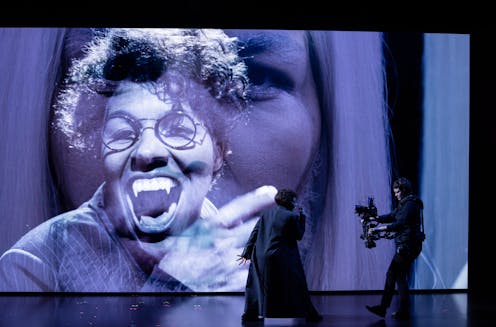
The figure of Dracula has always lived somewhere between the written word, screen projections and our fantasy lives. His story is tailor-made for one of Kip Williams’ hybrid adaptations.
Williams’ technique is, by now[1], familiar[2] to Sydney audiences. Again with Dracula, the third part of this loose trilogy, he makes spectacular use of live action, live filming and recorded video, all interwoven into exciting spectacles that drive the story forward.
Dracula on screen
Bram Stoker’s novel was first published in 1897. It only took 24 years for the count to make his way onto screen. This first film version appeared more than a hundred years ago: a lost 1921 Austrian silent movie, Drakula halála.
More familiar is F.W. Murnau’s loose adaptation, Nosferatu (1922), with its startling central performance from Max Schreck.
From these early appearances, cinema did not look back, bringing us multiple Hammer Horror appearances, the camp romanticism of Coppola’s more faithful adaptation in 1992, and onwards to this year’s much-anticipated revisiting[3] of the Murnau film from director, Robert Eggers.

The Sydney Theatre Company production makes some cheeky references to these screen versions while developing a compelling visual language of its own. It all centres on Zahra Newman’s utterly brilliant performance of all 23 characters.
Her virtuosic shifts between the count’s victims, his multiple hunters, and the glamorous vampire himself ensure the audience is drawn into a world of desire, fantasy and horror from start to finish.
A queer rewriting
Dracula’s use of journals, newspaper reports, and letters really lends itself to this kind of stage treatment, but the difficulty of adapting a long-ish novel into a short live production does strain the audience’s capacity to keep up at times.
If you aren’t familiar with the story (and perhaps it’s OK to assume that people are familiar with it?) then some sequences might escape you.
Williams’ habit of faithfully reproducing the prose really worked in Jekyll and Hyde[4], mainly because Stevenson is a beautiful writer.
 Zahra Newman’s gives an utterly brilliant performance of all 23 characters.
Daniel Boud/Sydney Theatre Company
Zahra Newman’s gives an utterly brilliant performance of all 23 characters.
Daniel Boud/Sydney Theatre Company
But Stoker’s strengths as a writer do not lie in his prose style and, in the word-laden first half of this production, there is a sense of trying to cram in too much.
That said, Williams has made some judicious cuts throughout, all of which lead to a stunning and subtly celebratory queer rewriting of the novel’s final passages.
About half way through the production, the monologues give way to much more intense visual spectacle. Some of the production’s welcome humour falls away, to be replaced by some really sexy uses of the stage, much of it leaving the audience gasping with gleeful surprise.
An emerging modern world
In common with the other two pieces of writing from the 1890s Williams has brought to the stage as a trilogy, Dorian Gray[5] and Jekyll and Hyde, Stoker’s Dracula reflects on an emerging modern world at the turn of the century and considers whether older ideas of crime, sin, virtue and heroism will still be of use.
The way the story of the novel is told is firmly wedded to the modern world: diaries are recorded on phonograph and transcribed by typewriters that produce automatic copies; people communicate via telegram as well as in letters; journeys are taken by train and steam ship as well by horse and sail.
It is a world in which it seems like an old world is being replaced by modernity.
 Dracula reflects on an emerging modern world at the turn of the century.
Daniel Boud/Sydney Theatre Company
Dracula reflects on an emerging modern world at the turn of the century.
Daniel Boud/Sydney Theatre Company
But, with the vampire’s refusal to die, old ideas reassert themselves: superstitions and old moralities cannot be left behind quite so easily. As Van Helsing says:
It is the fault of our science that it wants to explain all; and if it explain not, then it says there is nothing to explain.
Where Stoker’s novel might lean, albeit ambiguously, towards endorsing a reassertion of traditional morality in an modern uncertain world, subsequent adaptations have never been so sure.
This story has not persisted into our cinemas and within our imaginations because we side with Van Helsing and his brotherhood of Christian warriors but because, like the poor doomed Lucy Westenra, we are all half in lust with the vampire.
In this production, Williams extends the capacities of his hybrid staging, making it all much more private, personal and intimate.
Between the live action and the screened action, we see mouths, lips and eyes being continually overlaid.
Distinctions are blurred not only between the living and the dead but between the monster and his victims, and between the desirer and the desired. The count is dead; long live the count.
Dracula is at the Sydney Theatre Company until August 4.
References
- ^ by now (theconversation.com)
- ^ familiar (theconversation.com)
- ^ revisiting (en.wikipedia.org)
- ^ Jekyll and Hyde (theconversation.com)
- ^ Dorian Gray (theconversation.com)