

View from The Hill: Morrison signals a long battle as the experts descend into the weeds of Victoria’s modelling
- Written by: Michelle Grattan
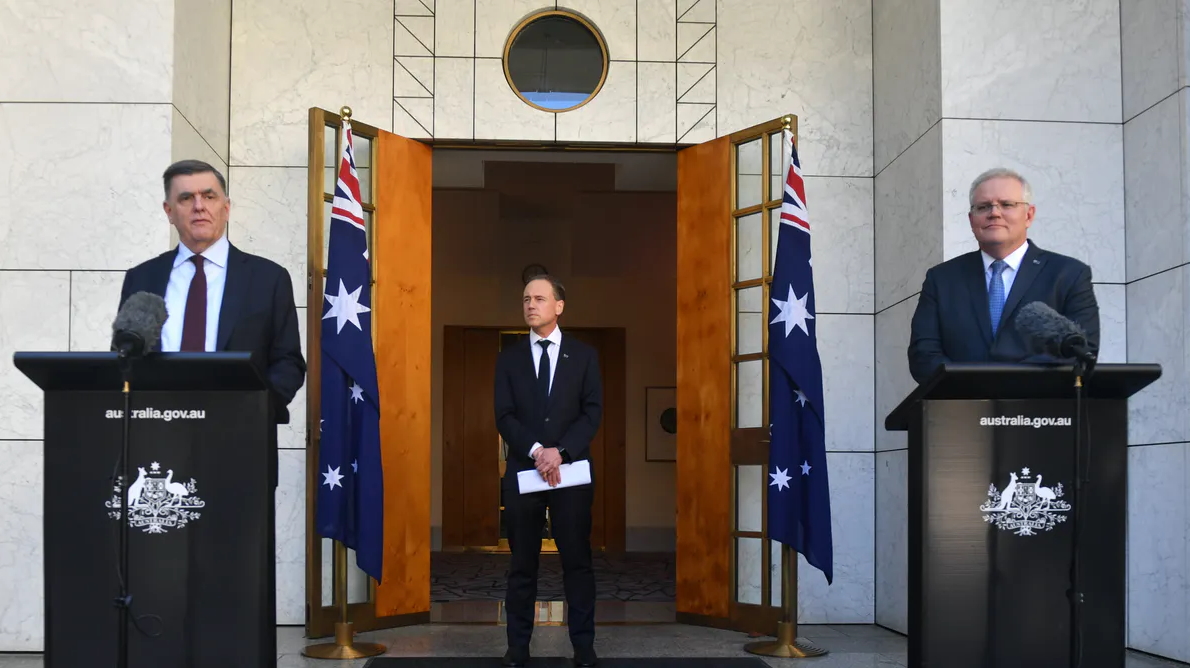
Scott Morrison and Daniel Andrews are in a high stakes arm wrestle.
Morrison, faced with the prospect of more economic devastation, is desperate to force Victoria to open faster than Sunday’s roadmap proposes.
Andrews, still reeling from the consequences of his government’s earlier mistakes, is terrified of risking a third Victorian wave by moving too quickly.
Morrison is flagging he’ll pull out whatever stops he can to prod Victoria to speed up its journey to COVID-safe activity in that state.
Get your politics analysis from academic experts, not vested interests.
Describing the Andrew government’s plan as “a worst case scenario”, he said on Monday: “I see it as a starting point in terms of how this issue will be managed in the weeks and months ahead in Victoria”.
The federal government warns of dire consequences for the Victorian economy, with a national flow-on. With epidemiologists divided over Victoria’s map, it quotes those experts who are questioning. And it intends to put under the microscope the assumptions on which the timetable is based.
It also demands to know what relief the Victorian government will give suffering businesses. There’s a general promise without specifics.
On the more positive side, the federal government declares itself ready to do anything it can to improve Victoria’s contact tracing.
When Morrison, Health Minister Greg Hunt and Health Department secretary Brendan Murphy (former chief medical officer) appeared at a Monday news conference pegged on an announcement about new agreements to secure vaccines, the Victorian roadmap was centre stage.
Murphy put aside his bureaucratic cloak to say “this does seem a very conservative approach”.
He questioned some of the “triggers” for planned steps. “Five cases rather than 10, no cases rather than a few. There’s no rule book for this virus but I think some of us feel that, if there were more confidence in the public health response capability, you could take some slightly more generous triggers.”
But Murphy rejected the suggestion (made by some critics, not the state government) that Victoria was pursuing an elimination strategy. “They’re still pursuing aggressive suppression.”
Morrison is focused, laser-like, on contact tracing. Yet again he raved about the strength of the NSW system – gold standard, as he repeatedly describes it – that has enabled a continuing small number of cases to be managed with the economy more or less open.
His point might be right but every time he makes it, he does sounds so much like – well, a New South Welshman.
It’s generally accepted Victorian contact tracing was very poor and this was a reason the quarantine bungle turned into a disaster. It’s also accepted – and Murphy attested to this – that it’s much better now.
The Victorian government said on Monday that now, almost all cases are interviewed within 24 hours (97.8% on September 3) and their close contacts notified within 48 hours (98.6%) of the state health department being informed of the result.
But Morrison remains convinced the Victorian system still leaves much to be desired, and believes it holds the key to speeding up the state’s opening.
The proposed federal examination of the Victorian modelling and settings will be an interesting moment for federal and state health advisers.
These experts have become nationally known figures during the pandemic, and commentators early on remarked how good it was to see politicians turning to experts.
But as time has gone on, the experts have found themselves used and abused, literally. Sometimes used to buttress the politicians’ cases. And abused, particularly by critics on the right, who condemn them for having too much sway.
Acting Commonwealth Chief Medical Officer Paul Kelly last week had to come up with a “hotspot” definition for Morrison, which was not endorsed by the Australian Health Protection Principal Committee (AHPPC), or the national cabinet.
Now Kelly and other federal experts are charged with reviewing the Victorian assumptions and modelling, done by university experts and used by the state government to devise the roadmap.
Victoria’s Chief Health Officer Brett Sutton said on Monday Victoria hadn’t discussed the specific roadmap with the AHPPC ahead of Sunday’s announcement. “Because no-one’s got a view of the Victorian industry and population and epidemiology to the extent that we do ourselves,” he said.
Despite his tough talk, Morrison admitted the federal government was not looking at making some formal intervention in Victoria – for which it lacks power. It intended to provide “constructive feedback to the Victorian government once we’ve had the opportunity to fully look at the assumptions that sit behind this plan”.
The Andrews government always says it acts on the health advice, so Morrison might be a little encouraged by Sutton’s remarks at the premier’s Monday news conference, which suggested a possibility of some acceleration in the later stages of the roadmap.
Not of a bring-forward of the proposed September 28 date for taking step 2 - assuming case conditions are met - which Sutton said was “locked in”.
“We need to absolutely have that time to drive transmission down so that we’re going in the right direction,” he said.
After that there seems potential for faster progress – but for a slowing too. “I think we should always be in a process of continuous review,” Sutton said.
“We could miss [step dates] on the one hand because […] we don’t get to those [required] numbers. But we should also reflect on being in a much more successful position earlier on.”
In its battle with Queensland over its border with NSW, the federal government couldn’t force a general opening but did get action to facilitate the process for people who needed to cross for health reasons.
When states are exerting their rights and powers, small progress is all Morrison seems able to achieve.
At this stage, probably the best he can hope for is the Victorian government becomes willing to be a little more ambitious if the case numbers are going well come October.
This article first appeared in The Conversation. It is republished with permission.