Hormuz traffic collapses as the escape route around the strait also falters
- Written by: The Times
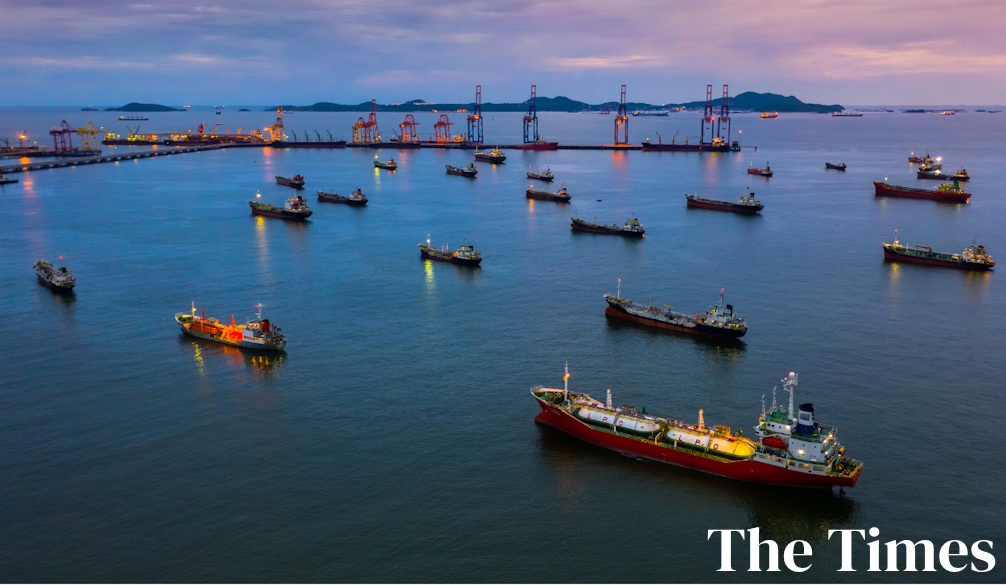
Only four commodity vessels reportedly passed through the Strait of Hormuz on Monday. Meanwhile, damage to Saudi Arabia’s East–West pipeline has interrupted the principal route designed to bypass it. The danger is no longer confined to one narrow waterway.
The number of commodity vessels passing through the Strait of Hormuz has reportedly fallen to just four in a day, compared with an estimated pre-war average of about 125.
The figure does not establish that the strait has been formally or completely closed. It reveals something potentially more consequential: commercial shipping is increasingly treating the route as though it cannot be relied upon.
Shipowners do not require a government declaration before deciding that a voyage is too dangerous. Nor do insurers need a naval blockade before imposing costs that make a shipment commercially impractical.
Warships may be able to enter contested waters under orders. Civilian crews, tanker operators, cargo owners and insurers make a different calculation.
They must decide whether the cargo is valuable enough, the protection credible enough and the risk to human life acceptable enough to justify proceeding.
Increasingly, the answer appears to be no.
The latest decline in traffic follows renewed attacks on shipping, disputed reports concerning naval mines and the postponement of talks between Iran and Gulf Arab states over arrangements for the strait.
It would be unwise to accept every wartime claim at face value. Iran’s Revolutionary Guard says a tanker struck mines and exploded. United States Central Command disputes that account and says the vessel had been attacked by an Iranian missile and drone.
The precise cause remains contested.
For the oil market, however, the effect of the incident can precede proof. Another burning or damaged tanker is enough to remind every shipowner that passage through Hormuz remains dangerous.
The bypass route has also been hit
The more significant development is occurring hundreds of kilometres away from the strait.
Saudi Arabia’s East–West pipeline carries oil from fields near the Persian Gulf across the country to the Red Sea port of Yanbu. It was built to give Saudi exports an alternative route that does not require tankers to pass through Hormuz.
That pipeline has now been disrupted following drone attacks attributed by Saudi Arabia to Iran-aligned militias.
Saudi oil cargoes destined for Europe have reportedly been cancelled or delayed, while buyers have begun seeking replacement supplies from the North Sea, the United States, Kazakhstan, Algeria and Guyana.
The pipeline’s interruption matters because it was one of the principal answers to the Hormuz problem.
If the strait became too dangerous, Saudi Arabia could move millions of barrels a day westward by land and load them onto tankers in the Red Sea. That did not replace the full capacity of Hormuz, but it provided an important pressure-release valve.
That valve is now impaired.
Saudi Arabia may attempt to redirect some oil back through the Persian Gulf and the Strait of Hormuz—the very route the East–West system was intended to avoid.
The escape route around Hormuz is therefore being forced back towards Hormuz.
Pressure at both ends
Even the Red Sea is no longer an uncomplicated alternative.
Fighting in Yemen and Houthi activity around the Bab el-Mandeb strait have placed pressure on the southern entrance to the Red Sea. Vessel traffic there has also declined.
This creates a much larger strategic problem than the temporary obstruction of a single shipping lane.
The region’s oil-export system depends upon a network of fields, pipelines, loading terminals, ports and narrow waterways. Disrupt one component and traders may be able to redirect cargoes through another. Disrupt several components at the same time and the entire network begins losing resilience.
Hormuz controls access between the Persian Gulf and the Arabian Sea.
The East–West pipeline provides a route across Saudi Arabia to the Red Sea.
Bab el-Mandeb controls the southern entrance to that sea, while the Suez Canal provides access to Europe at its northern end.
These routes are not independent of one another. They are parts of the same energy transport system.
Pressure at Hormuz makes the Saudi pipeline more valuable. Damage to the pipeline makes Hormuz more necessary. Danger at Bab el-Mandeb reduces the usefulness of Red Sea alternatives.
The result is not merely a collection of isolated attacks. It is a progressive narrowing of the routes through which Middle Eastern energy can reach the world.
An economic closure without a legal closure
Governments and military analysts frequently debate whether Iran can “close” the Strait of Hormuz.
That question can be misleading.
Iran does not have to construct a permanent physical barrier across the waterway. It does not have to defeat the United States Navy or prevent every vessel from passing.
It needs only to create enough uncertainty that commercial shipping slows dramatically.
A waterway through which a few heavily protected or risk-tolerant ships can pass may remain technically open. Economically, it can still be largely closed.
This is the same principle that makes naval mines effective as area-denial weapons. Their purpose is not limited to destroying the ship that strikes one. Their greater value lies in making every other captain uncertain about the water ahead.
An unverified report of mines can therefore affect shipping. A confirmed mine can affect it more. A damaged tanker can alter decisions throughout the industry, even before investigators determine exactly what happened.
Fear is not separate from the weapon. Fear is part of how the weapon controls an area.
Oil prices reflect physical scarcity
The International Energy Agency’s September Oil Market Report said benchmark North Sea Dated crude averaged US$91 a barrel in August before reaching US$113.48 on 9 September.
The agency described a tightening market in which disruption in the Middle East and Russia had increased demand for oil from the Atlantic Basin. Tanker costs also rose sharply as buyers competed for vessels and tried to avoid dangerous routes.
This is an important distinction.
Earlier movements in oil prices were sometimes driven primarily by the possibility of future disruption. The market is now responding to actual restrictions on shipping, curtailed regional output, higher transport costs and buyers searching for replacement cargoes.
The world can obtain more oil from the United States, Brazil, Guyana, West Africa and other producers. But alternative oil may be farther away, of a different grade or more expensive to refine. It also requires tankers that are already in increasing demand.
Replacing a Middle Eastern cargo is not simply a matter of selecting another supplier from a list. The replacement must be available, compatible with the refinery and capable of arriving when required.
Why Australia remains exposed
Australia does not purchase all its fuel directly from countries bordering the Persian Gulf. That does not isolate Australian motorists or businesses from what happens at Hormuz.
Australia buys much of its petrol, diesel and aviation fuel from Asian refineries. Those refineries compete for crude oil in the same global market and many have historically depended heavily upon Middle Eastern supplies.
When their crude becomes more expensive, their refined products become more expensive. When tankers, insurance and replacement cargoes cost more, those costs move through the refining and distribution chain.
Australia is therefore exposed through price even when a particular shipment does not pass through Hormuz.
The consequences extend well beyond the service-station sign.
Diesel powers trucks, farm machinery, mining equipment, construction vehicles and many backup generators. Aviation fuel affects the cost of moving passengers and freight across a large country. Higher transport costs eventually appear in supermarket prices, building costs and the expense of operating regional businesses.
Petrol is the visible price of an oil shock. Diesel is often the mechanism through which the shock spreads into the rest of the economy.
Australian petrol and diesel prices are already rising sharply. The federal government has ruled out another general reduction in fuel excise, arguing that the previous relief was temporary and that excise cannot be repeatedly adjusted with every movement in international markets.
The government has announced measures to expand Australia’s fuel security and reserves, including plans to increase diesel and aviation-fuel coverage. Those measures may improve resilience, but they cannot immediately shield Australia from the global price of replacement supply.
A reserve can provide time during an interruption. It does not manufacture new fuel, repair a damaged pipeline or make a dangerous shipping route safe.
What happens next
Several developments now require close attention.
The first is whether traffic through Hormuz recovers from the extraordinarily low reported level or whether shipowners continue to remain outside the Gulf.
The second is the condition of Saudi Arabia’s East–West pipeline and how quickly normal operations at Yanbu can resume.
The third is whether attacks around Yemen further restrict shipping through Bab el-Mandeb.
The fourth is whether Gulf states and Iran revive negotiations over safe passage through Hormuz. The postponement of talks does not mean diplomacy has failed permanently, but it removes one of the few available routes towards commercial confidence.
Finally, markets will watch whether alternative producers can release sufficient crude and refined fuel without creating new shortages elsewhere.
None of these questions can be answered merely by watching the quoted price of Brent oil. Vessel movements, refinery supply, tanker availability and insurance conditions now provide an equally important measure of the crisis.
The Times View
The strategic importance of the Strait of Hormuz has always rested on concentration: too much of the world’s energy must pass through too little water.
The latest developments expose a second weakness. The alternative routes are also concentrated, vulnerable and connected to the same regional conflict.
When Hormuz became dangerous, the world looked to Saudi Arabia’s pipeline and the Red Sea. When that pipeline was attacked, Saudi exporters were pushed back towards Hormuz. When instability spread around Yemen, the Red Sea alternative also became less secure.
This is how an energy system loses resilience—not necessarily through one decisive act, but through the progressive removal of every practical alternative.
Only four commodity vessels reportedly passing through Hormuz does not prove that the strait is completely closed.
It proves something almost as important.
A shipping route does not have to be physically impassable to stop functioning as a dependable part of the world economy.