If you were called by a melody, how would it sound? Communities in Ethiopia and PNG name people with unique individual tunes
- Written by: Hannah Sarvasy, Research Fellow in Linguistics, Western Sydney University
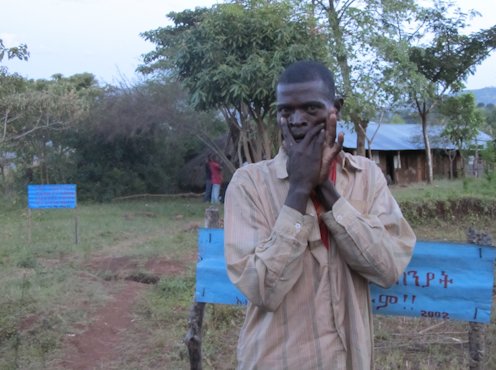
36-year-old Binoora Bhultse lives in Garda village in the Oyda district of southwest Ethiopia.
While he could share the name Binoora with other local men, Binoora also has a name that is special to him. It may never have existed before him, and may never name anyone else after he dies.
This name isn’t a word. It is a two-second wordless melody, given to Binoora in early childhood and recognised throughout his community to refer to him alone.
Binoora’s moyzé, or “name tune,” is most often whistled, using one hand at the mouth and the other opening and closing against that one to modulate the pitch.
It can also be sung to a series of non-meaningful sounds different for each name tune. For Binoora, this sequence is “tuutelmutelmtéetmtéel”.
Any other Binooras in the community will have their own unique moyzé, and so do most of the other 45,000 Oyda people.
None of the communities surrounding the Oyda are known to practice anything similar — in fact, name tunes are unknown in most of the world.
But, in one small region of Madang Province in northeastern Papua New Guinea, about 15,000 people across three language areas (Nankina, Domung and Yopno) also employ name tunes, which they call konggap.
Unique melodies label people
Yopno konggap differ in performance style from the Oyda moyzé, since they are either simply whistled with no use of the hands, or sung on a series of open vowels (like “a-o-a-o-e-e-a”).
But in many other respects, as our new research[1] shows, konggap and moyzé are strikingly similar. Both moyzé and konggap are unique to every individual, and generally bear no relation to a person’s given name, which is often shared with other community members.
The tunes in both traditions use similar pitch ranges and last 1-4 seconds. Moyzé and konggap are also used for similar purposes. Both are used on a daily basis to hail and summon people, especially across long distances. They are also used to mourn the dead. Funeral laments in both communities involve performing the name tunes of the deceased and their relatives.

The traditions do differ in some ways. A moyzé can be inherited by a family member after death: given to children or grandchildren who do not yet have a moyzé, or inherited by adults who then abandon their own moyzé. Konggap are not inherited.
Konggap feature in a striking performance that has no moyzé equivalent: on special occasions a group of men dance while each sings his own konggap simultaneously, producing a remarkable polyphony of distinct name tunes.
Talking through music
Many communities use melodies for messaging.
“Whistled speech[2]” is used in rural areas of the Canary Islands, Mexico, Turkey and elsewhere. These whistled messages mimic the cadences of actual speech to communicate across long distances: certain pitch levels relate to certain sounds, or accented syllables, in the corresponding spoken language.
Another type of “surrogate speech” can involve a small set of drum patterns to convey a fixed set of messages across long distances, as found in other parts of Africa and Papua New Guinea[3].
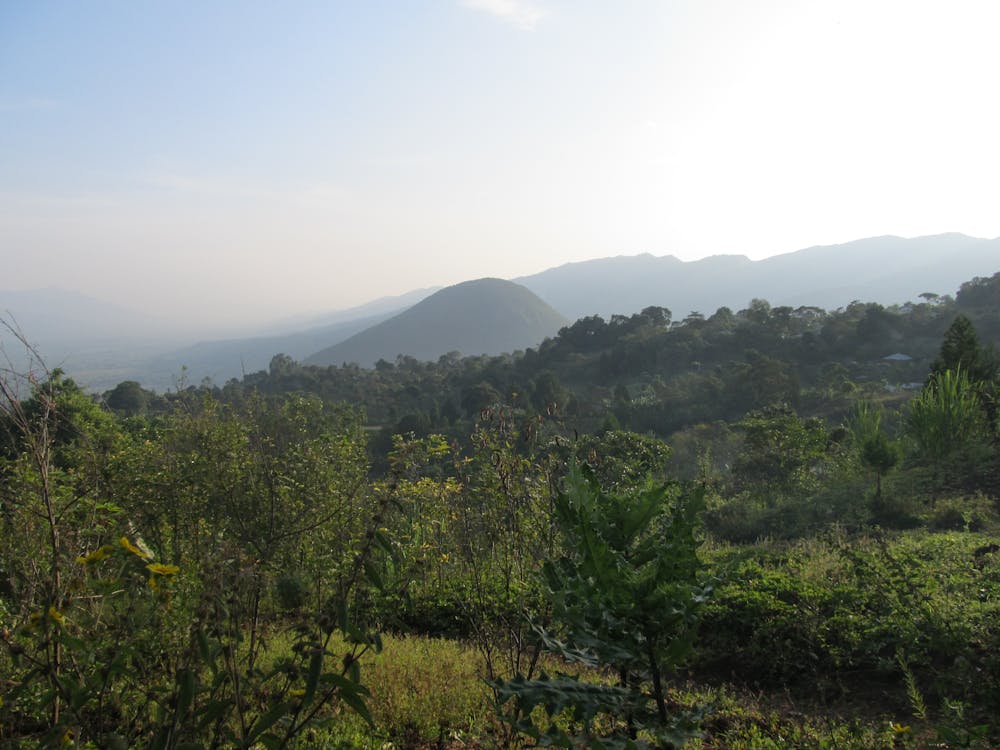 The Oyda area in Ethiopia.
Azeb Amha, Author provided
The Oyda area in Ethiopia.
Azeb Amha, Author provided
But name tunes are different from whistled messaging and meaningful drum patterns[4]. They do not appear to mimic the cadences of speech, and, rather than drawing on a fixed number of messages, name tunes employ a potentially infinite number of musical patterns to uniquely identify people.
In that respect, konggap and moyzé reveal the possibilities for human creativity, and our capacity to recognise and reproduce distinct musical sequences. Each member of these communities must know and be able to accurately reproduce hundreds of unique name tunes. And every new generation entails the creation of myriad new name tunes, which must then be learned by others.
The name tune keeps ringing
We still don’t know why name tunes arose in these two far-flung communities.
Mountainous topography is said to be a factor in the development of many musical messaging systems, as music may carry farther than speech in such environments. Both the Oyda and Yopno live in mountainous terrain, but since neighbouring communities living in similar terrain appear to lack name tunes, this can only be part of the answer.
Other long-distance communication systems — such as slit-gong drum messaging in other parts of Papua New Guinea — have fallen out of use[5] with the advent of, first, letter-writing, and later, mobile phones.
Name tunes appear to be robust in the face of technological change. Although there is some attrition in moyzé use among Oyda with white-collar jobs, at least one young Oyda man uses his deceased father’s moyzé — which he inherited — as a ringtone on his mobile phone.
References
- ^ our new research (www.frontiersin.org)
- ^ Whistled speech (www.smithsonianmag.com)
- ^ as found in other parts of Africa and Papua New Guinea (www.tandfonline.com)
- ^ are different from whistled messaging and meaningful drum patterns (anthrosource.onlinelibrary.wiley.com)
- ^ have fallen out of use (www.pngbuai.com)