How many lives have coronavirus vaccines saved? We used state data on deaths and vaccination rates to find out
- Written by: Sumedha Gupta, Associate Professor of Economics, IUPUI
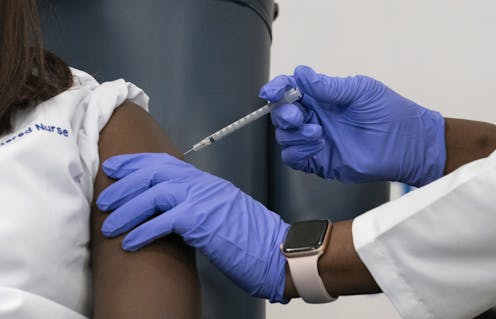
 State data for vaccination rates and COVID–19 deaths can shed light on the real-world effectiveness of the vaccines.
DeskCube/iStock via Getty Images[10]
To do this, our model compares COVID-19 incidence in states with high vaccination rates against states with low vaccination rates. As part of the analysis, we controlled for things that influence the spread of the coronavirus, like state–by–state differences in weather[11] and population density[12], seasonally driven changes in social behavior[13] and non-pharmaceutical interventions[14] like stay-at-home orders, mask mandates and overnight business closures. We also accounted for the fact that there is a delay between when a person is first vaccinated and when their immune system has built up protection[15].
Vaccines saved lives
To check the strength of our model before playing with variables, we first compared reported deaths with an estimate that our model produced.
When we fed it all of the information available – including vaccination rates – the model calculated that by May 9, 2021, there should have been 569,193 COVID-19 deaths in the U.S. The reported death count[16] by that date was 578,862, less than a 2% difference from our model’s prediction.
Equipped with our well-working statistical model, we were then able to “turn off” the vaccination effect and see how much of a difference vaccines made.
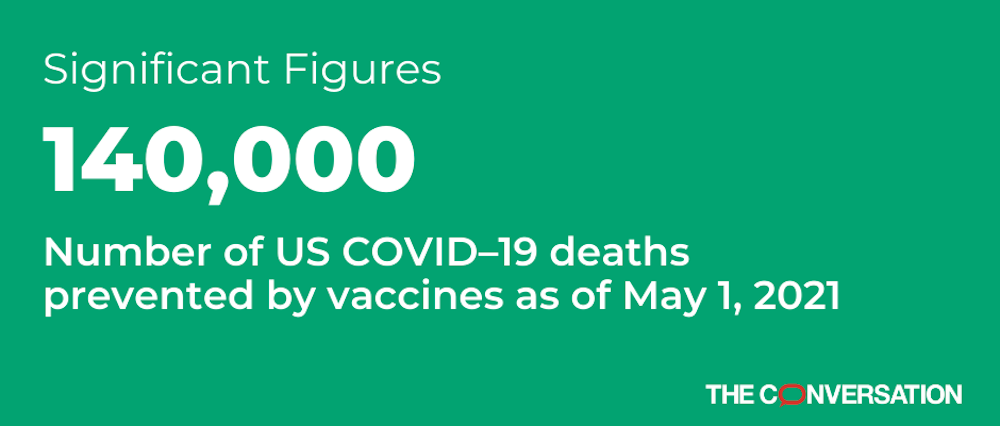
Using near real-time data of state vaccination rates[17], coronavirus cases and deaths in our model, we found that in the absence of vaccines, 708,586 people would have died by May 9, 2021. We then compared that to our model estimate of deaths with vaccines: 569,193. The difference between those two numbers is just under 140,000. Our model suggests that vaccines saved 140,000 lives[18] by May 9, 2021.
Our study only looked at the few months just after vaccination began. Even in that short time frame, COVID-19 vaccinations saved many thousands of lives despite vaccination rates still being fairly low in several states by the end of our study period. I can say with certainty that vaccines have since then saved many more lives – and will continue to do so as long as the coronavirus is still around.
References^ CC BY-ND (creativecommons.org)^ large-scale clinical trials (www.pfizer.com)^ very effective at preventing severe COVID–19 (www.cdc.gov)^ especially good at preventing death (www.cdc.gov)^ differ from the efficacy found in clinical trials (www.who.int)^ only been getting the first shot (www.newsweek.com)^ less protected than a fully vaccinated person (abc7.com)^ much less likely to transmit COVID-19 to others (www.nbcnews.com)^ I am a health economist (scholar.google.com)^ DeskCube/iStock via Getty Images (www.gettyimages.com)^ weather (dx.doi.org)^ population density (doi.org)^ seasonally driven changes in social behavior (www.mayoclinic.org)^ non-pharmaceutical interventions (statepolicies.com)^ immune system has built up protection (news.weill.cornell.edu)^ reported death count (www.nytimes.com)^ data of state vaccination rates (www.bloomberg.com)^ saved 140,000 lives (doi.org)
State data for vaccination rates and COVID–19 deaths can shed light on the real-world effectiveness of the vaccines.
DeskCube/iStock via Getty Images[10]
To do this, our model compares COVID-19 incidence in states with high vaccination rates against states with low vaccination rates. As part of the analysis, we controlled for things that influence the spread of the coronavirus, like state–by–state differences in weather[11] and population density[12], seasonally driven changes in social behavior[13] and non-pharmaceutical interventions[14] like stay-at-home orders, mask mandates and overnight business closures. We also accounted for the fact that there is a delay between when a person is first vaccinated and when their immune system has built up protection[15].
Vaccines saved lives
To check the strength of our model before playing with variables, we first compared reported deaths with an estimate that our model produced.
When we fed it all of the information available – including vaccination rates – the model calculated that by May 9, 2021, there should have been 569,193 COVID-19 deaths in the U.S. The reported death count[16] by that date was 578,862, less than a 2% difference from our model’s prediction.
Equipped with our well-working statistical model, we were then able to “turn off” the vaccination effect and see how much of a difference vaccines made.
Using near real-time data of state vaccination rates[17], coronavirus cases and deaths in our model, we found that in the absence of vaccines, 708,586 people would have died by May 9, 2021. We then compared that to our model estimate of deaths with vaccines: 569,193. The difference between those two numbers is just under 140,000. Our model suggests that vaccines saved 140,000 lives[18] by May 9, 2021.
Our study only looked at the few months just after vaccination began. Even in that short time frame, COVID-19 vaccinations saved many thousands of lives despite vaccination rates still being fairly low in several states by the end of our study period. I can say with certainty that vaccines have since then saved many more lives – and will continue to do so as long as the coronavirus is still around.
References^ CC BY-ND (creativecommons.org)^ large-scale clinical trials (www.pfizer.com)^ very effective at preventing severe COVID–19 (www.cdc.gov)^ especially good at preventing death (www.cdc.gov)^ differ from the efficacy found in clinical trials (www.who.int)^ only been getting the first shot (www.newsweek.com)^ less protected than a fully vaccinated person (abc7.com)^ much less likely to transmit COVID-19 to others (www.nbcnews.com)^ I am a health economist (scholar.google.com)^ DeskCube/iStock via Getty Images (www.gettyimages.com)^ weather (dx.doi.org)^ population density (doi.org)^ seasonally driven changes in social behavior (www.mayoclinic.org)^ non-pharmaceutical interventions (statepolicies.com)^ immune system has built up protection (news.weill.cornell.edu)^ reported death count (www.nytimes.com)^ data of state vaccination rates (www.bloomberg.com)^ saved 140,000 lives (doi.org)