Sex on the beach might be fun for people – but it's bad for dunes and wildlife
- Written by: Patrick Hesp, Professor, Flinders University
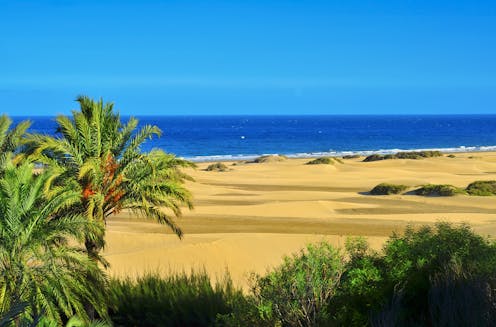
Sun, surf, sand, sea – and public sex with strangers. These five S’s are a key part of tourism in the Canary Islands, a Spanish archipelago west of Morocco. Unfortunately, what’s fun for humans can be bad for wildlife.
Our new research[1], released yesterday, found public sex – known as “cruising” – in the Canary Islands is leading to significant degradation of the Dunes of Maspalomas, one of Europe’s last naturally functioning transgressive dune fields[2] (in other words, they move around).
These semi-vegetated and mobile dunes are one of the most popular sightseeing spots on Gran Canaria island, and are legally protected as a nature reserve. Unfortunately, they are being loved to death.
We studied almost 300 sex spots across the vegetated section of these dunes, and found damage to 10 plant species, including three endemic to dune areas.
When plants suffer, so do the animals and reptiles, with rare lizards and endemic plant species notably impacted.
We’re not calling for an end to public sex – but we do want people to be aware of the damage it can do.
Sex in the Canary Islands
Before COVID, the Canary Islands was attracting up to 14 million tourists[3] a year. Around 15% of tourists are men drawn to the gay-friendly beach resorts, with the area also popular for lesbians and heterosexual swingers. Those interested in casual sex are likely to venture into the coastal dunes, seeking privacy and partners.
The impact of these visitors is, unfortunately, large and growing. We found around 5,800 square metres of the dunes has been totally altered by people seeking sex. These impacts have made it impossible for the area to be used as an environmental education centre for students.
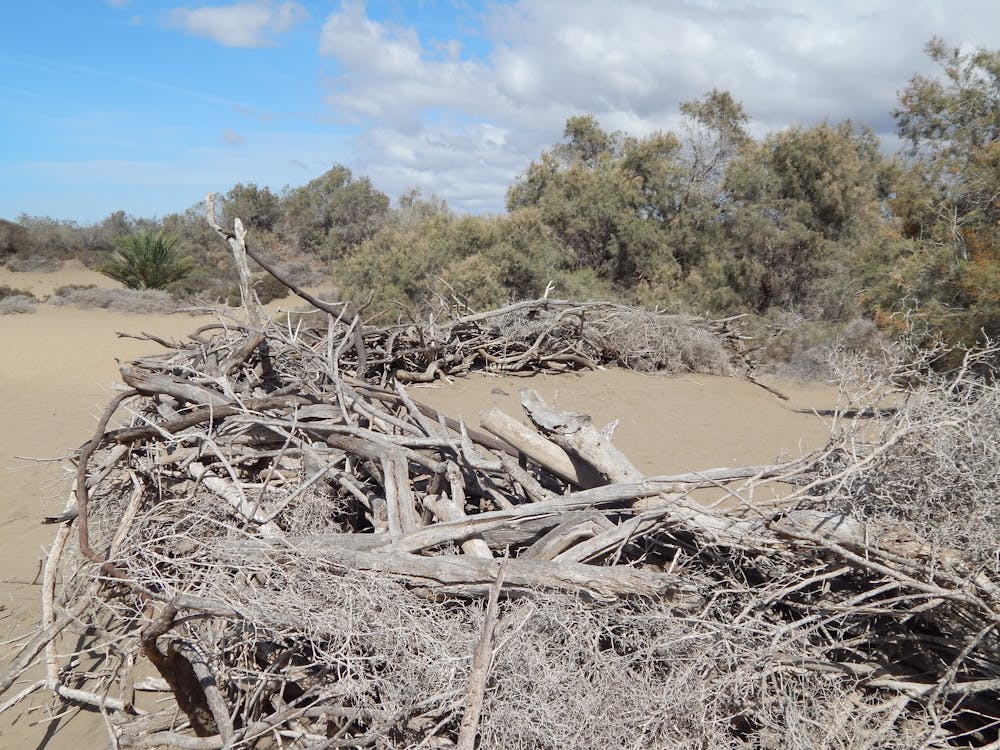
Dumped cigarette butts and condoms have become a major problem, as has removal of vegetation to make “nests”, sites for sex, and destruction due to trampling and track creation.
While there are sand-only dunes known as the little Sahara nearby, we found these are far less popular for sex spots compared to the vegetated dunes, which are home to more wildlife. And interestingly, the building of resorts nearby has changed the way the dunes move, and allowed more vegetation to grow in these areas. This, in turn, may have made cruising more popular.
Read more: How the histories of Mardi Gras and gay tourism in Australia are intertwined[4]
So what’s the damage?
Sex on the beach as an isolated activity is unlikely to damage the environment. The issue starts when a dune area becomes popular for cruising (casual sex) and attracts hundreds of people a day. It’s similar to the impact of 4WD driving, which may have a relatively low impact on dune ecosystems if vehicle numbers are low, but leads to major erosion and habitat destruction [5]when vehicle numbers are high.
We found public sex was particularly damaging to the local nebkhas, the term for discrete dune hummocks covered in plants. That’s because people have trampled many paths through the vegetation, as well as cutting branches off trees and shrubs to make a semi-private space.
The rare plants are the first ones to disappear. Soon, you lose connectivity for animals. A lizard has to run from one vegetated patch to another, making them more exposed to predators. The whole ecosystem starts to fragment into isolated islands, which can eventually destabilise the ecosystem as a whole.
Animals suffer in more direct ways, too. Jellyfish-eating Gran Canary giant lizards (Gallotia stehlini) have died after eating condoms left behind by pleasure seekers.
This matters because these dunes are rare. Transgressive dunefields[6] are wide, semi-vegetated dune systems with a variety of dunes found nowhere else in coastal systems. They’re worth protecting due to their beauty, value for research, educational value and endemic plants and animals. Europe has almost none left, due to massive development along its coasts since the 1970s.
Are the dunes trashed beyond repair?
No, not yet. Our research has helped nudge the government and local resort owners to take action.
Over the last two years, the government has run major cleanup operations through its MASDUNAS project[7], removing a great deal of waste and dead vegetation. Encouragingly, some resort owners are discussing the impact of cruising with their guests.
Environmental protection will be high on the radar for authorities as the Canary Islands recovers from the ongoing volcanic eruption on La Palma island.
Read more: Contested spaces: conflict behind the sand dunes takes a new turn[8]
Is this happening in Australia?
While dune systems are popular cruising locations around the world, it is not known if Australian dunes have been similarly affected, given few studies have been conducted.
But if you are looking to go cruising on dunes in one of the popular spots near major cities, it’s good to be aware of your impact on plants, animals and birds. Some Australian shorebirds use dunes as nesting sites[9], for instance.
Tread lightly – and preferably in a less environmentally fragile location.
References
- ^ new research (www.sciencedirect.com)
- ^ transgressive dune fields (www.nature.com)
- ^ 14 million tourists (www.statista.com)
- ^ How the histories of Mardi Gras and gay tourism in Australia are intertwined (theconversation.com)
- ^ major erosion and habitat destruction (link.springer.com)
- ^ Transgressive dunefields (www.youtube.com)
- ^ MASDUNAS project (www.grancanaria.com)
- ^ Contested spaces: conflict behind the sand dunes takes a new turn (theconversation.com)
- ^ use dunes as nesting sites (theconversation.com)