Pfizer's pill is the latest COVID treatment to show promise. Here are some more
- Written by: Nial Wheate, Associate Professor of the Sydney Pharmacy School, University of Sydney
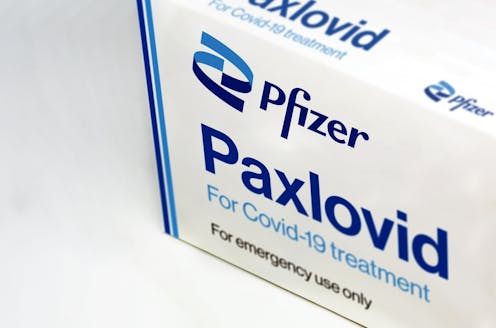
Pfizer says its antiviral COVID treatment Paxlovid cuts the chance of ending up in hospital or dying by 89%[1].
What differentiates this from other medicines we have used since the start of the pandemic is it provides the opportunity for patients to be treated at home, with a combination of a capsule and a pill.
The phase 2/3 trial data on which those hospitalisation rates are based have yet to be independently verified. Nor has the treatment been approved by any country for use outside a clinical trial.
Yet this development adds to our growing portfolio of potential options to directly target SARS-CoV-2, the virus that causes COVID-19, and to treat COVID symptoms.
What is it?
Paxlovid is a combination of two different drugs – the HIV drug ritonavir[2] (a capsule) and an experimental drug PF-07321332 (a pill).
Ritonavir protects the body from metabolising PF-07321332. It acts by being broken down by the body first (known as a sacrificial chemical) to ensure enough PF-07321332 reaches the virus intact.
PF-07321332 is a so-called protease inhibitor[3] (as is ritonavir). It blocks the action of a vital enzyme (protease) and stops SARS-CoV-2 from making copies of itself.
What did the trial show?
The trial included 1,219 “high risk” adults with COVID who were not in hospital. Each person had at least one characteristic or underlying medical condition associated with an increased risk of developing severe COVID. One group received the treatment, the other placebo.
The trial’s interim results showed[4] a reduction in the risk of hospitalisation or death by 89% in the Paxlovid group compared to placebo.
At day 28, there were no deaths reported in the Paxlovid group, compared with ten deaths in the placebo group. Side-effects were similar in both groups and were generally mild.
Read more: Could a simple pill beat COVID-19? Pfizer is giving it a go[5]
The company said the results were so promising it was recommended no new patients needed to be enrolled into the study. And the company was recommended to submit the data to the US Food and Drug Administration for emergency use approval.
Before the drug could be used in Australia, the Therapeutic Goods Administration (TGA) would need to assess its efficacy and safety.
Just as importantly, the TGA would need to decide who may prescribe it and under what conditions. This may include whether it would be available from GPs, and what sort of patient risk factors would be considered.
Read more: What is sotrovimab, the COVID drug the government has bought before being approved for use in Australia?[6]
One of several potential antiviral drugs
Paxlovid is one potential COVID drug for use at home. The idea is these could be prescribed at the first sign of infection to prevent serious illness and death. People would manage their own symptoms[7], monitored while at home, and only be transferred to hospital if their condition deteriorates.
Merck has its own antiviral drug, molnupiravir[8], also for home use. It’s been approved for use in the UK, and is being considered for use in Australia.
Read more: Take-at-home COVID drug molnupiravir may be on its way — but vaccination is still our first line of defence[9]
Then there’s AstraZeneca’s emerging COVID drug Evusheld[10]. The TGA has just given this “provisional determination[11]”, meaning the company can now submit data for evaluation.
Evusheld contains two long-acting monoclonal antibody drugs – tixagevimab and cilgavimab. It’s an injection that could be given in hospital or as an outpatient to prevent infections from getting worse.
Human trials[12] have shown when Evusheld was used before exposure to COVID, there were significantly fewer symptoms.
Although Evusheld may potentially be used to prevent COVID, it would not be a substitute for vaccination. But it could provide additional protection for people who may have an inadequate response to vaccination or who cannot be immunised.
Read more: Stopping, blocking and dampening – how Aussie drugs in the pipeline could treat COVID-19[13]
Treating COVID symptoms
We also have a range of existing and emerging treatments for use in hospital to treat the symptoms of infection – inflammation on the lungs and difficulty breathing.
If patients with mild COVID have certain risk factors for disease progression, such as diabetes or a heart condition[14], doctors may consider using hospital administered treatments such as sotrovimab, Ronapreve, or inhaled budesonide to prevent disease progression.
According to Pfizer’s trial results, Paxlovid could be used as an alternative to in-hospital treatment for preventing disease progression in patients with the same risk factors.
Read more: Here's what happens when you’re hospitalised with COVID[15]
Where next?
There are several steps before we can routinely expect to take COVID drugs at home to prevent the worst of the symptoms. We need independent verification of these drugs’ efficacy and safety[16], and of course, regulatory approval.
Then there’s the issue of cost[17].
Developing new medicines, particularly at the pace required because of COVID, means these new drugs aren’t cheap. One consideration for state and federal governments will be balancing the costs of the medicines against health outcomes.
The daily cost of a patient in hospital[18] is around A$5,000 for an uncomplicated (non-COVID) admission. This is much more than the reported cost[19] of a full course of molnupiravir to the US government at US$700 (about A$960).
But the costs of Paxlovid, and other new COVID medicines, have not been released and may be very much higher than the hospital costs. Some medicines subsidised by the government for other conditions can cost almost A$19,000 per pack of tablets[20].
References
- ^ by 89% (www.pfizer.com)
- ^ ritonavir (www.nps.org.au)
- ^ protease inhibitor (www.healthline.com)
- ^ The trial’s interim results showed (www.pfizer.com)
- ^ Could a simple pill beat COVID-19? Pfizer is giving it a go (theconversation.com)
- ^ What is sotrovimab, the COVID drug the government has bought before being approved for use in Australia? (theconversation.com)
- ^ manage their own symptoms (theconversation.com)
- ^ molnupiravir (theconversation.com)
- ^ Take-at-home COVID drug molnupiravir may be on its way — but vaccination is still our first line of defence (theconversation.com)
- ^ COVID drug Evusheld (www.theguardian.com)
- ^ provisional determination (www.tga.gov.au)
- ^ Human trials (www.astrazeneca.com)
- ^ Stopping, blocking and dampening – how Aussie drugs in the pipeline could treat COVID-19 (theconversation.com)
- ^ diabetes or a heart condition (www.cdc.gov)
- ^ Here's what happens when you’re hospitalised with COVID (theconversation.com)
- ^ efficacy and safety (www.nature.com)
- ^ issue of cost (www.forbes.com)
- ^ daily cost of a patient in hospital (www.canstar.com.au)
- ^ reported cost (scholar.harvard.edu)
- ^ A$19,000 per pack of tablets (www.pbs.gov.au)