Be a force for global good without ideological warfare
- Written by: Lavina Lee, Senior lecturer, Macquarie University
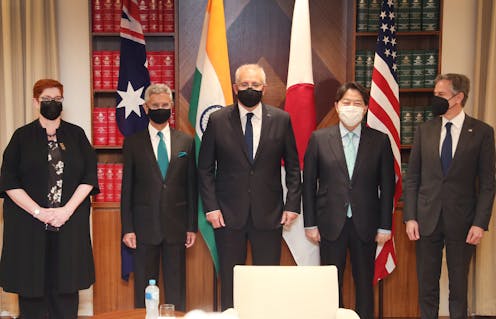
The stakes were high when the foreign ministers of the Quad security group met in Melbourne this week. The US has warned[1] a Russian invasion of Ukraine could be imminent. And Russian President Vladimir Putin had just met with his Chinese counterpart, Xi Jinping, and announced a “no limits[2]” partnership between the two powers.
Amid such uncertainty, the main goal of the foreign ministers of the US, Australia, Japan and India was to display unity, resolve and collective strength as a response to the increasing authoritarian challenge to world order.
In the lead-up to the dialogue, US Secretary of State Antony Blinkin[3] laid down the gauntlet, declaring
I would put our partnerships, our alliances, our coalitions against anything anyone else has to offer.
But the Quad members were also keen to show they are not merely reacting to a rival’s agenda, but able to offer their own ambitious, positive and practical contributions to the development goals of smaller states in the Indo-Pacific region.
A force for global good
This objective of recasting of the Quad as not just an anti-China coalition, but a force for global good began over a year ago with the no-strings-attached pledge to donate at least one billion doses of COVID-19 vaccines[4] to developing countries in the region by the end of 2022.
This was a direct response to Beijing’s use of COVID-19 vaccine donations to cast itself as a regional saviour, while simultaneously demanding political concessions from smaller countries.
Read more: Quad group makes vaccine deal as a wary China watches on[5]
This time around, the Quad foreign ministers were keen to emphasise their vaccine pledge had not been derailed by India’s devastating second wave[6] of COVID infections last year, with more than 500 million doses already delivered to the region.
Such a pledge directly addresses the top priority of Southeast Asian states, whose ability to move to a post-COVID economic recovery has been hobbled by a lack of vaccines, deepening poverty and global inequality[7].
Additionally, the Quad members signalled their intent to strengthen collaboration on humanitarian assistance and disaster relief. This is a return to the group’s 2004 origins[8], when the four countries first came together to respond to the Indian Ocean tsunami[9].
The Quad members have, for example, been active in supporting Tonga after its January volcano eruption[10]. While not openly discussed, such collaboration also provides opportunities for the four countries’ navies to coordinate more closely, which has military advantages.
Countering Chinese actions in South China Sea
Despite the focus in Melbourne on being a force for good, the Quad has not forgotten the realpolitik objective of countering China’s ability to create an uncontested sphere of influence in the Indo-Pacific.
Though not mentioning China directly in their joint statement, the foreign ministers set their sights[11] on countering its expansive and illegal claims over nearly the entirety of the South China Sea.
As the other Southeast Asian claimants to the sea have been consumed with responding to the pandemic, Beijing has deployed coast guard ships, civilian militia vessels[12], fishing fleets and resource survey ships[13] in ever greater numbers to aggressively block other nations from fishing and exploiting oil and gas deposits in their own exclusive economic zones.
In response, the Quad announced it will deepen engagement with regional partners to build their capacities to safeguard their exclusive economic zones. This includes developing coast guard resources, strengthening information sharing, ensuring freedom of navigation and helping combat illegal fishing.
This approach is very appealing to regional states, such as Vietnam and Indonesia, who are reluctant to openly join an anti-China coalition but are keen to develop their own sovereign capabilities to defend their access to resources.
Read more: With vision of a 'free and open Indo-Pacific', Quad leaders send a clear signal to China[14]
Slight differences in approach
Despite these shared goals, there were slight differences between the Quad members. A conspicuous omission from their joint statement was America’s framing of the global competition with China (and Russia) as an ideological contest between democracies and authoritarian states, or liberal and illiberal regimes.
Australia, Japan and India are reluctant to enter into ideological warfare with China. Australian Prime Minister Scott Morrison has at times spoken[15] about the intractable differences between democratic and authoritarian political systems. However, the general Australian approach remains to criticise Chinese behaviour without necessarily implying it is derived from an illegitimate and dangerous authoritarian political system.
Japan, too, is uncomfortable with taking the US approach, fearing it will undermine its foreign policy influence built on a foundation of investment and development aid to quasi-democratic and authoritarian countries alike.
India is the most reluctant of all, having deep historical ties and a strong defence relationship with both the former Soviet Union and now Russia.
India diverged[16] from the other members on the threat of a Russian invasion of Ukraine, instead preferring the Quad focus on Indo-Pacific issues and avoid any agenda that might damage its relationship with Moscow.
At the same time, India would not want to legitimise a Russian invasion of Ukraine, as this might offer Pakistan cover to do the same against Indian-controlled Kashmir.
Nevertheless, the schisms between democratic and authoritarian great powers are widening and will be increasingly difficult to manage.
The good news is the declaration of a Sino-Russian “no-limits” partnership has given even more momentum to the Quad and further strengthened the resolve of the four members to advance a “free and open Indo-Pacific”.
The bad news is we are a few steps closer to outright division between the democratic Quad members and China and Russia, with less room to manoeuvre to find common ground.
Read more: Russia and China's growing 'friendship' is more a public relations exercise than a new world order[17]
References
- ^ warned (www.abc.net.au)
- ^ no limits (en.kremlin.ru)
- ^ Antony Blinkin (www.theaustralian.com.au)
- ^ one billion doses of COVID-19 vaccines (www.bbc.com)
- ^ Quad group makes vaccine deal as a wary China watches on (theconversation.com)
- ^ India’s devastating second wave (www.bbc.com)
- ^ poverty and global inequality (thedocs.worldbank.org)
- ^ group’s 2004 origins (www.thehindu.com)
- ^ Indian Ocean tsunami (theconversation.com)
- ^ after its January volcano eruption (news.un.org)
- ^ set their sights (www.state.gov)
- ^ civilian militia vessels (amti.csis.org)
- ^ resource survey ships (amti.csis.org)
- ^ With vision of a 'free and open Indo-Pacific', Quad leaders send a clear signal to China (theconversation.com)
- ^ spoken (www.smh.com.au)
- ^ diverged (timesofindia.indiatimes.com)
- ^ Russia and China's growing 'friendship' is more a public relations exercise than a new world order (theconversation.com)