Set among the American Mafia of the 40s, Coppola's film is unmistakably a film of the disillusioned 70s
- Written by: Daryl Sparkes, Senior Lecturer (Media Studies and Production), University of Southern Queensland
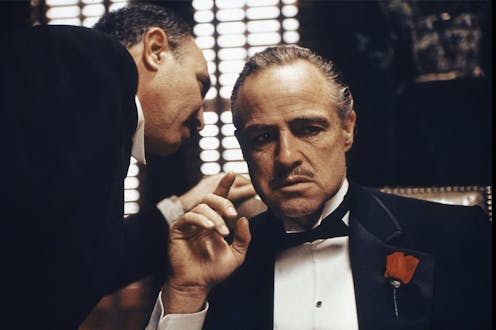
When it was released 50 years ago, The Godfather won a swag of Oscars and hailed director Francis Ford Coppola as the voice of a new auteur. But timing is, as they say, everything.
The story of an ageing Mafia Don and his family in New York City from 1945 to 1955, The Godfather is a sweeping saga of the trials and tribulations of running a criminal organisation.
There are two timelines that need to be looked at when watching The Godfather: when it was set, and when it was made. They are inextricably linked, yet polar opposites of the moral, cultural and social fabric of the United States.
Post-war optimism
Coming out of the devastating destruction and loss of life of the second world war, Americans had a newfound sense of optimism[1] that the worst was behind them.
After years of uncertainty and stress, people yearned for a “normality” in the mundane in their suburban houses, family life and nine-to-five job. People believed in governments and traditional institutions to look after their interests and well-being.
New opportunities and an even distribution of wealth created through low post-war unemployment incentivised growth and created “an advanced consumer economy[2]” which drew both legitimate and illegitimate businesses.
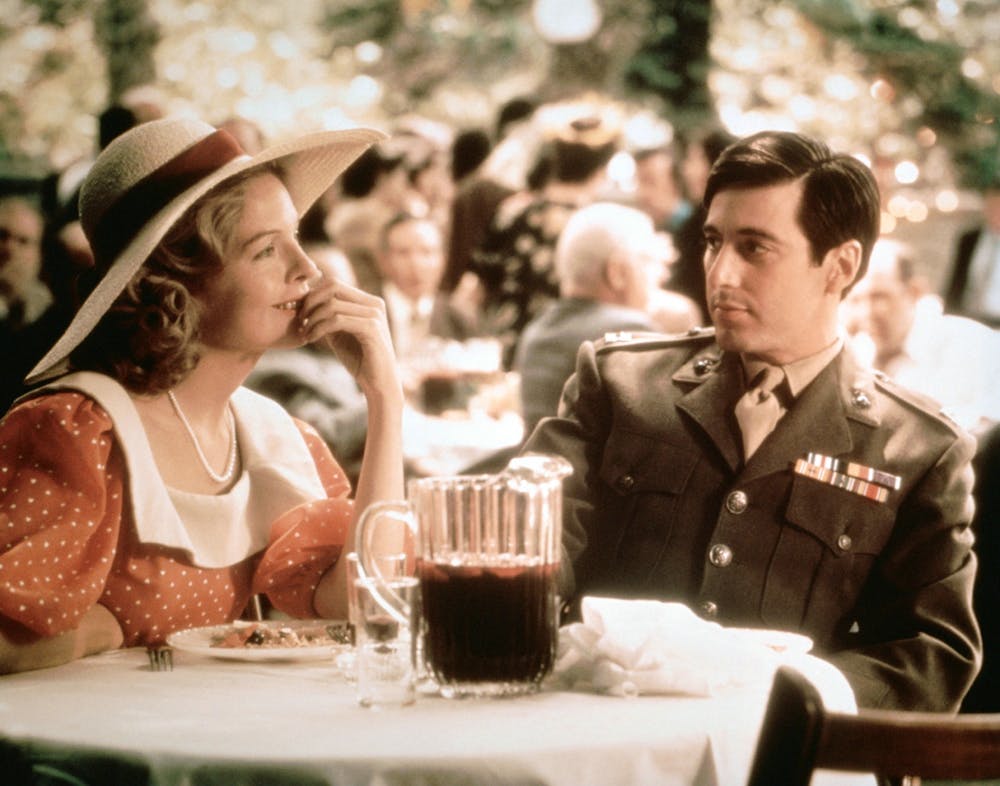
With easy money to be made, Mafia groups flourished[3]. This is the world where we find the Corleone family: Italian immigrants who sought a distorted vision of the American Dream through theft, extortion and violence.
Vito Corleone (Marlon Brando) wants to continue with the old ways. He is suspicious of this new trade in drugs offered by the Tattaglia crime family. His son Michael (Al Pacino) has experienced life outside of the Mafia world and wants to change the whole structure of the organisation, vowing to make the family legitimate.
What happens next is as much a statement on the character arc of Michael as it is about a statement of when The Godfather was made.
Read more: The great movie scenes: The Godfather[4]
A new war for a new generation
By 1972, the social and cultural norms had shifted dramatically.
People, especially young people, had grown increasingly suspicious and disenchanted[5] with both government and the institutions that had grown post war. While many saw the second world war as a “moral war”, they did not express the same feelings towards the Vietnam war. Many saw America as the immoral aggressor[6].
The 1960s had started out as a decade of hope, full of idealism. Young people were not happy with continuing the ways of the past and wanted change. They were leading the charge for the better.
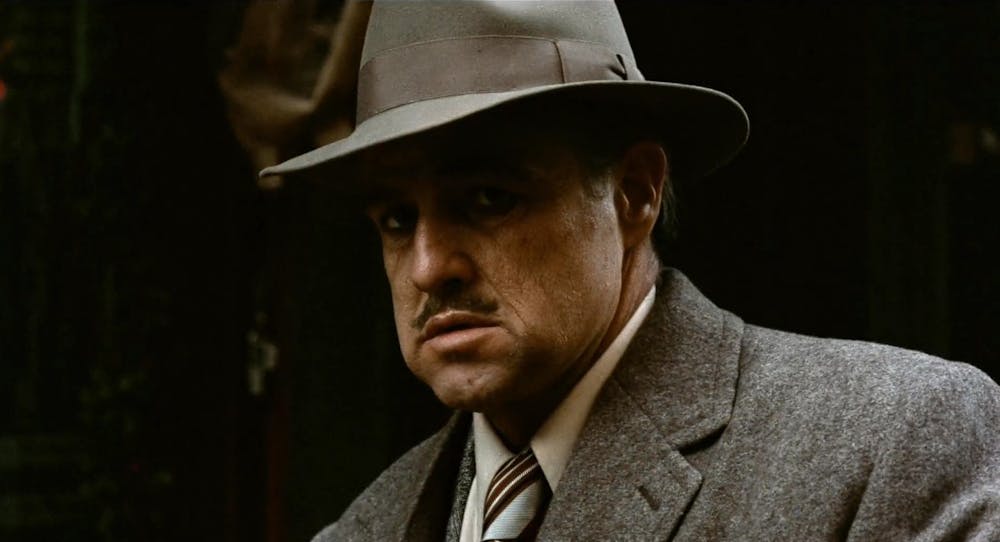 The Godfather is as much a story of the lost ideals of the 60s as it is the Mafia families of the 50s. Paramount Pictures
But in the 1970s, it was dawning on the Woodstock generation the values they had fought for were not coming to fruition. The ongoing Vietnam War, the publishing of the Pentagon papers[7] and the unravelling Watergate[8] all added to the disillusionment.
Despite the cries of revolution, the old institutions kept a strong grasp on the mechanisms of society.
This all becomes a metaphor for The Godfather.
Growing into pragmatism
The Godfather argues the principles of a generation are often corrupted by the realities of the times.
As with the the lost ideals of the 1960s, Michael is confronted with the pragmatism of running a criminal organisation. The Corleone’s could never be legitimate: the institutions of the past are just too powerful.
Like a big Italian opera, the film sways between personal loyalties, betrayals and consequent ruthless murders.
At the end of it all, Michael – a man of morals who desperately wants to transform the world into something better – falls back down the rabbit hole of the past. He takes over the family “business” and is forced to be more cunning and ruthless than even his father was.
The one figure who stood for light turns out to be the darkest of them all. There will be no change from the past.
The film’s ending is powerful but pessimistic. Early in the film, Michael tells his then girlfriend Kay (Diane Keating) he is going to change the whole way the organisation operated.
Now, Michael tells his wife Kay “don’t ask me about my business”. He closes the door on her as he takes his father’s chair.
In a way, Coppola was predicting the path of the next generation, and perhaps every young generation.
They all start with good intentions but practicalities often change ideals. The 1980s started as the era of anti-apartheid and Live Aid, but soon changed to “greed is good[9]”. The 1990s started with the fall of the Soviet Union and the confirmed belief in Western Democracy, but resulted in disillusioned grunge.
Will the youth movements of this era have any demonstrable impact in ten years time? Or, like Michael Corleone, will they have been turned by the power and authority of the traditional institutions?
Five decades later, The Godfather still remains an allegorical tale for the passing of power from one generation to the next. But perhaps the greatest lesson from the film is the old adage that unless you learn from the past you are doomed to repeat it. The past often makes an offer you can’t refuse.
Read more: Wall Street at 30: is greed still good?[10]
References
- ^ sense of optimism (www.inquiriesjournal.com)
- ^ an advanced consumer economy (www.economicsandpeace.org)
- ^ Mafia groups flourished (www.journals.uchicago.edu)
- ^ The great movie scenes: The Godfather (theconversation.com)
- ^ suspicious and disenchanted (notevenpast.org)
- ^ immoral aggressor (www.fff.org)
- ^ Pentagon papers (www.washingtonpost.com)
- ^ Watergate (www.vox.com)
- ^ greed is good (theconversation.com)
- ^ Wall Street at 30: is greed still good? (theconversation.com)