Western pharma companies should supply only essential medicines to Russia
- Written by: Alex Polyakov, Clinical Associate Professor, Faculty of Medicine, Dentistry & Health Sciences., The University of Melbourne
In response to Russia’s invasion of Ukraine and overwhelming destruction of property and loss of innocent lives, a number of western companies – from McDonalds to Apple[1] – stopped or severely limited their activities in the Russian Federation.
One glaring exception appears to be the majority of western pharmaceutical companies that continue to supply medicines and equipment.
There is growing political and consumer pressure on these companies to take steps to join the concerted efforts designed to pressure the Russian government to stop the war in Ukraine.
The counterargument[2] advanced by the companies continuing business in Russia revolves around the fact medicines are exempt from sanctions on humanitarian grounds.
However there is a way pharmaceutical companies could signal their disapproval to Russia, without risking the lives of ordinary Russian citizens.
Read more: What are sanctions, do they ever work – and could they stop Russia's invasion of Ukraine?[3]
Separate the people from Putin
Western countries that imposed crippling sanctions on the Russian economy are not technically at war with Russia. Therefore, unless directed by their governments as part of the sanctions regime, these companies have no legal barriers to continuing to supply medicines to Russia.
It is also true that any interruption in the supply of medicines will disproportionately affect the most disadvantaged members of the Russian society, while having minimal impact on the country’s elite and decision-makers.
Furthermore, one could legitimately argue the majority of the Russian people are not responsible for the decisions made at the top and should not suffer unjustly. It is also likely the current government of Russia may not be swayed by the suffering of its people and therefore any interruption of supply of medicines may create human misery without any appreciable gain.
Still, there is little doubt widespread abandonment of Russia by western companies will have a substantial impact on the Russian government, economy and population. Therefore, it is morally essential for western drug companies to take some concrete steps to participate in the effort to influence the Russian government as well as its people.
Read more: The power of tech giants has made them as influential as nations. Here's how they're sanctioning Russia[4]
Some pharma companies are withdrawing
A list of companies[5] that either withdrew, scaled back or continue to operate in Russia demonstrates the majority of pharmaceutical companies have either scaled back their involvement in the Russian economy or continue to operate at pre-war levels.
Those that scaled back have done so to a variable extent, in some instances only reducing their activity by a tokenistic amount, such as suspending advertising in Russia, delaying new investments or pausing clinical trial enrolments.
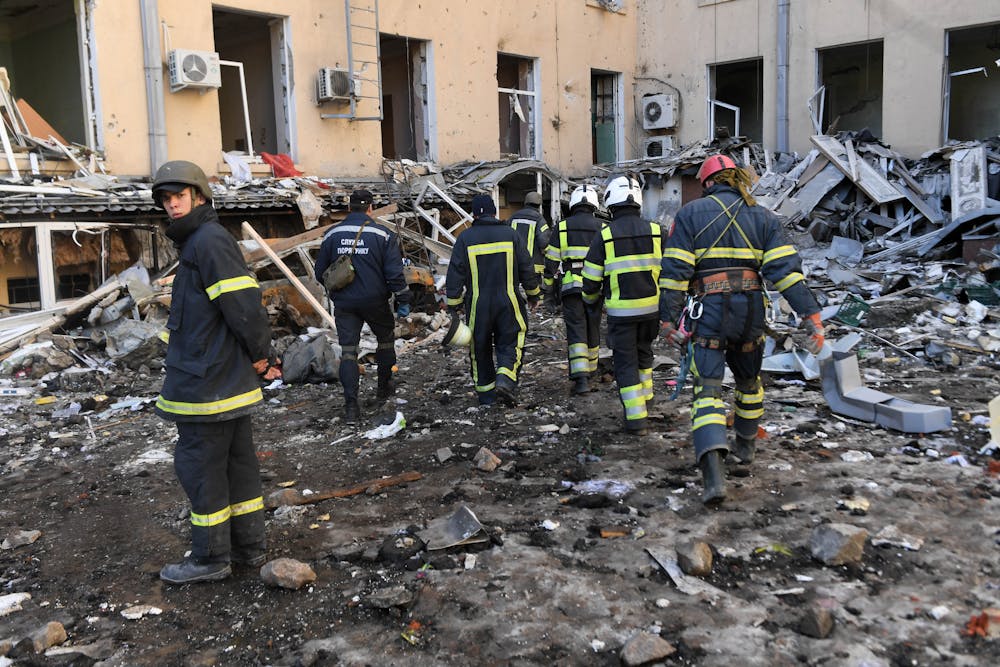
 Innocent Russian citizens should still have access to life saving medicines.
Yuri Kotchetkov/AAP[6]
Innocent Russian citizens should still have access to life saving medicines.
Yuri Kotchetkov/AAP[6]
These minimalistic measures are unlikely to have a meaningful impact and are likewise unlikely to be acceptable by the general public in the west or by activist shareholders. Some companies appear to have taken no steps to reduce their activities in Russia and appear at the very bottom of the list.
Western pharmaceutical companies must balance two conflicting considerations: they must provide life-saving medicines to avoid humanitarian disaster in Russia, and at the same time they must not appear to support in any way the humanitarian catastrophe currently taking place in Ukraine.
Read more: Can a martini stop Putin? How consumers and investors are imposing DIY sanctions on Russia[7]
What should pharmaceutical companies do?
It is a difficult line to tread, however there is a pragmatic compromise. Essential medicines, as defined by the World Health Organisation’s Expert Committee on Selection and Use of Essential Medicines[8], could continue to be supplied, with all other business ceasing.
Medicines on this essential list are defined as:
those that satisfy the priority health care needs of the population. They are intended to be available within the context of function health systems at all times, in adequate amounts, in the appropriate dosage forms, of assured quality and at prices that individuals and the community can afford.
This would include medicines for serious chronic illness, life-saving cancer drugs, antibiotics, antivirals, poison antidotes, and pain relief and anaesthetics.
Western pharmaceutical companies should only supply medicines in this list to Russia and suspend all other commercial activities including local manufacturing of medicines, advertising, clinical trials, scientific collaborations and infrastructure investments. Medicines not included on the essentials list should be withheld, which include drugs for non-life threatening complaints such as acne, erectile dysfunction, cosmetic medications and fertility drugs.
This action would be consistent with both their humanitarian obligations towards Russian patients and their obligations as global citizens.
Any profits derived from business activities in Russia could be considered tainted by the actions of the Russian government. Pharmaceutical companies that continue to supply essential medicines to the Russian market should consider donating profits generated by such transactions to established charities closely involved in managing the devastating humanitarian effects of Russia’s invasion of Ukraine, such as the UNICEF Ukraine Emergency Appeal[9].
References
- ^ from McDonalds to Apple (www.wsj.com)
- ^ counterargument (www.bmj.com)
- ^ What are sanctions, do they ever work – and could they stop Russia's invasion of Ukraine? (theconversation.com)
- ^ The power of tech giants has made them as influential as nations. Here's how they're sanctioning Russia (theconversation.com)
- ^ list of companies (som.yale.edu)
- ^ Yuri Kotchetkov/AAP (photos.aap.com.au)
- ^ Can a martini stop Putin? How consumers and investors are imposing DIY sanctions on Russia (theconversation.com)
- ^ Expert Committee on Selection and Use of Essential Medicines (www.who.int)
- ^ UNICEF Ukraine Emergency Appeal (www.unicef.org.au)