How Tolkien and Lord of the Rings inspired the commercial and artistic success of the fantasy fiction genre
- Written by: Helen Young, Lecturer, Deakin University
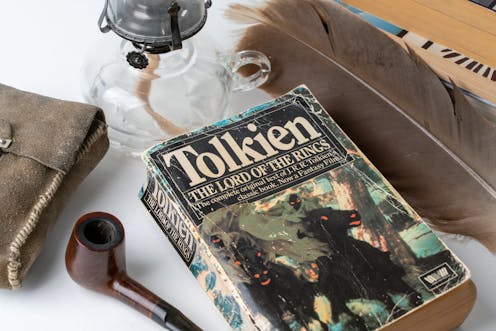
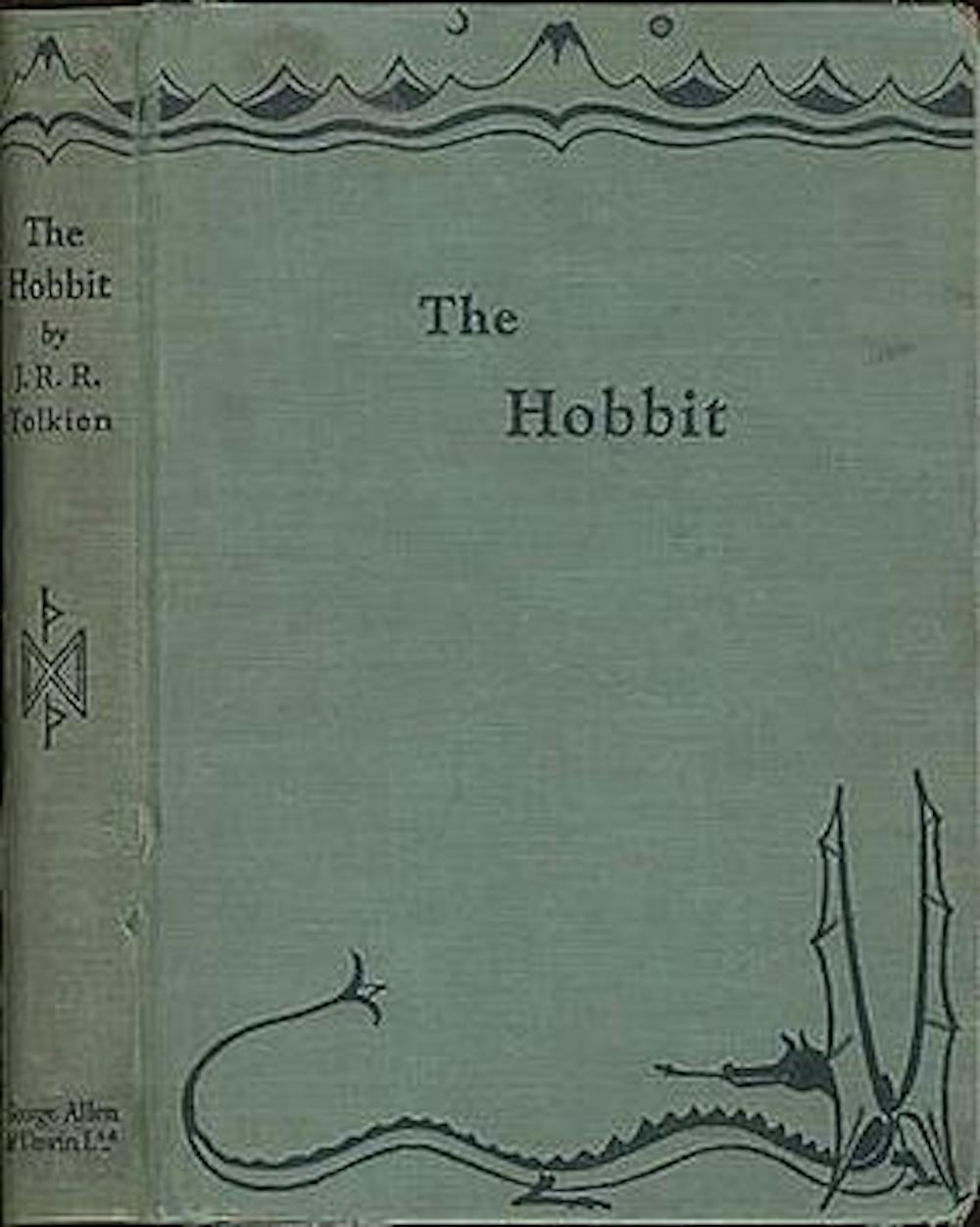
When Allen & Unwin requested a sequel to J.R.R. Tolkien’s first novel The Hobbit (1937)[1], they could not have known that it would be one of the best publishing decisions of the century, if not all time.
The Lord of the Rings has sold an enormous number of copies[2], and generated a vast and still-growing multimedia franchise, including the upcoming TV series The Rings of Power[3]. Tolkien’s work and ideas also inspired countless readers and authors and is at the root of contemporary fantasy’s commercial and artistic success.
All of this took time, even after the 15 year the publishers waited for their sequel. The Lord of the Rings sold well in its original hardback edition and was positively reviewed. The poet W. H. Auden called it a “masterpiece” and said that in parts it was better than John Milton’s canonical poem Paradise Lost.
It became an international publishing phenomenon in the 1960s, with cheap paperback editions, first with an unauthorised version from Ace Books and then licensed ones from Ballantine Books and Houghton Mifflin.
Sparking a genre
These paperback editions sparked the commercial fantasy genre. According to the late David G. Hartwell, a leading figure in US fantasy and science fiction publishing, what the 1970s reading public wanted was “not more fantasy but more Tolkien”.
That desire was fulfilled with books like Terry Brooks’ Shannara series and Stephen R. Donaldson’s The Chronicles of Thomas Covenant, as well as the role-playing game Dungeons & Dragons.
Familiar fantasy conventions, with their roots in The Lord of the Rings, were established through this “genre-fication” of fantasy publishing: multi-book series about good vs evil, a pseudo-medieval time, a vaguely European setting and white, usually male, protagonists. They still persist, as in George R. R. Martin’s A Song of Ice and Fire series[4] and The Witcher[5] franchise.
Contemporary fantasy is varied, has many sub-genres, and is often strikingly and deliberately different to The Lord of the Rings. Tolkien and his work are still a touchstone, however, particularly for so-called epic fantasy.
 John Ronald Reuel Tolkien CBE FRSL was an English writer, poet, philologist, and academic.
IMDB
John Ronald Reuel Tolkien CBE FRSL was an English writer, poet, philologist, and academic.
IMDB
George R. R. Martin has been dubbed the “American Tolkien,” and critic Laura Miller explored the fantasy of David Anthony Durham and N. K. Jemisin in an article titled “If Tolkien Were Black”. Steven Erikson, the bestselling author of The Malazan Book of the Fallen series called his fiction “post-Tolkien”.[6][7]
 Peter Jackson, who created the Lord of the Rings and Hobbit film franchises, with a copy of the original book.
Chris Pizzello/ AP
Peter Jackson, who created the Lord of the Rings and Hobbit film franchises, with a copy of the original book.
Chris Pizzello/ AP
The impact of Tolkien’s ideas of fantasy
Tolkien’s ideas about fantasy literature are influential far beyond books (and other media) that were inspired, even indirectly, by The Lord of the Rings.
The great American fantasy and science fiction author Ursula K. le Guin wrote that his essay On Fairy Stories[8] is “the best introductory guide I know to the domain of fantasy”. The ideas expressed in Tolkien’s essay validate fantasy as art and shape how many authors (and readers) understand what it means to write it.
For Tolkien, imagination and story-telling are central to being human. He wrote that “fantasy” is the purest and most “potent” kind of art because it requires subcreation of a “secondary world”. A secondary world is a different world to reality, and has “inner consistency” obeying its own rules.
If there is any one thing that the great variety of fantasy works have in common, it is that they need imagination, even if not taking place in what Tolkien would have called a secondary world. Even urban fantasy, like Neil Gaiman’s novels[9], where magic and mythological beings exist in a world like our reality, involves creation of a world that differs meaningfully from our own.
“Subcreation” is the author’s process of imagining and building a secondary world and the story (or stories) that take place in it.
Tolkien, a devout Christian, thought of this process as being an emulation of what he believed was God’s creation. Many fantasy authors don’t share his religious beliefs of course, but the notion of making a new world is a powerful one that gives a framework for the artistic, literary endeavour of writing in a genre that is sometimes dismissed as juvenile, repetitive and unimportant.
For Tolkien, human subcreation differed from God’s creation because humans had to work with what already existed, recombining elements to create the new world. One example of this sort of re-combination he used was imagining a world with a sun that is green, rather than the bright white of the real sun.
Even more important, for him, is dipping into what he called the “cauldron of story”, a hypothetical pot of soup where every major story ever told bubbles together for the author to draw ingredients from.
Elements of folk and fairy tales, mythologies and mythical figures like King Arthur, are familiar features in fantasy, all taken from the cauldron of story.
Lord of the Rings though the ages
Exact sales figures[10] for The Lord of the Rings are impossible to get because it’s been sold in separate volumes as well as a single edition of all three books, and the many translations.
It is nonetheless clearly one of the best-selling books of all time with estimates putting sales at more than 150 million, and copies of The Hobbit at more than 100 million copies.
Peter Jackson’s film franchise has raked in more than US $5.8 billion[11]. This puts it in the top 15 franchises of all time.
Still, Tolkien’s fiction and ideas have a contested and troubling legacy. The Lord of the Rings’ impact was partly due to it being taken up by 1960s hippie counter-culture[12], but it is also a favourite text of neo-Nazis[13], who embraced the fantasy depictions of race within the texts.
Fantasy, along with science fiction, has been a battle ground in the culture wars for more than a decade. The bitter reaction of some fans[14] to casting actors of colour in Amazon’s The Lord of the Rings: The Rings of Power series shows that the “racialised” history of the series [15]continues in the present. Such reactions have been “debunked”, and were resisted by other fans.
Discussions like this abound in modern criticism of Tolkien’s work - but they are only part of his legacy. It is Tolkien’s insight into the nature of fantasy itself and the way it demands that we imagine and desire a new world, that defines his work.
References
- ^ The Hobbit (1937) (www.booktopia.com.au)
- ^ sold an enormous number of copies (publishingperspectives.com)
- ^ The Rings of Power (www.imdb.com)
- ^ A Song of Ice and Fire series (www.goodreads.com)
- ^ The Witcher (en.wikipedia.org)
- ^ “If Tolkien Were Black” (www.salon.com)
- ^ “post-Tolkien”. (www.fantastic-arts.org)
- ^ On Fairy Stories (www.harpercollins.com.au)
- ^ Neil Gaiman’s novels (www.neilgaiman.com)
- ^ Exact sales figures (www.theguardian.com)
- ^ more than US $5.8 billion (www.the-numbers.com)
- ^ 1960s hippie counter-culture (www.bbc.com)
- ^ favourite text of neo-Nazis (psmag.com)
- ^ bitter reaction of some fans (www.theguardian.com)
- ^ “racialised” history of the series (theconversation.com)