Google AI
The Times Australia
The Times World News

.

PEFO tells us Morrison has abandoned some secret promises, but his books are in order

  • Written by Stephen Bartos, Professor of Economics, University of Canberra
PEFO tells us Morrison has abandoned some secret promises, but his books are in order

Before each federal election, the heads of the Commonwealth departments of treasury and finance release a report on the state of the government’s budget, together with updated economic forecasts.

It is known as the pre-election fiscal and economic update, or PEFO.

The 2022 PEFO came out on Wednesday afternoon[1].

The Charter of Budget Honesty Act 1998[2] requires publication of a PEFO “within 10 days of the issue of the writ for a general election”.

This year’s was easy for Treasury and Finance to compile. PEFO came a bare three weeks after the budget on March 29, and not a lot had changed.

The economic forecasts are identical. Treasury would have heaved a large sigh of relief when last week’s unemployment numbers came out unchanged[3] at about 4%.

Unemployment forecast like budget’s

If they had come out significantly lower, Treasury would have had to update not only the economic forecasts but also revenue and spending forward estimates.

The unemployment rate affects both income tax and welfare spending. In PEFO the forecast is the same as at budget time, so no recalculations are required.

Yes, the economic outlook is volatile – but it is the same volatility as at budget time. It does not provide a reason for changing the forecasts.

There are a few small adjustments to spending. They net out at almost nothing. The estimated deficit in 2022-23 is $77.9 billion, close to the budget’s $78.0 billion.

Secret spending that never was

New spending since the budget includes some infrastructure projects and community development grants (unsurprisingly, prior to an election) but no significant new programs.

A mystery in this PEFO is the removal of provisions for some secret decisions taken but not yet announced[4]. Reversing those decisions amounts to a saving, which has been used to offset some new spending.

Decisions taken but not yet announced have become so common that this year PEFO refers to them by their own unlovely acronym: DTBNYAs.

They are recorded in Appendix B as “Across Portfolio. Various Agencies. Reversal of measures reported as a decision taken but not yet announced in prior rounds”.
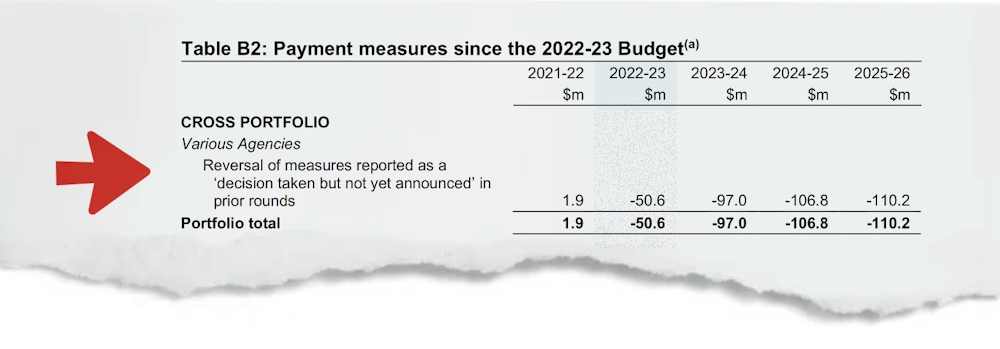
Pre-election Economic and Fiscal Outlook, Appendix B[5] They amount to $50.6 million in 2022-23, climbing to $110.2 million in 2025-26. What were these decisions? We don’t know. They weren’t announced. We do know the government has had second thoughts and reversed them. Second thoughts It might have been because the needs the measures were designed to meet have changed, which would be a sensible and rational reason for their reversal. Or it might have been because they were foolish and misguided decisions, meaning someone put a pencil through them to save the government embarrassment. We can’t tell. Either way, it is not a great look for budget transparency. Read more: Labor's budget reply goes big on aged care, similar on much else[6] This is not the same as the separate provision in the contingency reserve for items that cannot be disclosed for commercial or national security reasons. Often, these relate to procurement negotiations still underway – including, as noted in PEFO, the Australian Electoral Commission’s information technology modernisation program. There is a good argument that the amount of money the government is willing to pay to a private provider should not become public until negotiations are over. That’s normal, and the 2022 PEFO continues the practice. PEFO is an opportunity to speak the truth PEFO is written by the secretaries of the departments of finance and treasury rather than their political masters, meaning they are about the only time the secretaries can speak freely. Sometimes, the small details they include give an insight into what they are thinking. In 2016, for example, the media identified an inclination on the part of the departmental heads to push harder than the government[7] in cutting spending. It is a concern that seems quaint now. A return to surplus is a distant prospect. So if PEFO is essentially the same as the budget, do we need it? The answer is yes. It makes budgets and elections more honest For a start, it makes the budget or budget update that precedes it more honest. If ministers know that the top budgetary officials will soon release an independent report, they will be less inclined to interfere with budget forecasts or invent over-optimistic numbers, knowing they will be found out in PEFO. Even more important, it means election promises are more likely to be kept. Before PEFO was introduced in 1998, when a government changed hands it was routine for the newly-elected government to renege on its promises by saying something along the lines of: …we are shocked, just shocked! We had no idea how bad the country’s finances were! PEFO has done away with that excuse forever. It means both sides of politics know the state of the books going into the election. Parties’ promises are made with that full knowledge. Incoming governments no longer have a budgetary policy excuse for dropping their promises. For that reason alone, PEFO is worth keeping. References^ Wednesday afternoon (treasury.gov.au)^ Charter of Budget Honesty Act 1998 (www.legislation.gov.au)^ unchanged (theconversation.com)^ taken but not yet announced (www.aph.gov.au)^ Pre-election Economic and Fiscal Outlook, Appendix B (treasury.gov.au)^ Labor's budget reply goes big on aged care, similar on much else (theconversation.com)^ harder than the government (www.theage.com.au)

Read more https://theconversation.com/pefo-tells-us-morrison-has-abandoned-some-secret-promises-but-his-books-are-in-order-181538

Times Magazine

CRO Tech Stack: A Technical Guide to Conversion Rate Optimization Tools

The fascinating thing is that the value of this website lies in the fact that creating a high-cali...

How Decentralised Applications Are Reshaping Enterprise Software in Australia

Australian businesses are experiencing a quiet revolution in how they manage data, execute agreeme...

Bambu Lab P2S 3D Printer Review: High-End Performance Meets Everyday Usability

After a full month of hands-on testing, the Bambu Lab P2S 3D printer has proven itself to be one...

Nearly Half of Disadvantaged Australian Schools Run Libraries on Less Than $1000 a Year

A new national snapshot from Dymocks Children’s Charities reveals outdated books, no librarians ...

Growing EV popularity is leading to queues at fast chargers. Could a kerbside charger network help?

The war on Iran has made crystal clear how shaky our reliance on fossil fuels is. It’s no surpri...

TRUCKIES UNDER THE PUMP AS FUEL PRICES BECOME TWO THIRDS OF OPERATING COSTS FOR SOME BUSINESS OWNERS

As Australia’s fuel crisis continues, truck drivers across the nation are being hit hard despite t...

The Times Features

Mortgage Stress – it is happening. Here is what is driv…

Mortgage stress is no longer a fringe issue confined to a small group of overextended borrowers...

Mortgage Lending in Australia: Brokers vs Banks — Trust…

For most Australians, taking out a mortgage is the single largest financial decision they will e...

Building Costs in Australia: Permits, Taxes, Contributi…

Australia’s housing debate is often framed around supply and demand, interest rates, and populat...

Airfares: What the Iran Disarmament Campaign Means for …

For Australians planning their next interstate getaway or long-awaited overseas holiday, the cos...

Interest-free loans needed for agriculture amid fuel cr…

The Albanese Government should release the details of its plan to provide interest-free loans to b...

Next stage of works to modernise Port of Devonport

TasPorts is progressing the next stage of its QuayLink program at the Port of Devonport, with up...

‘Cuddle therapy’ sounds like what we all need right now…

Cuddle therapy is having a moment[1]. The idea for this emerging therapy is for you to book in...

The Decentralized DJ: How Play House is Rewriting the M…

The traditional music industry model is currently facing its most significant challenge since the ...

What Australians Use YouTube For

In Australia, YouTube is no longer just a video platform—it is infrastructure. It entertains, e...