war, social media and the urgent need to update how we teach English
- Written by: Lucinda McKnight, Senior Lecturer in Pedagogy and Curriculum, Deakin University
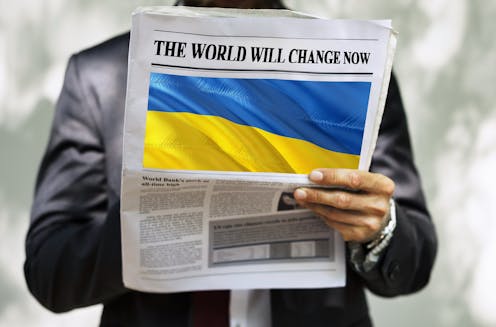
The war in Ukraine is being described as the first social media war, even as “the TikTok war[1]”. Memes, tweets, videos and blog posts communicate both vital information and propaganda, potentially changing the course of history. This highlights the importance of agile and critical social media use.
English in schools, in contrast, still focuses on reading books and writing exam essays. Despite mentions of media[2] in the Australian Curriculum for English, the study of digital writing via social media is not prioritised in senior assessment or national high-stakes testing. This approach seems increasingly out of touch with modern communication.
Meme-ification[3] is a feature of media coverage of the Ukraine war. This new word describes the explosion of ordinary people creating shareable, and potentially influential, digital content.
Anyone with a smartphone and internet access can participate in a war that is being fought both on the ground and on digital platforms. And this content frequently references other popular digital culture. For example, Ukrainian President Volodymyr Zelenskyy is portrayed as Captain Ukraine[4] by photoshopping his head onto Marvel’s Captain America’s body and tweeting this image.
Read more: Guns, tanks and Twitter: how Russia and Ukraine are using social media as the war drags on[5]
English education for our age
This “writing” contributes to narratives and debates about heroism, military morale, fan fiction and US cultural imperialism. This kind of immediate, vibrant and global communication needs to be the basis of study in English.
The ability to critically consume and strategically create social media is vital to the health of democracies. Yet writing for social media posts and powerful platforms such as Twitter, TikTok and Facebook is not central to how we teach English.
Students need to be able to create memes, write rolling news blogs and produce digital news podcasts, all for networked audiences. They need to determine aims, invent concepts, manipulate images, combine different media, compose compelling text and respect copyright law. This is impactful and purposeful writing to achieve influence in the world.
Research initiatives such as the Digital Self Portrait project[6] demonstrate how students can create vivid new forms of “writing” that explore tensions between their own digitally rich lives and traditional literacies.
Digital writing is often collaborative, and a recent Australian Education Research Organisation review[7] recommends more collaborative writing in classrooms. Community organisations such as Write4Change[8] are making this possible by connecting youth to write together using digital media via private, communal and moderated sites on mainstream platforms.
Read more: In an age of digital disinformation, dropping level 1 media studies in NZ high schools is a big mistake[9]
Our approach is outdated
Yet education’s high-stakes assessment regimes don’t value these forms of writing. Sadly, the National Assessment Program – Literacy and Numeracy (NAPLAN) has narrowed the kinds of writing[10] taught in schools even further. One sample NAPLAN writing task[11] says, basically, “Here is a picture of a box. Write a story about it.”
This approach needs to change so students are practising the forms of writing and communication that are meaningful in today’s world. This will support citizens of the future to participate fully in workplaces and, most importantly, in democracies.
The Australian government, through the Australian Research Council, has recognised this and funded a new study into the importance of contemporary writing in education. This is through a Discovery Early Career Research Award[12] (DECRA) titled Teaching digital writing in secondary English[13]. This project will explore how teachers can conceptualise and enact the teaching of real-world writing.
Read more: How well does the new Australian Curriculum prepare young people for climate change?[14]
It’s not a choice of classics or digital writing
Of course, studying the classics remains important, as does mastering basic skills. Zelenskyy himself quoted Hamlet in a recent address to the British parliament[15]. So this is not an either/or situation, but what digital writing expert Professor Troy Hicks calls “both/and[16]”. We can study both Hamlet as a play and how other media quote its main character in powerful ways.
Students can themselves explore making strategic literary references in their own social media posts and interventions. The study of rhetoric (argument and persuasion) and aesthetics (cultural value) needs to include diverse media for contemporary relevance.
Human conflicts, projects, imaginings and achievements are now happening in new forms. The devastating theatre of war playing out in Ukraine and online has offered “a masterclass in message[17]”.
If a key aim of Australia’s compulsory literacy education is to “create confident communicators, imaginative thinkers and informed citizens[18]” then students need to learn to communicate in the modes of contemporary society. They need to enjoy the engagement and learning that comes from participating in genuinely important dialogues and situations, even if just in protected classroom and school-based versions of these.
Social media use potentially both threatens and supports democracy. Yet media education remains devalued in the English curriculum and classroom, largely in favour of reproducing print literature forms and essays.
It is time for English to join the 21st century and embrace all the diverse and digital means of communication that are part of our lives today. Our freedom and futures depend on it.
References
- ^ the TikTok war (www.theguardian.com)
- ^ mentions of media (link.springer.com)
- ^ Meme-ification (www.vice.com)
- ^ Captain Ukraine (www.insidehook.com)
- ^ Guns, tanks and Twitter: how Russia and Ukraine are using social media as the war drags on (theconversation.com)
- ^ Digital Self Portrait project (files.eric.ed.gov)
- ^ Australian Education Research Organisation review (www.edresearch.edu.au)
- ^ Write4Change (www.write4change.org)
- ^ In an age of digital disinformation, dropping level 1 media studies in NZ high schools is a big mistake (theconversation.com)
- ^ narrowed the kinds of writing (naplanreview.com.au)
- ^ sample NAPLAN writing task (nap.edu.au)
- ^ Discovery Early Career Research Award (www.arc.gov.au)
- ^ Teaching digital writing in secondary English (teachingdigitalwriting.wordpress.com)
- ^ How well does the new Australian Curriculum prepare young people for climate change? (theconversation.com)
- ^ address to the British parliament (www.nytimes.com)
- ^ both/and (hickstro.org)
- ^ a masterclass in message (www.theguardian.com)
- ^ create confident communicators, imaginative thinkers and informed citizens (www.australiancurriculum.edu.au)