Local newspapers are vital for disadvantaged communities, but they're struggling too
- Written by: Kristy Hess, Professor (Communication), Deakin University

As residents in the small Victorian city of Portland voiced concerns about the loss of vital healthcare services in their area, the local newspaper – The Portland Observer[1] – was there to cover the story. It produced a series of reports highlighting the impact on residents (including a baby being born in a carpark[2]), eventually attracting broader media attention[3] and putting pressure on politicians to act.
This is just one example of how rural and regional newspapers can play an important role[4] in serving their communities.
Small, local newspapers can campaign and advocate on key issues such as roads, telecommunications infrastructure, or improved mental health services. In many ways, they are an essential service for rural communities.
But the future of rural newspapers[5] is uncertain. Advertising revenue is declining and they face tough competition from tech giants. Several closed their doors during the pandemic, leaving many areas without local news services.
Read more: Print isn't dead: major survey reveals local newspapers vastly preferred over Google among country news consumers[6]
An uncertain future
Portland, in the Glenelg Shire Council, is in the bottom third of the list of Australia’s disadvantaged local government areas[7]. Across Australia, the top ten regions for socio-economic disadvantage[8] are based in rural and regional areas. This means local newspapers are especially important in such communities.
Our research team[9] examined the future of local, independently owned newspapers across country Australia. Of the 180 newspapers across the Country Press Australia[10] network, a considerable proportion serve disadvantaged populations.
Other areas, such as the mining town of Lightning Ridge in the Walgett shire (ranked 39 in the Australian Bureau of Statistics’[11] disadvantaged local government area list) have no local newspaper, and rely on an intermittent Facebook page. Research[12] reveals local residents here feel they lack important information about civic, social and political affairs.
The role of local media in rural and regional areas is especially highlighted in times of hardship, such as during floods or drought.
When disaster strikes, local newspapers can promote community cohesion and resilience. A local printed newspaper is especially important in areas with poor digital connectivity[13] (in other words, much of rural Australia).
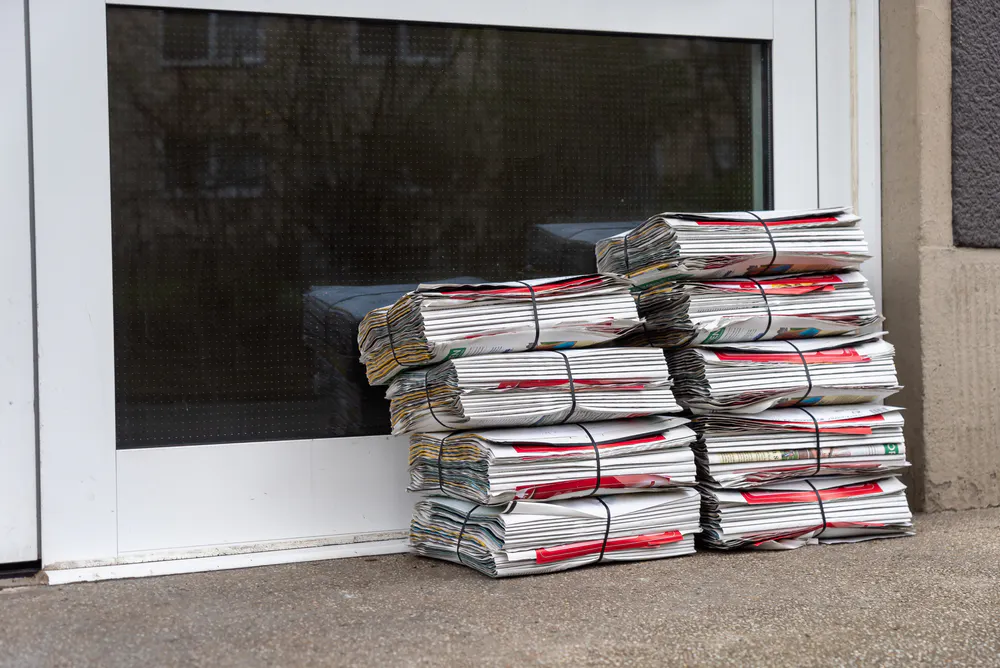
 A local printed newspaper is especially important in areas with poor digital connectivity.
Shutterstock
A local printed newspaper is especially important in areas with poor digital connectivity.
Shutterstock
It takes time, effort and money
Of course, local media can also generate inequalities[14]. They can end up ignoring marginalised voices and privileging the powerful.
But here, we argue, the benefits of independent public interest journalism in local communities outweigh the negatives when it comes to spotlighting issues about disadvantage. They are, despite their imperfections, a fundamental essential service for disadvantaged rural and regional areas.
Practicing local journalism, however, takes time, effort and money. Many newsrooms operate, as one small newspaper proprietor put it, “on the smell of an oily rag”.
Our research[15] has looked at some of the sector’s structural issues especially, in an effort to find ways to maintain or improve resources for rural media.
This has included, for example:
stemming loss of revenue from local, state and federal government advertising spend, which has been redirected to social media
alternative business models
collaboration
drawing more on community contributed content.
Read more: The government's regional media bailout doesn't go far enough — here are reforms we really need[16]
A role for government
Victorian Premier Daniel Andrews recently announced[17] an election pledge to guarantee his government would pay for a full-page public notice “every single week in every single regional newspaper”. This move, he said, would “bring some certainty to your business model”.
Subject to ironing out the finer details, this is an important and necessary step to securing the future of local news. The Victorian government recognises the importance of this type of expenditure more than any other government in the country, according to the latest government inquiry[18].
A further challenge is to prioritise support for small independent media in the country’s most disadvantaged areas, where the commercial advertising dollar is arguably scarce.
In recent years, two rounds of federal government funding packages[19] have been open to media outlets to apply for help, employ new journalists and purchase digital equipment or online services.
However, new start-ups did not qualify for the funding, even when they play a vital role in keeping communities informed in the interests of democracy.
Any public money granted to private media entities must benefit community, so any rural and regional newspapers receiving government funding will need to be monitored. With the right policy settings, we can support them to ensure they are producing quality, local, public interest journalism that represents their diverse communities.
References
- ^ The Portland Observer (spec.com.au)
- ^ baby being born in a carpark (spec.com.au)
- ^ broader media attention (www.theage.com.au)
- ^ important role (www.google.com.au)
- ^ future of rural newspapers (www.aph.gov.au)
- ^ Print isn't dead: major survey reveals local newspapers vastly preferred over Google among country news consumers (theconversation.com)
- ^ disadvantaged local government areas (www.abs.gov.au)
- ^ top ten regions for socio-economic disadvantage (www.abs.gov.au)
- ^ research team (www.localnewsinnovation.org)
- ^ Country Press Australia (countrypressaustralia.com.au)
- ^ Australian Bureau of Statistics’ (www.abs.gov.au)
- ^ Research (search.informit.org)
- ^ digital connectivity (www.abc.net.au)
- ^ inequalities (firstnationsmedia.org.au)
- ^ Our research (www.localnewsinnovation.org)
- ^ The government's regional media bailout doesn't go far enough — here are reforms we really need (theconversation.com)
- ^ announced (www.danandrews.com.au)
- ^ according to the latest government inquiry (www.aph.gov.au)
- ^ federal government funding packages (www.infrastructure.gov.au)