The Liberals are the fifth iteration of Australia's main centre-right party. Could the Voice campaign hasten a sixth?
- Written by: Chris Wallace, Professor, School of Politics Economics & Society, Faculty of Business Government & Law, University of Canberra
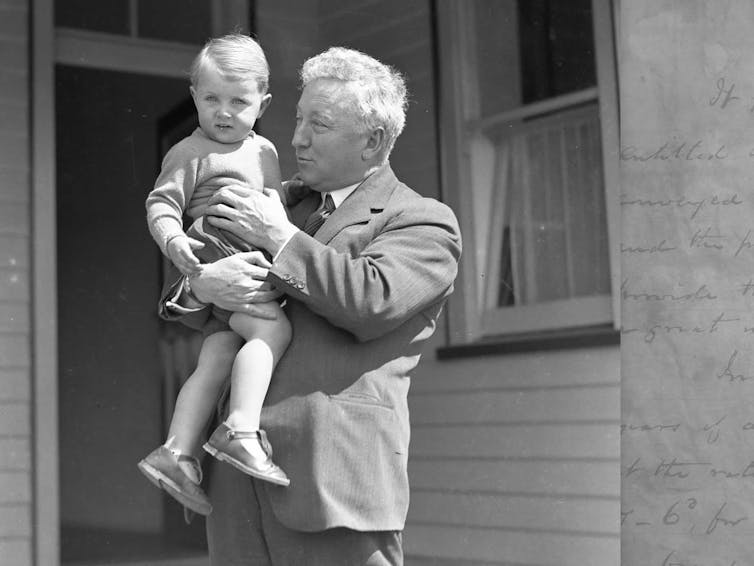
Party stability on the progressive side of politics, and repeated party reconfiguration on the conservative side of politics, is a marked contrast in the history of Australia’s two-party political system.
That history is relevant now, as the Liberals find themselves in the electoral wilderness, and as a schism emerges over its stance on the referendum for an Indigenous Voice to the Australian parliament.
It raises a legitimate question about whether, as has happened several times in the past, the Liberal Party might be superseded by a new vehicle that better represents mainstream liberal and conservative voters’ interests and provides a viable electoral alternative to Labor.
A party of many iterations
In contrast to the Australian Labor Party, which predates Federation in 1901 and has existed continuously since, the Liberal Party was formed in 1944 and formally launched in 1945. It is the fifth iteration of the main vehicles through which the centre-right has sought federal parliamentary representation.
Federally, the Liberal Party’s genealogy is:
Protectionist Party, Free Trade Party (1901-1909)
Commonwealth Liberal Party (1909-1917)
Nationalist Party (1917-1931)
United Australia Party (1931-1945)
Liberal Party (1945+).
The earliest parliaments were dominated by, as Alfred Deakin famously dubbed them[1], “the three elevens” – because it was like having three cricket teams play the same match. They were the Deakin-led Protectionist Party, the Free Trade Party (later renamed the Anti-Socialist Party) and the Labor Party.
In 1909 the Protectionist Party and Anti-Socialist Party united to create the Commonwealth Liberal Party to compete with Labor, ushering in the “two party” era.
The next two iterations saw the main anti-Labor party unite, from opposition, with Labor breakaways to form a new party.
In 1917, the opposition Commonwealth Liberals merged with Billy Hughes’ breakaway National Labor Party to form the Nationalist Party, which held office under the prime ministership of Hughes and later Stanley Melbourne Bruce.
In 1931, the Nationalist Party opposition and Labor defector Joseph Lyons and his allies joined to form the United Australia Party (UAP). This was the vehicle for Lyons’ prime ministership and, on his death, Robert Menzies’ first prime ministership.
The UAP became increasingly dysfunctional after Lyons’ death. Menzies proved a poor war-time prime minister, was unpopular with colleagues, and resigned as prime minister in 1941. The coalition UAP-Country Party government of Arthur Fadden fell several weeks later after losing a confidence motion on the floor of parliament, succeeded by the Curtin Labor government.
Labor’s landslide 1943 election win finished the UAP as a political force. The party’s primary vote slumped to 21.9% and it won just 14 of the federal parliament’s then 74 seats.
Menzies drove the Liberal Party’s foundation as a fresh start for centre-right politics in Australia.
His insight that the UAP was terminal was partly driven by the large amount of political activity that sprang up from centre-right forces outside the party’s bounds. This included a large number of independent anti-Labor candidates running at the 1943 election.
The upsurge in centrist community independent candidates – notably the Teals ¬– running at the 2022 federal election is a striking parallel.
Read more: The Liberal Party is in a dire state across Australia right now. That should worry us all[3]
Could the Liberal Party be reborn again?
Forming a new political party is a drastic move. The calculus on whether an existing party is still viable and can be renewed, or whether, as Menzies judged with the UAP, it is too far gone and needs to replaced, is a delicate one.
Former prime minister and Liberal leader John Howard declared after the 2022 election that “we have to hold ourselves together[4]”, arguing Peter Dutton was the right man for the job.
Holding the Liberal Party together has since become established as the benchmark for Dutton’s success or failure as opposition leader. This is either a low bar or it’s a sign that the Liberal Party is indeed at risk of breaking apart.
These tensions date from the early 1980s under Howard’s aegis, when the conservative push to crush moderate viewpoints began in earnest.
Howard and conservative Liberal leadership successors since demanded the selling out of principled centrist policy positions as the price of moderates’ inclusion in cabinet and shadow cabinet.
Liberal moderates persistently paid that price in exchange for ministerial advancement. This in turn hastened the Liberals’ lurch to the right. The party become less and less reflective of mainstream Australia even as some visible moderates survived and rose through the ministerial ranks.
Women especially feel unwelcome in the party. The bullying of MP Julia Banks and her subsequent resignation from the Liberals in 2018 became emblematic of the party’s toxic masculinity problem.
Former prime minister Scott Morrison’s misogynistic handling of sexual violence allegations concerning Liberal Party figures followed. Female voters remember this in the ballot box.
The pervasiveness of evangelical Christians and conservative Catholics in the branch membership combined with, under the influence of Sky News “After Dark” programming, US Republican-style fringe interests and agendas, are alienating people who in other eras could or would have been branch members. There seems to be little space now for moderate Liberals.
People trying to improve things quietly from the inside are frustrated by the hardened factionalism and capture of key party organs by warring right-wing factions. There are too few mainstream people to coalesce with to drag the party back towards the centre.
Combined with the demographic changes noted by Redbridge analysts Kos Samaras and Tony Barry after the Liberals’ poor showing at the Victorian state election and federal Aston by-election, the picture for the party looks bleak.
As well as losing support among women, the Liberals have lost it among young people, Samaras and Barry note. This is compounded, they say, by young people now not becoming conservative as they age: those who once would have developed into Liberal voters simply aren’t doing so.
Read more: Will a preoccupation with party unity destroy the Liberal Party?[5]
The Teals who won traditional blue riband Liberal seats in Sydney, Melbourne and Perth at the 2022 election are essentially moderate Liberals sitting on the crossbench, because sensible centrists are repellent to, and repelled by, the Liberal Party in its current state.
The entropy is gathering pace.
Less than a year ago, Indigenous MP Ken Wyatt was a Liberal cabinet minister before losing his seat at the 2022 election. In April this year, Wyatt resigned from the party in frustration over the Liberals’ opposition to the Indigenous Voice to Parliament, the co-design of which he himself commissioned and took to cabinet in the expectation of support. He was disappointed.
The resignation of the Dutton opposition’s Indigenous affairs spokesperson, Julian Leeser – a Voice supporter like Wyatt and a significant number of other Liberals – breaks the pattern of moderates selling their soul for career advancement. While admirable, there’s a lot less to lose taking a principled stand like this in opposition than government, but it’s a start.
Now Voice-supporting Liberals are forming WhatsApp groups[6] to co-ordinate their actions in the “yes” campaign. This will likely bring them into campaigning contact with centrist Teals in those traditional blue riband seats the Liberals lost at the 2022 election.
Could that create a chemistry that spurs development of the Liberal Party’s next iteration?
Who knows? But remnant centrists inside the Liberals finding common cause with Teals and their allies outside it, campaigning if not together then at least in close proximity around a galvanising issue of national importance, does make it more rather than less likely.
Opposition Leader Peter Dutton’s defensive posture of just appealing to “the base’” and trying to hold the Liberals together may prove the losing gambit in this fifth iteration of Australia’s main party of the centre-right. As Dutton would know from sport, purely playing defence rarely wins the game.
References
- ^ famously dubbed them (electionspeeches.moadoph.gov.au)
- ^ Stanley Heritage Walk (www.stanleyheritagewalk.com.au)
- ^ The Liberal Party is in a dire state across Australia right now. That should worry us all (theconversation.com)
- ^ we have to hold ourselves together (youtu.be)
- ^ Will a preoccupation with party unity destroy the Liberal Party? (theconversation.com)
- ^ Voice-supporting Liberals are forming WhatsApp groups (www.smh.com.au)