how do the Voice to Parliament ads try to influence voters? And is it effective?
- Written by: Tom van Laer, Associate Professor of Narratology, University of Sydney
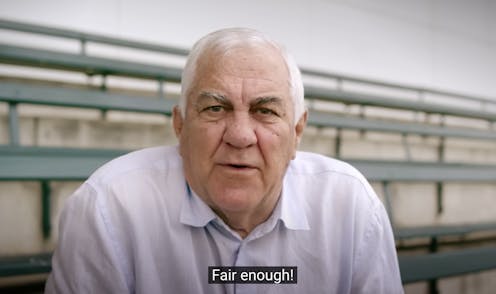
Political advertising for the Voice campaign is ramping up, particularly on social media. So, who is the target audience for each campaign’s ad, what are their key messages, and how effective will they be?
We research how people and organisations use stories to affect change through political advertising or entertainment. We looked at the different ads that have been released so far – by two groups campaigning for “no” and two groups campaigning for “yes” – to see how effective their communication strategies have been.
Advance Australia: fear
Some of the ads released by Advance Australia[1], a conservative political lobbying group, focus attention on prominent “yes” campaigners like Teela Reid and Thomas Mayo:
Advance Australia ad.These ads aim to make us link Mayo, Reid and, by extension, the “yes” campaign itself with a sense of fear. Ominous music and fat-lettered words like “Rulebook,” “Force” and “Powerful” try to elicit fear of what the other camp would do if the Voice came to be.
Research on the use of fear[2] in negative political communication shows it to be effective in influencing people. Fear is an intense, powerful emotion that encourages passivity – we tend to prefer the status quo if we are afraid. Such a response is seldom reasoned, which can make it difficult to counter in advertising.
The ad above seems to be directed at undecided voters in an effort to harden attitudes against the Voice and encourage them to vote “no”.
Read more: The campaign pamphlets for the Voice don't offer new perspectives. Do they still serve a purpose?[3]
Blak Sovereign Movement: a different argument
The Blak Sovereign Movement[4], which advocates for sovereignty for First Nations people, relies on arguments as a means of persuading voters.
The group wants to persuade Australian voters to vote against the Voice, underpinned by three key premises:
First Nations people have not given free, prior, informed consent to hold a referendum on the Voice
First Nations people have never surrendered sovereignty
First Nations people do not want constitutional recognition without a treaty.
The argument follows a “bottom-up” structure. This means it starts with a specific statement idea (to hold a Voice referendum, Australia needs consent from First Nations people), and from this, a more general, logical conclusion is derived (that it is better to have a treaty first).
Arguments are effective when voters are well-informed and highly motivated. Whether or not this argument resonates with voters depends in part on whether they believe the premise – that a treaty can happen before a Voice.
The Uluru Dialogue: anticipated pride
The Uluru Dialogue[5] is a group of First Nations people from across Australia who have the mandate of the Uluru Statement from the Heart. The key message at the centre of their ads is anticipated pride if the nation votes “yes” on the referendum.
The Uluru Dialogue ad.Pride is an emotion regularly exploited in advertising campaigns. Here, it is used to remind voters they can help create a future, more harmonious Australian nation and that will be something of which they can be proud. Voters are essentially being told they can create history.
This emotion has been used effectively in other campaigns to drum up support during wartime. It was also used in advertising during the pandemic to mobilise people to “do their bit” for their country, first through physical distancing and later by getting vaccinated.
Read more: In a Voice campaign marked by confusing, competing claims, there's a better way to educate voters[6]
Yes23: fairness
Yes23[7], a group advocating for Indigenous constitutional recognition, has turned to fairness in its advertising.
Yes23 ad.Seen as a value Australians hold dear[8], fairness can play an important role in influencing voters.
Science suggests[9] the key aspect to fairness is integrity. In this ad, Yes23 touches on this sentiment by asking Australians to adhere to certain ethical principles by joining the cause.
Which ads will be most effective?
The fear aroused by Advance Australia will only work provided people perceive Reid and Mayo as a threat, and feel that voting “no” will stop the First Nations movement for political change.
Thinking deeply is necessary for the arguments of the Blak Sovereign Movement to be persuasive. Yet, the Voice is extraordinary enough that some people find it difficult to form an opinion about it that takes full consideration of all the facts.
The Uluru Dialogue uses anticipated pride in order to attract votes. The success of this approach depends mainly on voters’ desire to make a good impression, or be better than others.
Yes23’s appeal to fairness can have a significant impact on the way people vote on the Voice. Feelings of fairness are instinctive and wide-ranging emotions, and ones that are becoming more important in our increasingly complex society.
References
- ^ Advance Australia (theconversation.com)
- ^ Research on the use of fear (doi.org)
- ^ The campaign pamphlets for the Voice don't offer new perspectives. Do they still serve a purpose? (theconversation.com)
- ^ Blak Sovereign Movement (blaksovereignmovement.com)
- ^ The Uluru Dialogue (ulurustatement.org)
- ^ In a Voice campaign marked by confusing, competing claims, there's a better way to educate voters (theconversation.com)
- ^ Yes23 (yes23.com.au)
- ^ Australians hold dear (www.homeaffairs.gov.au)
- ^ Science suggests (doi.org)