High Court ruling vindicates sacked Qantas workers but doesn't stop the outsourcing of jobs in the future
- Written by: Shae McCrystal, Professor of Labour Law, University of Sydney
Qantas faces a potentially huge compensation payout to sacked workers, in a further knock to the carrier’s already diminished reputation.
On Wednesday the airline lost its bid[1] to have the High Court overturn a ruling that it unlawfully outsourced the jobs of around 1,683 ground crew, including baggage handlers, cleaners and tug drivers.
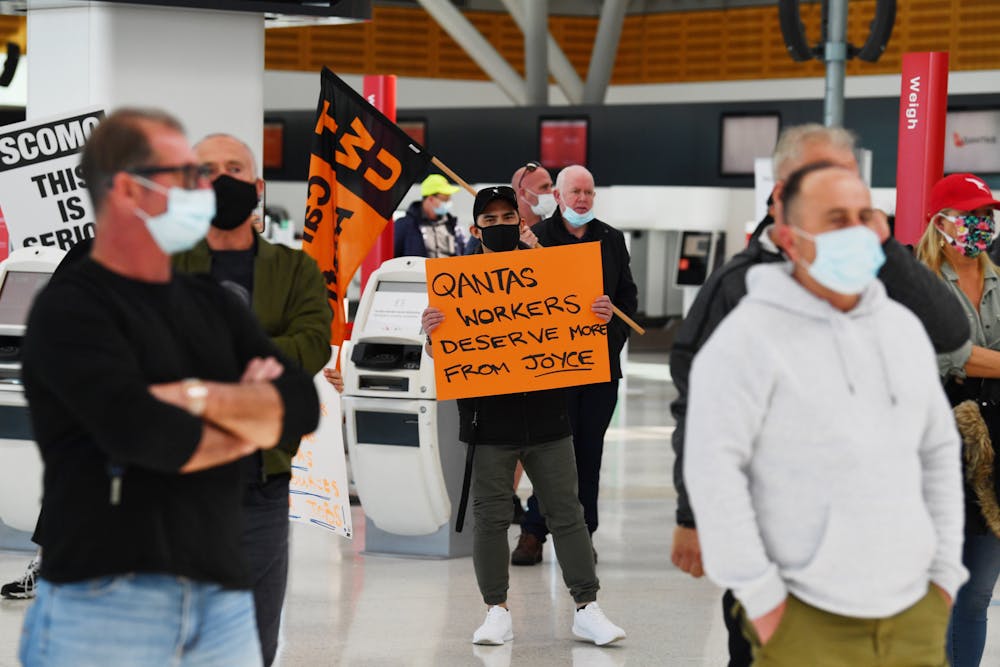
The ruling was the culmination of a long road for the Transport Workers’ Union, and the impacted employees, whose belief that their jobs were outsourced because Qantas wanted to avoid negotiating with them over their future pay and conditions was vindicated by the High Court.
In November 2020, at the height of the pandemic, Qantas made the outsourcing decision which made the ground crews across ten airports redundant, and saved Qantas an estimated $100 million a year in operating costs.
The workers turn to the courts
The union took action[3] in the Federal Court of Australia, arguing the decision was made to avoid bargaining with those same workers for a new enterprise agreement, and to stop them taking protected industrial action.
In July 2021, Justice Lee in the Federal Court found that Qantas could not show it had not made the workers redundant for the reasons alleged by the union. Because the right to bargain and take industrial action are workplace rights under the Fair Work Act, this meant Qantas had taken adverse action against those employees in breach of the Act.
Justice Lee’s decision was upheld by the Full Federal Court of Australia in May 2022[4], and on Wednesday was unanimously upheld by the High Court.
Read more: Qantas chief Alan Joyce quits early, amid customer fury at the airline[5]
Qantas will now be required to pay compensation to the employees concerned and penalties for breaches of the Fair Work Act[6] – with those amounts to be determined by Justice Lee in the Federal Court.
While the workers have been vindicated, the ruling does not mean employers cannot make outsourcing decisions, or that those former Qantas employees will get their jobs back. It doesn’t even mean Qantas will suffer substantial harm beyond what is likely to be a hefty bill.
As demonstrated after its 2011 worldwide lockout and shutdown, Qantas seems willing and able to absorb both financial pain and substantial damage to its reputation in pursuit of its industrial objectives.
So, what does the ruling mean?
It is important to understand that the case turned on very narrow principles of law and findings of fact.
When making a decision that affects an employee, an employer must not make that decision because the employee has workplace rights, or to prevent the employee exercising their workplace rights.
Read more: Will it be greener pastures for Qantas as Alan Joyce takes off?[7]
The Fair Work Act does not prevent employers making business decisions. Qantas was lawfully able to make a decision to outsource its ground handling staff. And it was entitled to base its decision on legitimate business grounds, including factors such as cost, profit and convenience.
What it was not entitled to do was to include, as a reason for the outsourcing decision, seeking to avoid engaging in collective bargaining with those employees or to avoid them exercising their right to strike.
Qantas could not prove this was not an operative or substantial part of its reasoning.
A rare win for the unions
The High Court case is significant, but not because it makes a precedent that employers cannot outsource their workforces.
It is significant because the union won. And these cases are notoriously hard to win. Because they turn on the subjective reasons of the decision maker, which can be very difficult to challenge in practice.
Furthermore, it is hard to get injunctive relief to prevent decisions taken for prohibited reasons before they can be implemented.
In the Federal Court, the union sought reinstatement of the workers impacted by Qantas’s unlawful actions.
But the egg was already scrambled – the workers had been made redundant, and the work outsourced to external providers and their employees (with less generous industrial arrangements). Third-party interests had got involved. So, the Federal Court refused the reinstatement request.
This leaves the compensation and penalties payments that Qantas now faces potentially as just a cost of doing business.
So what has come out of this ruling?
The lessons we can draw from the decision are threefold.
First, the laws that protect our workers in the exercise of their rights need to be strengthened so the victory of the Transport Workers’ Union does not stand as an anomaly.
Second, early injunctive relief in these cases should be easier to access so workers rights are preserved, and courts are not left attempting to compensate workers once the damage is done and cannot be undone.
Read more: What will putting the interests of Qantas ahead of Qatar Airways cost? $1 billion per year and a new wave of protectionism of legacy carriers[8]
Third, this decision won’t prevent businesses outsourcing to avoid negotiating enterprise agreements with their workers – not where they can show legitimate business reasons for their actions that do not involve any substantive prohibited reasons.
The solution to the outsourcing problem lies in multi-employer and industry-level bargaining. It shouldn’t be significantly cheaper to outsource your workers. If all employers within a sector have to pay the same rates through multi-employer or industry-level agreements, the incentive to outsource falls away.
References
- ^ lost its bid (www8.austlii.edu.au)
- ^ AAP (photos.aap.com.au)
- ^ union took action (www8.austlii.edu.au)
- ^ May 2022 (www8.austlii.edu.au)
- ^ Qantas chief Alan Joyce quits early, amid customer fury at the airline (theconversation.com)
- ^ Fair Work Act (classic.austlii.edu.au)
- ^ Will it be greener pastures for Qantas as Alan Joyce takes off? (theconversation.com)
- ^ What will putting the interests of Qantas ahead of Qatar Airways cost? $1 billion per year and a new wave of protectionism of legacy carriers (theconversation.com)