Signs of life? Why astronomers are excited about carbon dioxide and methane in the atmosphere of an alien world
- Written by: Brad E Tucker, Astrophysicist/Cosmologist, Australian National University
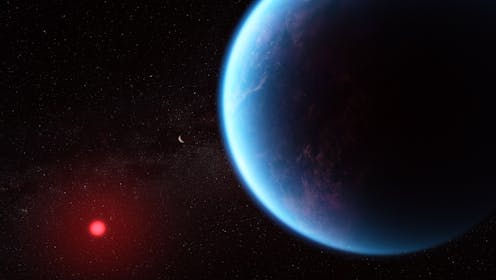
Are we alone? This question is nearly as old as humanity itself. Today, this question in astronomy focuses on finding life beyond our planet. Are we, as a species, and as a planet, alone? Or is there life somewhere else?
Usually the question inspires visions of weird, green versions of humans. However, life is more than just us: animals, fish, plants and even bacteria are all the kinds of things we seek signs of in space.
One thing about life on Earth is that it leaves traces in the chemical makeup of the atmosphere. So traces like that, which are visible from a long way away, are something we look for when we’re hunting aliens.
Scientists in the United Kingdom and the United States have just reported[1] some very interesting chemical traces in the atmosphere of a planet called K2-18b, which is about 124 light-years from Earth. In particular, they may have detected a substance which on Earth is only produced by living things.
Meet exoplanet K2-18b
K2-18b is an interesting exoplanet – a planet that orbits another star. Discovered in 2015 by the Kepler Space Telescope’s K2 mission, it is a type of planet called a sub-Neptune. As you probably guessed, these are smaller than Neptune in our own Solar System.
The planet is about eight and a half times heavier than Earth, and orbits a type of star called a red dwarf, which is much cooler than our Sun. However, K2-18b orbits much closer to its star than Neptune does – in what we call the habitable zone. This is the area that is not too hot and not too cold, where liquid water can exist (instead of freezing to ice or boiling into steam).
Read more: To search for alien life, astronomers will look for clues in the atmospheres of distant planets – and the James Webb Space Telescope just proved it's possible to do so[2]
Earth is what is called a rocky planet (for obvious reasons), but sub-Neptunes are gas planets, with much larger atmospheres containing lots of hydrogen and helium. Their atmosphere can also contain other elements.
Which brings us to the excitement around K2-18b.
How to fingerprint an atmosphere
The planet was first discovered by the Kepler Space Telescope, which was monitoring distant stars and hoping for planets to pass in front of them. When a planet does pass between us and a star, the star becomes momentarily dimmer – which is what tells us a planet is there.
By measuring how big the dip in brightness is, how long it takes for the planet to pass in front of the star, and how often it happens, we can work out the size and orbit of the planet. This technique is great at finding planets, but it doesn’t tell us about their atmospheres – which is a key piece of information to understand if they hold life or are habitable.
NASA’s James Webb Space Telescope – the big space telescope launched at the end of 2021 – has now observed and measured the atmosphere of this exoplanet.
The telescope did this by measuring the colour of light so finely, it can detect traces of specific atoms and molecules. This process, called spectroscopy, is like measuring the fingerprint of elements.
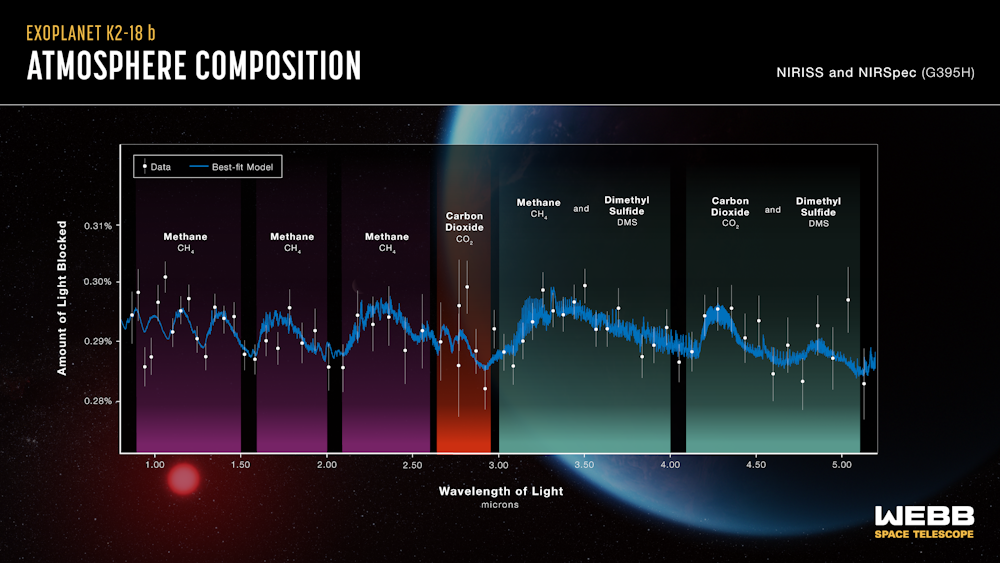
Each element and molecule has its own colour signature. If you can look at the colour signature, you can do a bit of detective work, and work out what elements or compounds are in the planet.
While the planet does not have its own light, astronomers waited for when K2-18b passed in front of its star, and measured the starlight as it went through the planet’s atmosphere, allowing the team to detect fingerprints of substances in the atmosphere.
Alien marine farts?
The new study found a lot of carbon dioxide and methane. This is interesting as this is like what is found on Earth, Mars, and Venus in our Solar System – rather than Neptune.
However, it also found a small amount of dimethyl sulfide. Dimethyl sulfide is an interesting molecule, made up of carbon, hydrogen, and sulfur.
On Earth, it’s generally a bit smelly. But it’s also closely linked to life.
The only process we know that creates dimethyl sulfide on our planet is life. In particular, marine life and plankton emit it in the form of flatulence.
So yes, scientists are excited by the potential idea of alien marine farts. If it is real. And linked to life.
The search continues
While on Earth, dimethyl sulfide is linked to life, on other planets it may somehow be related to geological or chemical processes.
After all, K2-18b is something like Neptune – a planet we do not really know a lot about. Just last month, researchers discovered that clouds on Neptune are strongly linked[4] to the Sun’s 11-year cycle of activity. We have a lot to learn about planets and their atmospheres.
Also, the measurement of dimethyl sulfide is very subtle – not nearly as strong as the carbon dioxide and methane. This means more detailed measurements, to improve the strength of the signal, are required.
Read more: The Webb telescope has released its very first exoplanet image – here's what we can learn from it[5]
Other telescopes may need to join the effort. Instruments on the Very Large Telescope in Chile are able to measure the atmospheres of planets around other stars – as is a new instrument called Veloce on the Anglo Australian Telescope at Siding Spring Observatory in Australia.
And new space telescopes, like Europe’s PLATO which is under construction, will also help us get a better look at alien atmospheres.
So while the signs of dimethyl sulfide on K2-18b may not be linked to life, they are still an exciting prospect. There is plenty more to explore.
References
- ^ have just reported (arxiv.org)
- ^ To search for alien life, astronomers will look for clues in the atmospheres of distant planets – and the James Webb Space Telescope just proved it's possible to do so (theconversation.com)
- ^ NASA / CSA / ESA / R. Crawford (STScI) / J. Olmsted (STScI) / N. Madhusudhan (Cambridge University) (www.nasa.gov)
- ^ clouds on Neptune are strongly linked (www.sciencedirect.com)
- ^ The Webb telescope has released its very first exoplanet image – here's what we can learn from it (theconversation.com)