an avalanche of images that invites us to sit alone in time and space together
- Written by: Leah Mercer, Associate Professor of Theatre Arts, Curtin University
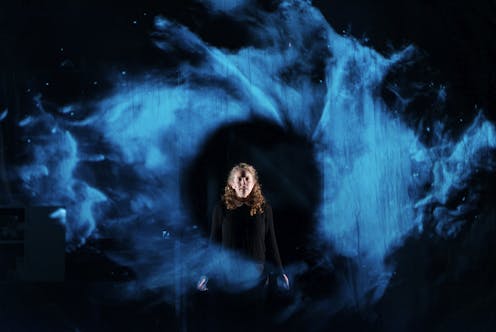
At the End of the Land, a world premiere production by Western Australian interdisciplinary theatre makers Too Close to the Sun, is an experiential encounter with the liminal space between life and death and other unknowable things.
Performed, written and co-devised by Talya Rubin with co-devisor and director Nick James, At the End of the Land integrates Rubin’s live, amplified voice, delivered via direct address, with Samuel James’ luscious, seemingly three-dimensional video.
Working in concert with the soundscape (composed by Rachael Dease with sound design by Daniel Herten and Hayley Forward), the performance is a parade of images – aural, live and projected – that hold for a moment to imprint on our retinas, but then are gone as quickly as they appeared.
Rubin’s spoken text, sometimes heightened and poetic, other times direct and specific, has multiple narratives. The most recurring throughline references a story of the deaths of 18 young women in a Victorian-era boarding house. Speaking as one of these vanished women about “the day we all died” and what it’s like to be dead, Rubin guides the audience into this in-between place. There is a slightly disembodied quality to her presence, anchored by the serious sincerity of her deliberate delivery.
Read more: 'The hardest and most beautiful conversation I've ever had': how end-of-life storytelling on TikTok helps us process death[1]
Dreamscapes
The stage is variously zoned, with miniature rooms and landscapes enlarged via projection that plays with perspective, as the performer manipulates the tiny scenes.
One of the zones features a red velvet armchair, with a small side table and lamp, on a black and white checked floor, reminiscent of Alice in Wonderland. This space places Rubin in her Peter Pan-collared outfit as a sort of Alice in the underworld.
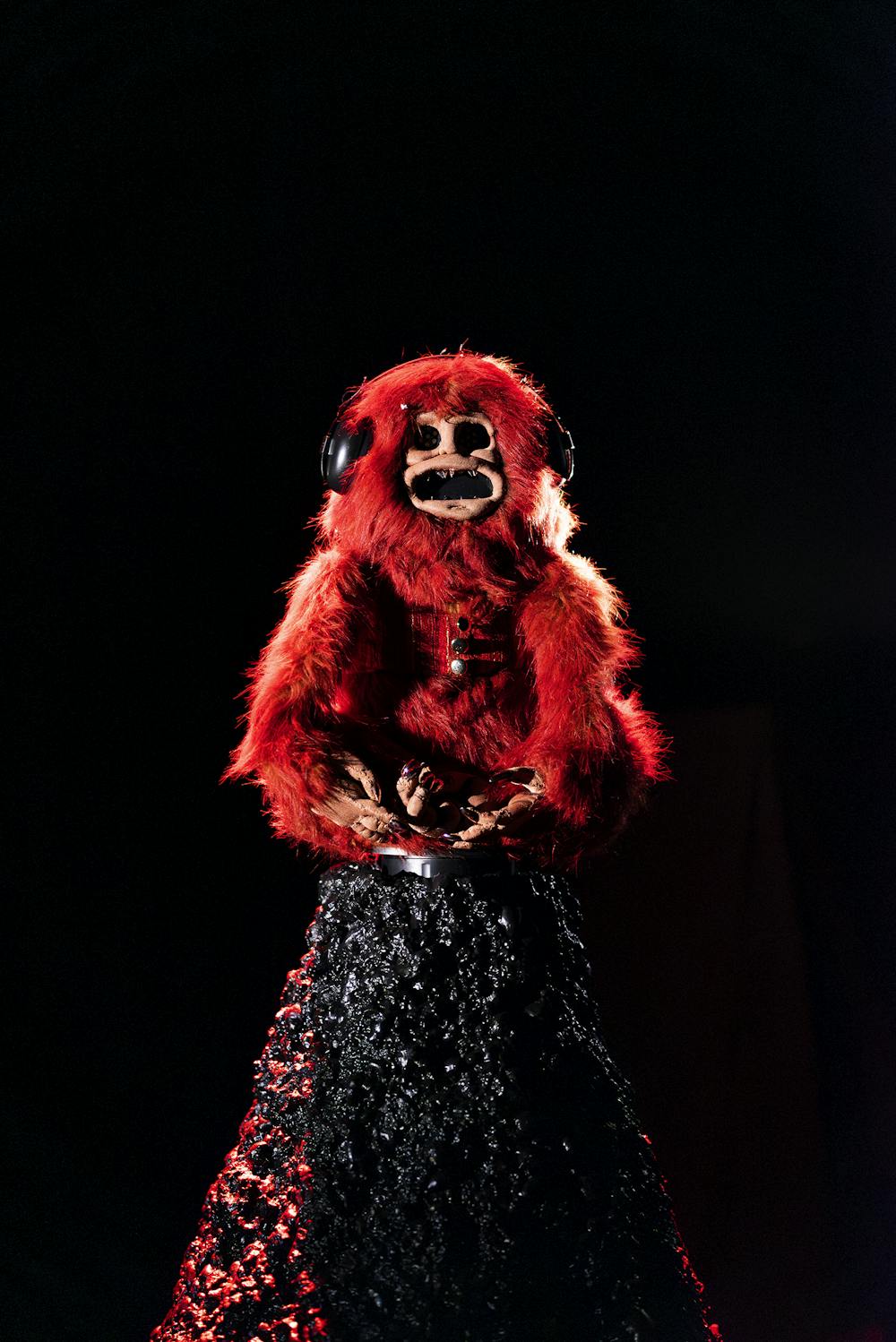
Sometimes accompanied by the recurring figure of the Red Monkey, the narrator’s sidekick who acts as a sort of demonic oracle, the overall effect is of a surreal, painterly dreamscape.
At one point Rubin narrates a verbatim interview with American filmmaker and painter David Lynch talking about his ideas and process, particularly with regards to his first feature Eraserhead. It works to position the performance in the highly visual “dreamlike logic[2]” of a Lynchian landscape.
Our own memories
At The End of The Land creates a very specific, sustained introspective mood, twice deliberately broken by Rubin when the house lights are raised and the audience directly engaged.
There is a relief in this direct connection, momentarily unfiltered by technology. Rubin invites us to embrace the living and the dead, to contemplate and embrace the inevitability of our own death and the invisible threads that guide (and sometimes abandon) us all.
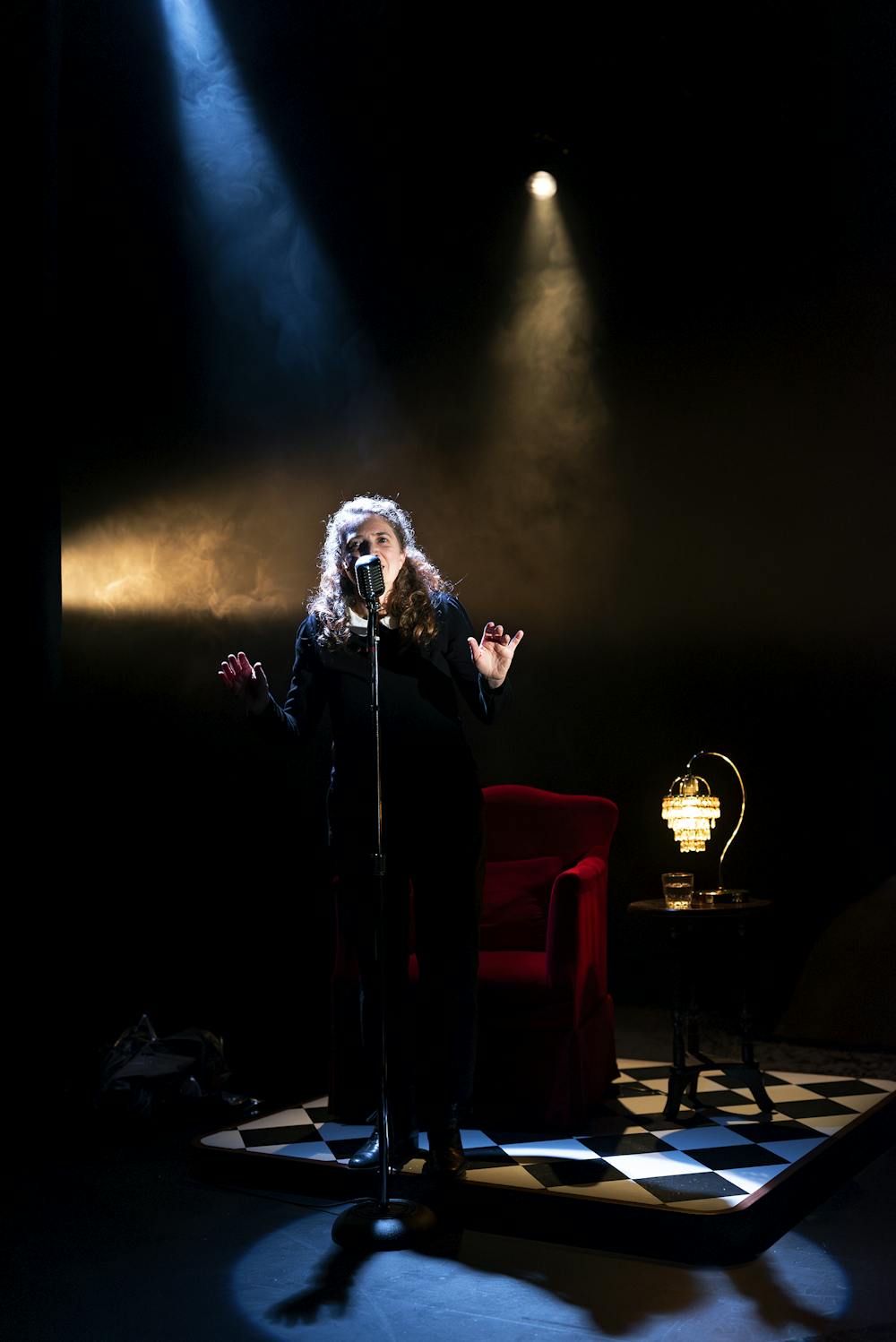 Rubin becomes an Alice in the underground.
Aaron Claringbold/PICA
Rubin becomes an Alice in the underground.
Aaron Claringbold/PICA
These moments of suspension create space and self-reflection leaving us alone with our own memories.
Operating in a non-linear surreality, Rubin’s text gives us hooks and signposts, but ultimately the density of images create a sensory overload that washes over you. It works to open the viewer up to the varied associations that accord with their own experience, ensuring At the End of the Land will land differently for each person.
For my companion, the references to the 18 dead women, provoked an association with 16 Days in WA[3], a family and domestic violence campaign currently running in the state. Amid the myriad associative possibilities, Rubin’s endeavour is personal but also invitational as she finds ways to bring us together.
It is a seamless performance, which is pretty remarkable considering the work is really all seam: an avalanche of images knitted together with visible seams that invite the audience to sit alone in time and space together.
At the End of the Land played at PICA, Perth. Season closed.
Read more: 49 women have been killed in Australia so far in 2023 as a result of violence. Are we actually making any progress?[4]
References
- ^ 'The hardest and most beautiful conversation I've ever had': how end-of-life storytelling on TikTok helps us process death (theconversation.com)
- ^ dreamlike logic (www.goodreads.com)
- ^ 16 Days in WA (www.wa.gov.au)
- ^ 49 women have been killed in Australia so far in 2023 as a result of violence. Are we actually making any progress? (theconversation.com)