Australia’s restrictive vaping and tobacco policies are fuelling a lucrative and dangerous black market
- Written by: James Martin, Senior Lecturer in Criminology, Deakin University
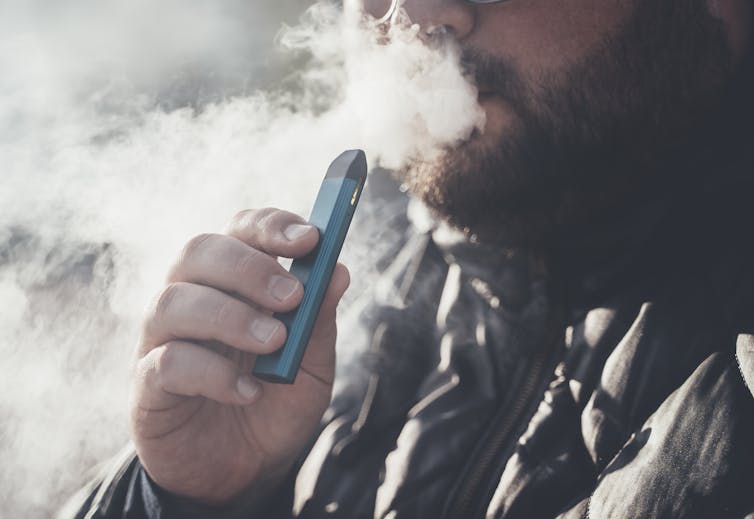
Australia currently has the most restrictive tobacco and vaping policies in the developed world. Australian smokers are taxed at one of the highest rates[1] among comparable nations, with taxes set to further increase[2] at rate of 5% per year. Meanwhile, Australia is the only country[3] to have a prescription model for accessing vaping products.
These policies have begun to attract international attention. The UK government, for example, recently announced increased taxes on tobacco and vaping products[4], while the Labour opposition has vowed to emulate Australia’s prescription model[5] if it wins this year’s election.
Australia’s policies have been backed by some medical experts[6] as a means to drive down and eventually eliminate smoking and vaping. There has been much alarm[7] around youth vaping, in particular.
While arguably well-intentioned, the increasing taxes and restrictions on cigarettes and vaping products have resulted in an unintended and dangerous outcome – the rise of a lucrative and expanding black market for these products.
Read more: Albanese government launches war on vaping, declaring it the 'number-one behavioural issue in high schools'[8]
Tobacco ‘war’ unfolding in Victoria
Emerging black markets tend to attract established organised crime groups, which have the capacity to use violence to enforce contracts, collect debts and threaten competitors.
Over the past six months, for instance, there have been more than 40 firebombings[9] of stores selling illicit tobacco and vapes across Victoria. In October, police said the killing of Melbourne man in a drive-by shooting[10] was also linked to the underworld war over illegal tobacco products. Reports of standover tactics and extortion[11] targeting tobacco shop owners are also on the rise.
According to police, this serious criminal activity is being committed at the behest of rival criminal networks[12] who are engaged in a “turf war” for control of the lucrative trade.
Since October, police have searched almost 70 stores[13] believed to be involved in the illegal tobacco trade, seizing more than 100,000 vapes with an estimated street value of A$3.2 million, along with 3.2 million cigarettes.
While most of the violence associated with the black market appears to be taking place in Victoria, this is a national problem. Last month in Sydney, health authorities seized over 30,000 vapes and 118,000 cigarettes[14] with a estimated street value of $1.1 million.
These numbers may sound impressive, but they represent a drop in the ocean of the total black market. Authorities estimate[15] the size of the illicit vape market could be worth up to $500 million in Victoria alone.
The economics of the black market
The black market for illicit tobacco and vaping products has been driven by economic forces on both the supply and demand side.
On the demand side, smokers are disproportionately concentrated among lower socio-economic groups[16]. Many are unable or unwilling to pay the ever-increasing prices for cigarettes.
People who vape are also largely rejecting the government’s prescription model, with 87% reporting they source their vapes illegally[17].
This demand is only likely to increase as cigarette prices increase further and prescription vapes become even less appealing with the introduction of new flavour restrictions[19].
On the supply side, economic models[20] suggest traffickers of illicit products are attracted to opportunities that present the lowest risks and highest rewards.
Similar to drugs like cocaine, the importation of illicit tobacco offers attractive profits. The difference is that while importing large quantities of cocaine can lead to substantial prison sentences[21], the penalties for the importation of illicit tobacco are not as severe[22].
Vapes are similarly low risk and highly profitable. They can be purchased wholesale from China for as little as $2.50[23] and sold “on the street” in Australia for more than ten times that amount[24].
The limits and dangers of prohibition
These economic realities suggest it is unlikely law enforcement agencies will be able to effectively tackle the black market under current government settings.
The Australian Border Force is already stretched beyond capacity tackling the booming illicit drug market[25]. So, even if eight out of ten consignments of illicit vapes are intercepted at the border (an unrealistically high proportion on the best of days), the two that make it through are sufficient for traffickers to make a profit.
And while law enforcement agencies have made inroads with arrests of black marketeers and seizures of their products, these are often quickly replaced[26] so trafficking operations can continue unabated.
Read more: How bad is vaping and should it be banned?[27]
As previous examples of prohibition on alcohol and other drugs have demonstrated, the dangers of black markets extend beyond systemic violence. Other harms include the influx of inferior and adulterated products[28], which can pose even more health risks than legal tobacco products. Young people also have greater access to vapes as black market retailers ignore restrictions on sales to minors[29]. (It should be noted, though, that many retailers may be doing so under duress.)
Added to this is the risk of criminalisation of consumers. A teenager in NSW was recently arrested[30], for example, following an altercation with police over his possession of a vape.
Then there is the lost tax revenue from tobacco goods sold under the counter, which the Taxation Office estimated[31] at $2.3 billion in 2021-22.
The Australian public and policymakers, as well as other countries considering emulating our policies, need to be mindful of these risks and the implacable economic forces that are driving the black market.
Australia’s tobacco and vaping policies have transformed two largely legal and peaceful markets into increasingly dangerous and uncontrolled ones. The situation could even get worse in the absence of meaningful legislative reform, enhanced multi-agency cooperation, nationally consistent policy platforms and the winding back of some restrictions.
As the history of prohibition[32] has taught us time and again, there is a “sweet spot” in restricting the sale of harmful products – one that limits access and reduces harm, but is not so onerous as to create a large black market. The violence unfolding on our streets suggests our current tobacco and vaping polices are failing to strike this balance.
References
- ^ one of the highest rates (www.theguardian.com)
- ^ further increase (www.afr.com)
- ^ only country (www.parliament.nsw.gov.au)
- ^ increased taxes on tobacco and vaping products (www.theguardian.com)
- ^ vowed to emulate Australia’s prescription model (www.telegraph.co.uk)
- ^ backed by some medical experts (www.phrp.com.au)
- ^ alarm (www.cancer.org.au)
- ^ Albanese government launches war on vaping, declaring it the 'number-one behavioural issue in high schools' (theconversation.com)
- ^ more than 40 firebombings (www.mandurahmail.com.au)
- ^ killing of Melbourne man in a drive-by shooting (www.dailymail.co.uk)
- ^ Reports of standover tactics and extortion (www.theguardian.com)
- ^ behest of rival criminal networks (www.9news.com.au)
- ^ searched almost 70 stores (www.theguardian.com)
- ^ health authorities seized over 30,000 vapes and 118,000 cigarettes (www.abc.net.au)
- ^ estimate (www.skynews.com.au)
- ^ disproportionately concentrated among lower socio-economic groups (www.aihw.gov.au)
- ^ source their vapes illegally (www.aihw.gov.au)
- ^ Shutterstock (www.shutterstock.com)
- ^ new flavour restrictions (adf.org.au)
- ^ economic models (onlinelibrary.wiley.com)
- ^ substantial prison sentences (www.cdpp.gov.au)
- ^ are not as severe (www.ato.gov.au)
- ^ little as $2.50 (www.made-in-china.com)
- ^ more than ten times that amount (www.abc.net.au)
- ^ illicit drug market (www.acic.gov.au)
- ^ these are often quickly replaced (www.tandfonline.com)
- ^ How bad is vaping and should it be banned? (theconversation.com)
- ^ inferior and adulterated products (www.theguardian.com)
- ^ ignore restrictions on sales to minors (www.cancer.org.au)
- ^ arrested (www.news.com.au)
- ^ estimated (www.ato.gov.au)
- ^ history of prohibition (www.taylorfrancis.com)