if you can’t afford as much fresh produce, are canned veggies or frozen fruit just as good?
- Written by: Evangeline Mantzioris, Program Director of Nutrition and Food Sciences, Accredited Practising Dietitian, University of South Australia
The cost of living crisis is affecting how we spend our money. For many people, this means tightening the budget on the weekly supermarket shop.
One victim may be fresh fruit and vegetables. Data from the Australian Bureau of Statistics[1] (ABS) suggests Australians were consuming fewer fruit and vegetables in 2022–23 than the year before.
The cost of living is likely compounding a problem that exists already – on the whole, Australians don’t eat enough fruit and vegetables. Australian dietary guidelines[2] recommend people aged nine and older should consume two[3] serves of fruit and five[4] serves of vegetables each day for optimal health. But in 2022 the ABS reported[5] only 4% of Australians met the recommendations for both fruit and vegetable consumption.
Fruit and vegetables are crucial for a healthy, balanced diet, providing a range of vitamins[6] and minerals as well as fibre.
If you can’t afford as much fresh produce at the moment, there are other ways to ensure you still get the benefits of these food groups. You might even be able to increase your intake of fruit and vegetables.
Frozen
Fresh produce is often touted as being the most nutritious (think of the old adage “fresh is best”). But this is not necessarily true.
Nutrients can decline in transit from the paddock to your kitchen, and while the produce is stored in your fridge. Frozen vegetables may actually be higher in some nutrients such as vitamin C and E[7] as they are snap frozen very close to the time of harvest. Variations in transport and storage can affect this slightly.
Minerals[8] such as calcium, iron and magnesium stay at similar levels in frozen produce compared to fresh.
Another advantage to frozen vegetables and fruit is the potential to reduce food waste, as you can use only what you need at the time.
As well as buying frozen fruit and vegetables from the supermarket, you can freeze produce yourself at home if you have an oversupply from the garden, or when produce may be cheaper.
A quick blanching[10] prior to freezing can improve the safety and quality of the produce. This is when food is briefly submerged in boiling water or steamed for a short time.
Frozen vegetables won’t be suitable for salads but can be eaten roasted or steamed and used for soups, stews, casseroles, curries, pies and quiches. Frozen fruits can be added to breakfast dishes (with cereal or youghurt) or used in cooking for fruit pies and cakes, for example.
Canned
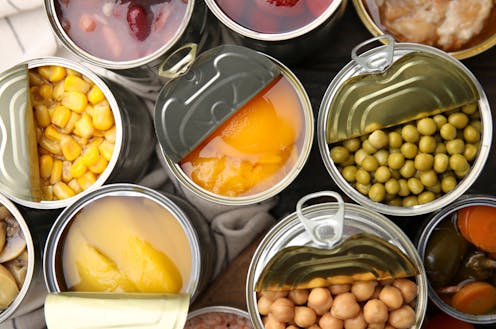
Canned vegetables and fruit similarly often offer a cheaper alternative to fresh produce. They’re also very convenient to have on hand. The canning process[11] is the preservation technique, so there’s no need to add any additional preservatives, including salt.
Due to the cooking process, levels of heat-sensitive nutrients such as vitamin C[12] will decline a little compared to fresh produce. When you’re using canned vegetables in a hot dish, you can add them later in the cooking process to reduce the amount of nutrient loss.
To minimise waste, you can freeze the portion you don’t need.
Fermented
Fermentation[14] has recently come into fashion, but it’s actually one of the oldest food processing and preservation techniques.
Fermentation largely retains the vitamins and minerals in fresh vegetables. But fermentation may also enhance the food’s nutritional profile by creating new nutrients and allowing existing ones to be absorbed more easily[15].
Further, fermented foods contain probiotics, which are beneficial for our gut microbiome[16].
5 other tips to get your fresh fix
Although alternatives to fresh such as canned or frozen fruit and vegetables are good substitutes, if you’re looking to get more fresh produce into your diet on a tight budget, here are some things you can do.
1. Buy in season
Based on supply and demand principles, buying local seasonal vegetables and fruit will always be cheaper than those that are imported out of season from other countries.
2. Don’t shun the ugly fruit and vegetables
Most supermarkets now sell “ugly” fruit and vegetables, that are not physically perfect in some way. This does not affect the levels of nutrients in them at all, or their taste.
3. Reduce waste
On average, an Australian household throws out A$2,000–$2,500[18] worth of food every year. Fruit, vegetables and bagged salad are the three of the top five foods[19] thrown out in our homes. So properly managing fresh produce could help you save money (and benefit the environment[20]).
To minimise waste, plan your meals and shopping ahead of time. And if you don’t think you’re going to get to eat the fruit and vegetables you have before they go off, freeze them.
4. Swap and share
There are many websites and apps which offer the opportunity to swap or even pick up free fresh produce if people have more than they need. Some local councils are also encouraging[21] swaps on their websites, so dig around and see what you can find in your local area.
5. Gardening
Regardless of how small your garden is you can always plant produce in pots[22]. Herbs, rocket, cherry tomatoes, chillies and strawberries all grow well. In the long run, these will offset some of your cost on fresh produce.
Plus, when you have put the effort in to grow your own produce, you are less likely to waste it[23].
References
- ^ Australian Bureau of Statistics (www.abs.gov.au)
- ^ Australian dietary guidelines (www.eatforhealth.gov.au)
- ^ two (www.eatforhealth.gov.au)
- ^ five (www.eatforhealth.gov.au)
- ^ ABS reported (www.abs.gov.au)
- ^ vitamins (theconversation.com)
- ^ vitamin C and E (pubmed.ncbi.nlm.nih.gov)
- ^ Minerals (pubs.acs.org)
- ^ Tohid Hashemkhani/Pexels (www.pexels.com)
- ^ quick blanching (www.growveg.com.au)
- ^ canning process (nchfp.uga.edu)
- ^ such as vitamin C (onlinelibrary.wiley.com)
- ^ Angela Khebou/Unsplash (unsplash.com)
- ^ Fermentation (www.ncbi.nlm.nih.gov)
- ^ absorbed more easily (www.ncbi.nlm.nih.gov)
- ^ gut microbiome (www.ncbi.nlm.nih.gov)
- ^ August de Richelieu/Pexels (www.pexels.com)
- ^ A$2,000–$2,500 (www.ozharvest.org)
- ^ three of the top five foods (www.ozharvest.org)
- ^ the environment (endfoodwaste.com.au)
- ^ local councils are also encouraging (www.charlessturt.sa.gov.au)
- ^ plant produce in pots (www.gardeningaustraliamag.com.au)
- ^ you are less likely to waste it (mdpi-res.com)