Second-term Albanese will face policy pressure, devastated Liberals have only bad options
- Written by: Michelle Grattan, Professorial Fellow, University of Canberra
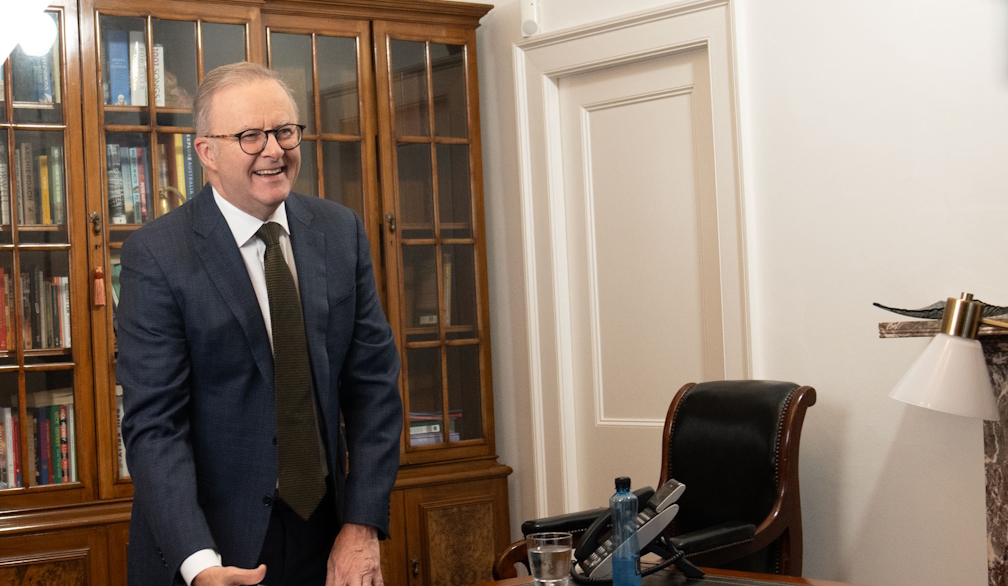
On February 1, on The Conversation’s podcast, Anthony Albanese not only declared that Labor would retain majority government, but held out the prospect it could win the Victorian Liberal seats of Menzies and Deakin.
This was when the polls were still bad for Labor and the Coalition was confident of gaining a swathe of seats in Victoria.
Now Liberal Michael Sukkar has lost Deakin to Labor’s Matt Gregg, while fellow Liberal Keith Wolahan says it is “more likely than not” he’ll be ousted from Menzies.
Obviously Albanese’s political judgement was better than most. Two other points are notable. The first is how quickly things turned around. But there’s a counterpoint: maybe they didn’t turn around in quite the way they seemed. Perhaps a few months ago, voters were expressing their frustrations, but many were always going to be reluctant to endorse Peter Dutton when decision-time came.
Even so, the extent of the decimation of the Liberals was nearly unthinkable. Labor minister Don Farrell said that two days out, Labor’s polling showed a majority but not this result. The Liberals are a rump, without a leader, with no obvious successor, and no clue of what direction to take a party left with hardly any urban seats and the prospect of another two terms, at least, in the wilderness.
First, however, to the government. Albanese is basking in golden days. But he knows Labor must avoid hubris. As he enjoyed Sunday morning at a local coffee shop, he said “we will be a disciplined, orderly government”.
To state the obvious, the win will boost Albanese’s authority. But it will also open him to pressures, externally and internally.
In Labor’s first term, many commentators and stakeholders argued the government was too cautious. Some urged it should tackle more robust economic reform; others wanted it to shift left. Those voices will strengthen now Labor has the numbers to flex its muscles more vigorously. But Albanese is wary of breaking promises – it took a long time for him to go back on his word over the stage three tax cuts – or surprising the electorate.
The person to watch is Treasurer Jim Chalmers.
On Saturday night, the treasurer said, “We do believe we’re an ambitious government but we know there is a sense of impatience as well when it comes to some of our big national challenges”.
Chalmers told the ABC on Sunday, “The best way to think about the difference between our first term and the second term that we won last night [is the] first term was primarily inflation without forgetting productivity, the second term will be primarily productivity without forgetting inflation”.
This is a very big aspiration. Australia’s productivity performance is dreadful. If that’s to improve significantly, Chalmers may have to take on battles in some policy areas, such as industrial relations, that are very sensitive for Labor and the unions.
The win, but more particularly the issues ahead, which focus on the economy here and overseas, will give Chalmers an even more central voice, as well as present even tougher tests for him. Chalmers was lavish in his praise of Albanese on Saturday night and Sunday; he said he had rung the PM during Saturday, before the result, and “I said his was an extraordinary campaign, he’s got a lot to be proud of and we are certainly proud to be part of his team”.
For all that, Chalmers is, and sees himself as, Albanese’s most credible successor, although other aspirants are in the mix. Despite Albanese indicating he will serve a full term and the result leading people to say he will be well placed to lead into the 2028 election, that is not inevitable.
Who will lead the Liberals into that election is absolutely unknowable. The potential field for the post election leadership vote is lacklustre, and whoever wins that vote could be a seat warmer.
That field includes shadow treasurer Angus Taylor, deputy leader Sussan Ley, shadow immigration minister Dan Tehan, and defence spokesman Andrew Hastie.
Taylor, an economic conservative, has faced immense criticism for his performance over the past three years. Ley, who is more towards the centre, has been guilty of overreach, although she’s toned down somewhat recently. Hastie has not broadened out from his defence comfort zone. Tehan is experienced but does not present well to voters.
Dutton had a weak team around him; the next leader will have an even thinner one.
Even more diabolical than who the Liberal Party should choose is where it should go in its positioning. The party has become an identity vacuum. It has lost its more genteel urbanites, and failed to win the aspirational suburbanites. These constituencies have different priorities but to revive themselves the Liberals have to thread the needle between them, which looks, at the moment, an impossible task.
Then there are the problems with women and younger voters. The Liberals’ “women problem” has been debated for years; they seem further than ever from grappling with it. The failure ranges from candidate selection to policy blindness.
On the latter, the working-from-home debacle was a classic example of disconnect with many women’s lives. The policy (later dumped) to bring public servants back to the office five days a week was driven by a woman, shadow finance minister Jane Hume. It wasn’t properly workshopped, but surely it was obvious that running this policy would be a disaster, especially with female voters. You wouldn’t need a focus group to tell you that.
As the baby boomers, already outnumbered, fade further, how are the Liberals to connect with the younger voters who are now the dominant demographic? These voters are increasingly progressive. For them, the Liberals need generational change. But the only new generation contender in the present leadership list is Hastie, and he is a conservative.
Another complication for the Liberals is that the Nationals have done well. This means they’ll have a bigger say in the Coalition, including a bigger share of the frontbench. This might push the Coalition further to the populist right. A few will argue the Coalition parties should separate, but this is not the answer – it hasn’t worked in the past.
There’ll be a policy overhaul, and that could involve a tricky argument over nuclear, to which the Nationals especially are deeply committed. And will the Coalition commitment to the Paris agreement and the 2050 net zero emissions target come under assault?
The Liberals are in an extraordinarily bad place. Politicians in such circumstances search for so-called “narrow goat tracks” to better ground. Debris is littering any track in sight for the Liberals. Their only comfort can be that politics is volatile.