Albanese’s Curtin speech becomes latest political football in debate over US relationship
- Written by: Michelle Grattan, Professorial Fellow, University of Canberra
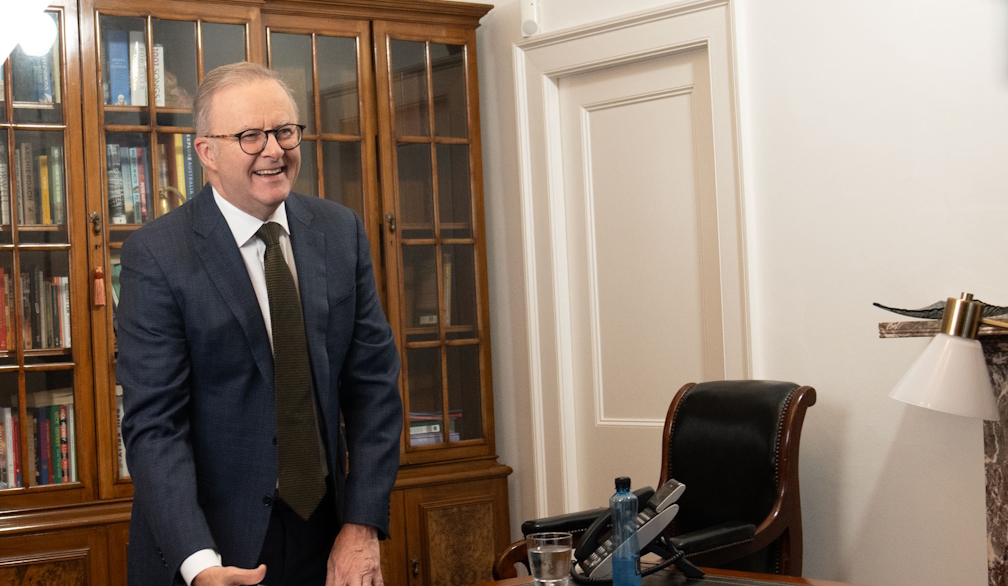
Anthony Albanese seems to find himself on eggshells whenever the Australian-American relationship comes up.
After the G7 debacle, he’s persistently pursued – to his obvious irritation – by journalists asking when he’ll have his first face-to-face meeting with Donald Trump. It’s a question he has so far been unable to answer, as he prepares for his fourth meeting with Chinese leader Xi Jinping.
There is no Washington meeting lined up, so Albanese just talks about the various occasions when their paths are due to cross. The next time is the Quad in India later this year (there is no fixed date).
Trump’s deadline for deals on his tariffs has now been moved from this week to August 1. Despite the months of negotiation, the government (as of now) is not expecting to receive a concession on the hefty 50% steel and aluminium tariffs, nor on the general 10% tariff. That will invite a fresh round of criticism that the government has not been able to leverage Australia’s advantages on critical minerals with the Trump administration.
And now the PM has stirred controversy with his John Curtin Oration, delivered on Saturday night.
Curtin is at the top of Labor’s pantheon of heroes, and generally regarded as one of Australia’s greatest prime ministers, by many as the greatest. Labor PMs regularly pay homage. (Bob Hawke and Paul Keating once had a spectacular falling out after Hawke considered Keating had slighted Curtin’s memory.)
In the second world war Curtin famously stood up to United Kingdom Prime Minister Winston Churchill to insist Australian troops be returned home, rather than diverted to Burma as Churchill wanted. And in those dark wartime days, Curtin dramatically “looked to America” for Australia’s security.
In delivering Saturday’s oration, Albanese painted the Curtin course as an example of Labor forging an independent foreign policy, and identified with it.
He said Curtin was the “founder” of the Australia-US alliance (contested by those who date the alliance from the Menzies years, when ANZUS was signed).
Albanese said “Curtin’s famous statement that Australia ‘looked to America’ was much more than the idea of trading one strategic guarantor for another”.
“It was a recognition that Australia’s fate would be decided in our region.
"It followed the decision Curtin had made in 1941 that Australia would issue its own declaration of war with Japan.
"Speaking for ourselves, as a sovereign nation.”
“We needed an Australian foreign policy anchored in strategic reality, not bound by tradition.”
“So we remember Curtin not just because he looked to America. We honour him because he spoke for Australia.
"For Australia and for Labor, that independence has never meant isolationism, Choosing our own way, doesn’t mean going it alone,” Albanese said.
Curtin’s biographer John Edwards, writing in the Lowy Institute’s The Interpreter, says Albanese’s oration “adroitly positions Australia for a testing time on foreign policy.
"Albanese’s speech affirms that in the competition between the United States and China, Australia will act in its own interests.”
Edwards puts the December 1941 appeal to the US against a particular background. The context of the article was a meeting then taking place in Washington between Churchill and US President Roosevelt, he writes.
Churchill was anxious the US not be distracted from the European conflict by the Pacific war. “Curtin’s article was a demand for Australia – not the United Kingdom – to be America’s principal partner in the war against Japan,” Edwards writes.
Others, notably the Australian’s foreign editor Greg Sheridan, have accused Albanese of misrepresenting the history.
But apart from details of the historical argument, the timing, emphasis and context of Albanese’s remarks are what’s relevant.
Sheridan writes, “Who on earth is Albanese messaging in this speech? Because it implies greater Australian strategic distance from the US, it will be welcomed in Beijing.”
Former ambassador to the United States Arthur Sinodinos (a Liberal government appointee but usually objective in his observations) said the speech made clear the bipartisan support for the alliance.
But “given the context of Australia-US relations at present, the speech will need careful explanation to our American friends to avoid a misconception that was hyped that the speech would be a declaration of independence from the US,” Sinodinos said.
An interpretive job that will presumably fall, in part, to ambassador Kevin Rudd.
If the oration will require “careful explanation”, how much more carefully will the prime minister have to be in what he says in China next week and the messages he sends indirectly to Washington?
It all serves to reinforce the importance of Albanese meeting the president as soon as feasible. The more time elapses, the more the fog needs to be cleared from the relationship.