From this week, every mainland Australian state will allow genetically modified crops. Here's why that's nothing to fear
- Written by: Daniel Tan, Professor of Agronomy (Agriculture), University of Sydney
On July 1, the New South Wales government will lift a ban[1] on genetically modified (GM) crops after an 18-year moratorium. It will mean GM crops can now be grown in every Australian state except Tasmania.
Major farming groups have welcomed[2] the move. GM proponents say the biotechnology leads to better crop yields and may solve food shortages and reduce infestations of weeds and pests.
But opponents say[3] GM crops are a potential threat to the environment and human health. They fear the technology will encourage superweeds, increase antibiotic resistance and food allergies in humans and may have other unintended effects.
So where does the truth lie? Academic research suggests GM crops are generally safe for humans and the environment, and so I believe the NSW government’s decision should be welcomed.
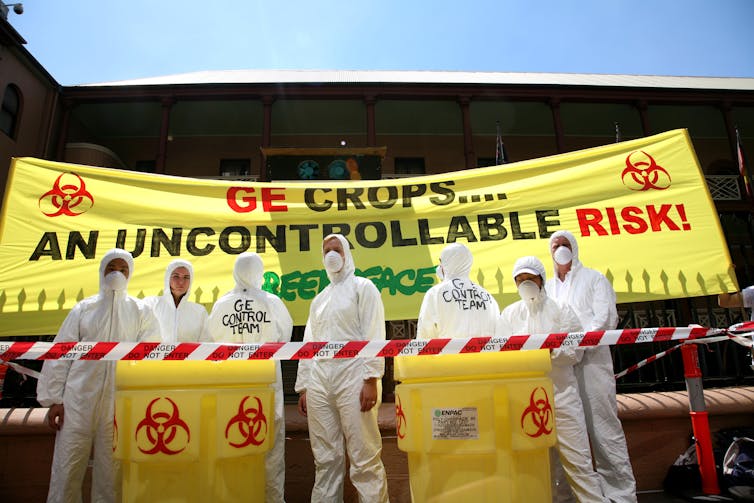 GM crops will be allowed in all mainland states, despite opposition from some.
Greenpeace/AAP
GM crops will be allowed in all mainland states, despite opposition from some.
Greenpeace/AAP
What is genetic modification?
Genetic modification[4] is the use of technology to change the genes of living things. It involves scientists injecting one organism’s DNA with genes from another, to give it a desirable trait such as resistance to drought, extreme temperature or pests.
Genetically modified crops were introduced commercially in the 1990s. The NSW moratorium began in 2003 following concerns from some importers and manufacturers. For example, countries in the Middle East and Southeast Asia had been refusing[5] GM grain, and Canada and Saudi Arabia had indicated they did not want GM-fed livestock.
Announcing[6] the lifting of the ban in March, NSW Agriculture Minister Adam Marshall said his government had been working to ensure trade and marketing issues surrounding GM food were well managed. He said the Commonwealth Gene Technology Regulator will assess all applications to grow GM crops, ensuring they are safe for people and the environment.
The NSW decision follows similar moves by other mainland states in recent years, including South Australia, which lifted the GM ban in 2020 (with an exemption for Kangaroo Island). A moratorium remains in the ACT.
The NSW government says allowing cultivation of GM crops will increase agricultural competitiveness and productivity, and bring up to A$4.8 billion in benefits over the next decade.
Read more: Battling misinformation wars in Africa: applying lessons from GMOs to COVID-19[7]
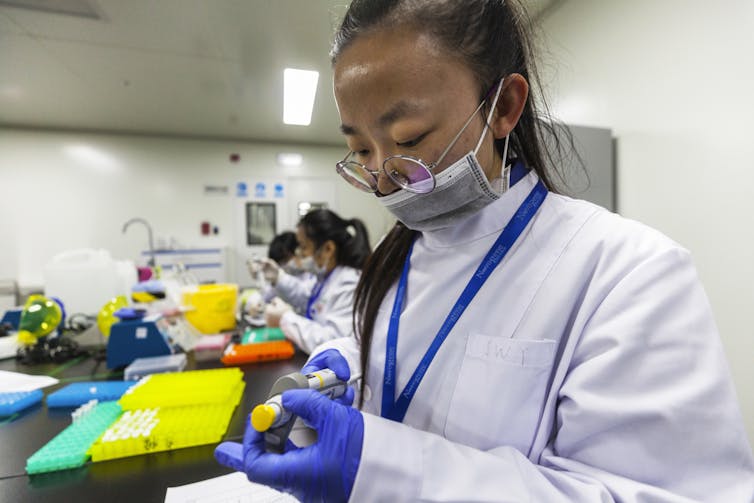 Genetic modification involves injecting one organism’s DNA with genes from another.
Aleksandar Plavevski
Genetic modification involves injecting one organism’s DNA with genes from another.
Aleksandar Plavevski
Benefits of lifting of the GM ban
So are the benefits of GM crops real? To answer this question, we can look to three precedents: GM canola, cotton and safflower, which have been grown in Australia for many years. These crops were exempt from the moratoria in NSW and other states, and evidence suggests their cultivation has been a success.
GM cotton has been modified with insecticidal genes, which research shows makes it more resistant[8] to pests. The modified cotton also requires less insecticide use[9].
GM canola has been transformed to make it resistant to herbicides, which enables better weed control[10].
State moratoria delayed the introduction of GM canola, including in NSW. Research[11] in 2018 found, across Australia, the environmental costs of the delay included an extra 6.5 million kilograms of active ingredients applied to canola land, and an extra 24.2 million kg of greenhouse gas and other emissions released. Economic costs included a net loss to canola farmers of A$485.6 million.
In recent years, Australian regulators allowed[12] cultivation of canola modified to contain long-chain omega-3 fatty acids, prized for their health benefits[13]. The canola variety was hailed as the world’s first plant-based source of omega-3 and may reduce reliance on fish stocks.
Safflower has been genetically modified to contain higher amounts of oleic acid. These renewable oils can be used in place of petroleum[14], a finite resource, in products such as[15] fuels, plastics and cosmetics.
Read more: The quest for delicious decaf coffee could change the appetite for GMOs[16]
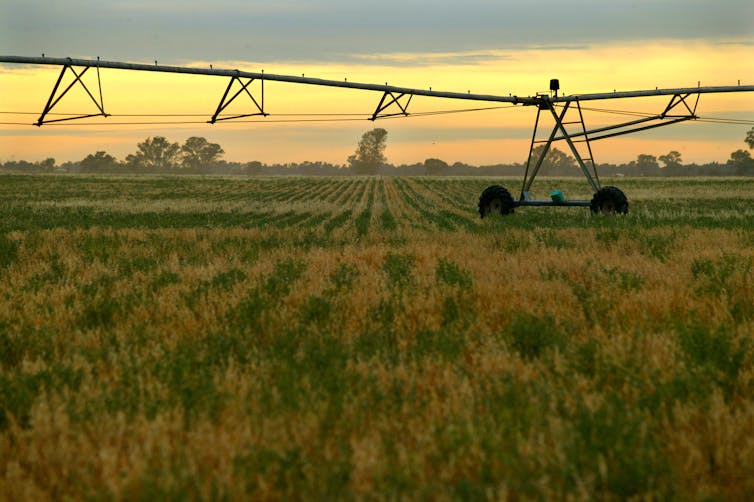 GM crops can be made resistant to herbicides.
Greenpeace/AAP
GM crops can be made resistant to herbicides.
Greenpeace/AAP
What are the risks?
Experts concede[17] there are limits to what can be known about the health effects of any food over the long term. However, scientists[18] broadly[19] agree the evidence so far suggests GM crops are safe to eat[20]. This view is backed by the World Health Organization.
Foods derived from GM plants are consumed by millions of people in many countries. And in Australia, authorities rigorously assess[21] all GM foods before they’re sold to consumers[22].
However many countries still ban[23] the the cultivation of GM foods. And some people remain worried about the effects on human health. Concerns include[24] that antibiotic resistance may be transferred from plants to humans, or that GM foods will trigger allergic reactions[25].
Read more: GM crops: to ban or not to ban? That's not the question[26]
Experts have concluded the risk of antibiotic resistance is not substantial. There is some[27] evidence of a small number of GM crops being allergenic. But since GM crops undergo extensive allergen testing, they should not be riskier than conventional crops once cleared for market release.
Other GM opponents say[28] the technology poses environmental risks – for example that herbicide-resistant GM crops can become “superweeds”.
Research has found[29] weed resistance to the herbicide glyphosate is a problem, and there is some evidence[30] of glyphosate-resistant canola persisting outside farms in Australia. Management strategies can reduce[31] the chance of superweeds developing, but more research is needed.
And it should be noted that while the use of herbicide-resistant crops sometimes leads to less herbicide use, the decrease is often not sustained. Researchers also say[32] a reduction in the kilograms of pesticides used does not necessarily predict environmental or health effects.
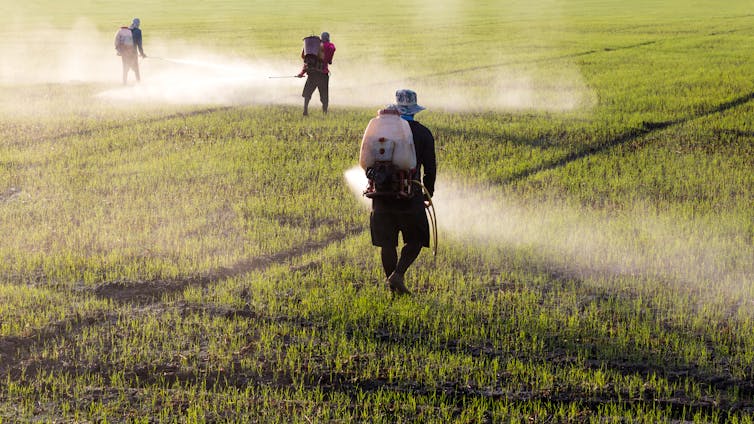 More research is needed into preventing herbicide-resistant superweeds.
Shutterstock
More research is needed into preventing herbicide-resistant superweeds.
Shutterstock
Some critics oppose GM crops on the basis that they allow a few large companies – which breed and commercialise seeds – to control food supplies. For example, in 2015 it was reported[33] the GM maize seed sector in South Africa was owned by just two companies, which meant small farmers could not compete.
Researchers have proposed measures[34] to counter this corporate concentration of power, by strengthening competition policies, boosting public sector support for diverse food systems and curbing corporate influence in the policy process.
The issue of cross-contamination is also a concern for organic farmers and consumers. In a well-known case from Western Australia, organic farmer Steve Marsh’s crop was contaminated[35] in 2010 with GM canola, causing him to lose his organic certification.
Looking ahead
The lifting of the NSW ban on GM crops means Australian mainland states have a consistent approach, and provides new opportunities for Australian growers and consumers.
There are still issues with GM crops to be ironed out, and there’s a need for continued stringent regulation to ensure human and environmental safety. Opposition to the practice will no doubt remain in some quarters. However this may lessen over time as the technology develops and long-term outcomes become clearer.
References
- ^ lift a ban (www.dpi.nsw.gov.au)
- ^ welcomed (7news.com.au)
- ^ say (www.ncbi.nlm.nih.gov)
- ^ Genetic modification (www.nature.com)
- ^ refusing (www.aph.gov.au)
- ^ Announcing (www.dpi.nsw.gov.au)
- ^ Battling misinformation wars in Africa: applying lessons from GMOs to COVID-19 (theconversation.com)
- ^ more resistant (books.google.com.au)
- ^ insecticide use (cottonaustralia.com.au)
- ^ better weed control (www.ogtr.gov.au)
- ^ Research (www.ncbi.nlm.nih.gov)
- ^ allowed (blog.csiro.au)
- ^ health benefits (www.tandfonline.com)
- ^ in place of petroleum (www.csiro.au)
- ^ such as (www.ogtr.gov.au)
- ^ The quest for delicious decaf coffee could change the appetite for GMOs (theconversation.com)
- ^ Experts concede (www.nap.edu)
- ^ scientists (royalsociety.org)
- ^ broadly (pubmed.ncbi.nlm.nih.gov)
- ^ safe to eat (doi.org)
- ^ rigorously assess (www.foodstandards.gov.au)
- ^ consumers (www.foodstandards.gov.au)
- ^ still ban (geneticliteracyproject.org)
- ^ include (www.ncbi.nlm.nih.gov)
- ^ allergic reactions (pubmed.ncbi.nlm.nih.gov)
- ^ GM crops: to ban or not to ban? That's not the question (theconversation.com)
- ^ some (www.annallergy.org)
- ^ Other GM opponents say (www.nap.edu)
- ^ has found (www.nap.edu)
- ^ some evidence (www.sciencedirect.com)
- ^ can reduce (www.tandfonline.com)
- ^ also say (www.nap.edu)
- ^ reported (www.bbc.com)
- ^ proposed measures (www.nature.com)
- ^ contaminated (www.abc.net.au)