Australia has record job vacancies, but don't expect it to lead to higher wages
- Written by: Jeff Borland, Professor of Economics, The University of Melbourne
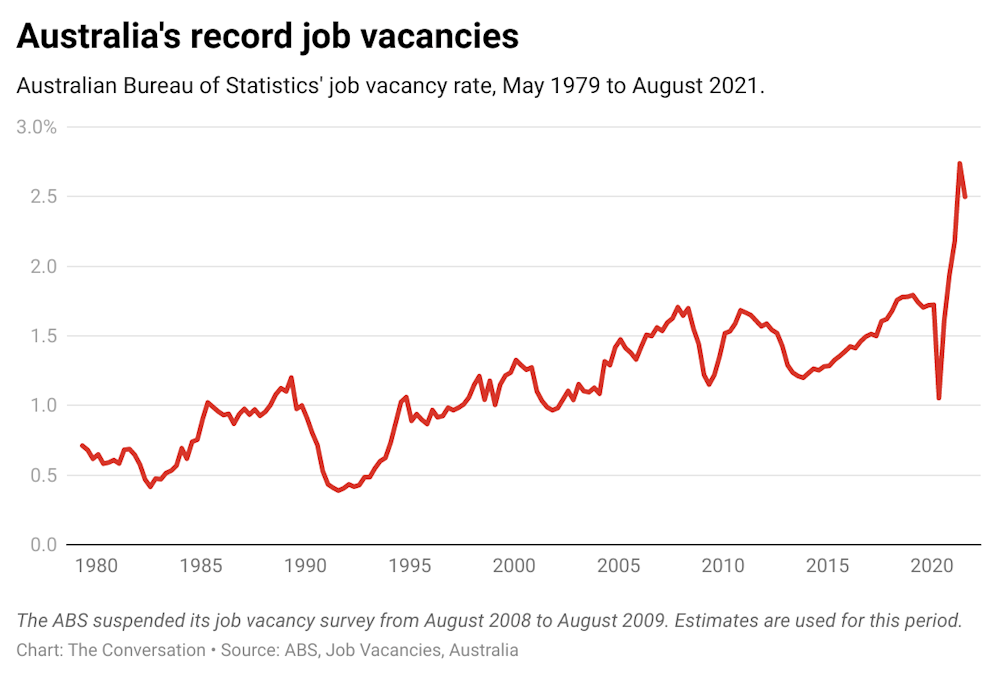
Job vacancies in Australia are at a record level. The Australian Bureau of Statistics’ job vacancy rate[1], measuring the proportion of available jobs currently unfilled, is now more than 2.5% – the highest level since the series started in the late 1970s.
This statistic gives weight to all the anecdotal talk about labour shortages in Australia. When employers have difficulty finding workers to hire, job vacancies stay unfilled longer and the vacancy rate increases.
 CC BY[4]
The high job vacancy rate primarily reflects this[5] fast pace, and the difficulty of hiring new workers in a short time. Hiring always lags new vacancies being created. With the bounceback from shutdowns, the lag has become pronounced.
Migration effects
Pandemic-related limits on international migration - especially temporary migrants, such as international students and working holiday makers – have also contributed to the labour shortages.
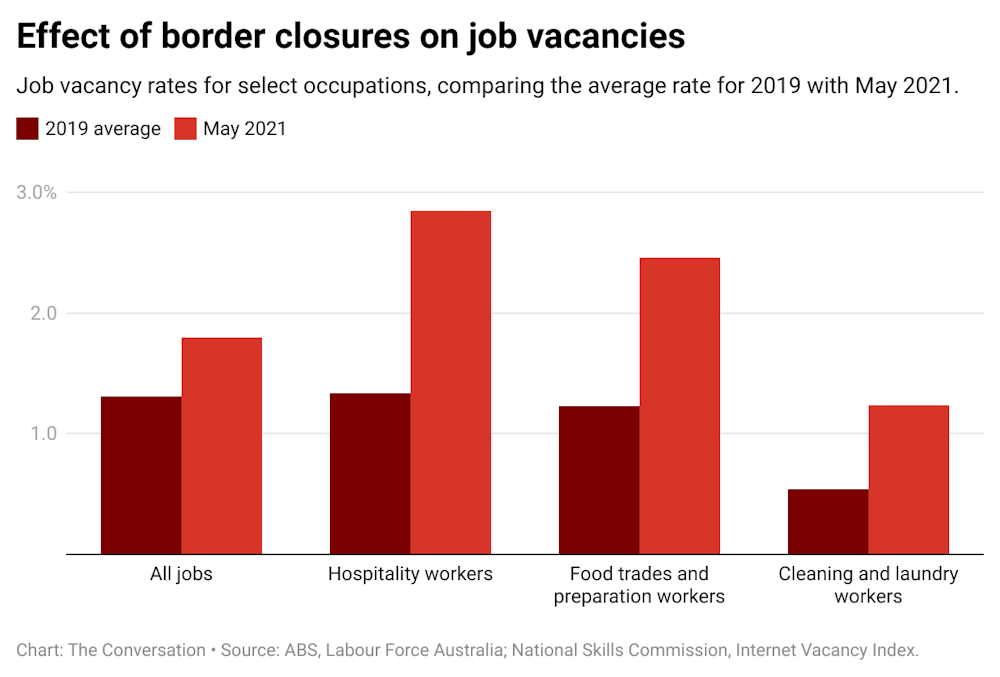
At the last census[6] (in 2016), the jobs most reliant on temporary migrants in were hospitality (18.3%); food trades and preparation (20.4%); and cleaning and laundry (19.3%).
By May 2021 (after a year of recovery and prior to the latest shutdowns in NSW and Victoria), the vacancy rates for these occupations were more than double their averages for 2019.
CC BY[4]
The high job vacancy rate primarily reflects this[5] fast pace, and the difficulty of hiring new workers in a short time. Hiring always lags new vacancies being created. With the bounceback from shutdowns, the lag has become pronounced.
Migration effects
Pandemic-related limits on international migration - especially temporary migrants, such as international students and working holiday makers – have also contributed to the labour shortages.
At the last census[6] (in 2016), the jobs most reliant on temporary migrants in were hospitality (18.3%); food trades and preparation (20.4%); and cleaning and laundry (19.3%).
By May 2021 (after a year of recovery and prior to the latest shutdowns in NSW and Victoria), the vacancy rates for these occupations were more than double their averages for 2019.
 As the effects of COVID-19 on the labour market dissipates, Australia’s vacancy rate should fall.
Read more:
Local training is the best long-term solution to Australia's skills shortages – not increased migration[7]
Effect on wages
In the meantime, there is natural interest in whether labour shortages will kick-start wage growth.
There some evidence that recent wage growth (over the year to the September quarter 2021) has been strongest in industries with the largest rises in job vacancy rates. Notable examples are professional, scientific and technical services (3.5%), construction (2.6%) and accommodation and food services (2.6%).
However, it is unlikely the COVID-related labour shortages are enough to make a permanent difference to wages.
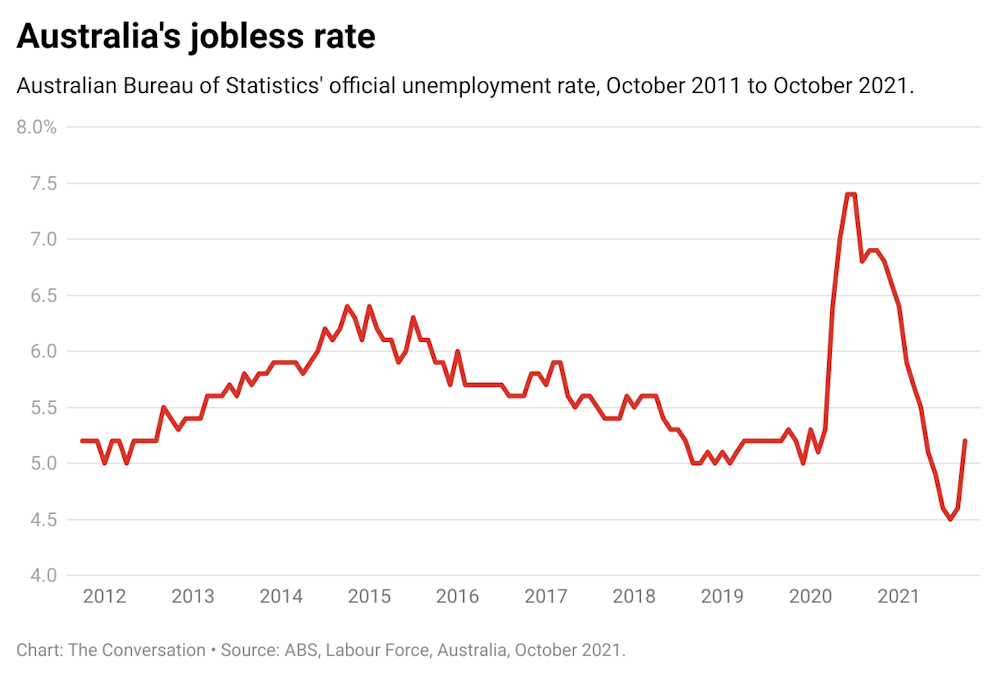
Even now, while shortages exist, much of the recovery in employment seems to be happening without big wage increases. In June 2021, when the rate of unemployment rate fell below 5% for the first time since in more than a decade, wage growth was still just a modest 0.44% for the quarter.
Read more:
Vital Signs: Chill, this week's news on wages points to anything but hyperinflation[8]
One reason for the lack of significant wages growth is revealed in the latest labour force statistics[9] from by Australian Bureau of Statistics. The majority of the COVID-19-related changes in employment involve workers being laid off during shutdowns and then returning to their old job.
During the national shutdown from March to May 2020, for example, more than 60% of workers on Job Seeker payments retained an attachment to their job. These workers accounted for the entire increase in employment from May to September 2020.
For employers, rehiring former workers has removed the need to offer higher wages to attract new staff.
For higher wages growth over longer term we will have to rely on policy makers, with the government and the Reserve Bank working together to get the unemployment rate down to 4% or lower.
References^ job vacancy rate (www.abs.gov.au)^ CC BY (creativecommons.org)^ the year to May 2021 (drive.google.com)^ CC BY (creativecommons.org)^ primarily reflects this (drive.google.com)^ census (www.abs.gov.au)^ Local training is the best long-term solution to Australia's skills shortages – not increased migration (theconversation.com)^ Vital Signs: Chill, this week's news on wages points to anything but hyperinflation (theconversation.com)^ latest labour force statistics (www.abs.gov.au)Authors: Jeff Borland, Professor of Economics, The University of Melbourne
As the effects of COVID-19 on the labour market dissipates, Australia’s vacancy rate should fall.
Read more:
Local training is the best long-term solution to Australia's skills shortages – not increased migration[7]
Effect on wages
In the meantime, there is natural interest in whether labour shortages will kick-start wage growth.
There some evidence that recent wage growth (over the year to the September quarter 2021) has been strongest in industries with the largest rises in job vacancy rates. Notable examples are professional, scientific and technical services (3.5%), construction (2.6%) and accommodation and food services (2.6%).
However, it is unlikely the COVID-related labour shortages are enough to make a permanent difference to wages.
Even now, while shortages exist, much of the recovery in employment seems to be happening without big wage increases. In June 2021, when the rate of unemployment rate fell below 5% for the first time since in more than a decade, wage growth was still just a modest 0.44% for the quarter.
Read more:
Vital Signs: Chill, this week's news on wages points to anything but hyperinflation[8]
One reason for the lack of significant wages growth is revealed in the latest labour force statistics[9] from by Australian Bureau of Statistics. The majority of the COVID-19-related changes in employment involve workers being laid off during shutdowns and then returning to their old job.
During the national shutdown from March to May 2020, for example, more than 60% of workers on Job Seeker payments retained an attachment to their job. These workers accounted for the entire increase in employment from May to September 2020.
For employers, rehiring former workers has removed the need to offer higher wages to attract new staff.
For higher wages growth over longer term we will have to rely on policy makers, with the government and the Reserve Bank working together to get the unemployment rate down to 4% or lower.
References^ job vacancy rate (www.abs.gov.au)^ CC BY (creativecommons.org)^ the year to May 2021 (drive.google.com)^ CC BY (creativecommons.org)^ primarily reflects this (drive.google.com)^ census (www.abs.gov.au)^ Local training is the best long-term solution to Australia's skills shortages – not increased migration (theconversation.com)^ Vital Signs: Chill, this week's news on wages points to anything but hyperinflation (theconversation.com)^ latest labour force statistics (www.abs.gov.au)Authors: Jeff Borland, Professor of Economics, The University of Melbourne