As Australian supermarkets are blamed over food costs, French grocer Carrefour targets Pepsi for 'unacceptable' price rises
- Written by: Garritt C Van Dyk, Lecturer, University of Newcastle
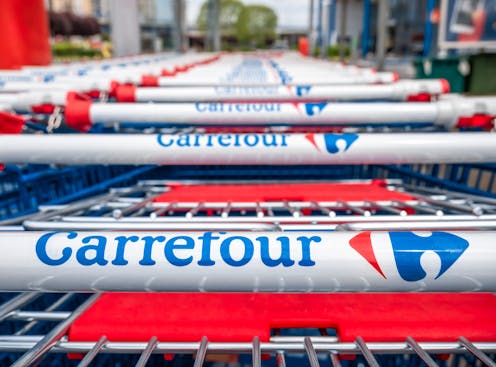
French supermarket Carrefour has fired a warning shot in a price war with global food brands, dropping PepsiCo products last week because of “unacceptably high[1]” increases.
This has seen Pepsi soft drinks removed from stores across Europe, as have Doritos, Quaker breakfast cereals and other food produced by the multinational.
It is usually the job of shoppers and consumer advocates to call out corporations for overstepping the mark on pricing, often targeting retailers. But this time, in a pre-emptive strike against the source of the increases, Carrefour pushed back, showing they were not the problem.
This is a radical departure from the usual policy of retailers passing on costs directly to consumers.
Refusing to carry producers’ brands – known as delisting products – can be risky for retailers, prompting customers to move to competitors who stock their favourite goods.
In Australia, 65% of the grocery retail sector[2] is controlled by Woolworths (37%) and Coles (28%), raising concerns about market dominance and a lack of real competition.
Strict rules set by the Australian Competition & Consumer Commission[3] (ACCC) govern the requirements for delisting to ensure there is no abuse of market power.
Market share vs brand value
In 2015[4] biscuit and snack food producer Arnott’s raised prices on 54 products by 10% and Coles refused to carry them.
This decision to stand up to the multinational (contradicting the stereotype it took advantage of its market dominance) was welcomed by many consumers.
However, some were not willing to go without their Tim Tams and Coles ultimately agreed to let Arnott’s raise the prices of 44 products.
Woolworths had a similar issue with Arnott’s in 2019[5] over prices and promotions, refusing to pass through an increase due to drought and currency fluctuations.
The opposite, however, happened earlier in the same year, when Uncle Toby’s [6]withheld inventory from Woolworths because they did not agree to pass on price hikes.
Runaway prices
Carrefour’s dispute with PepsiCo should be viewed in the context of the cost of food in Europe blowing out over the past two years, with average prices up 30% since 2021[7].
These increases have prompted retailers to be more transparent with consumers about how their profits compare to those of producers.
Revealing the cause of the price increases, and refusing to pass them on, distances the retailers’ business model from the producers’ opportunistic attempts to increase profits.
Price gouging or legitimate cost increases?
This week, Treasurer Jim Chalmers[8] echoed calls from the Coalition to investigate supermarket pricing and review the ACCC’s grocery code[9] to ensure savings are passed on as costs abate.
Data from the ABS[10] shows wholesale food costs only rose 0.7% in the most recent quarter, while the price for a typical basket of consumer food items rose 3.2%.

This gap also appears in Europe, where the percentage of “unexplained” rises in food prices increased from 3% to 10% from 2022 to 2023[12].
Bigger production costs did not account for all of the increases, leading to the conclusion producers were taking advantage of consumers, blaming the war in Ukraine, increased transport costs and global supply chain disruption to rationalise higher prices on the shelf.
In a 2023 report into European food inflation, Allianz said this was “catch-up profit-taking[13]” to recover losses from previous years.
The rise of shrinkflation
So-called “shrinkflation” – where the price of goods doesn’t change but they are sold in smaller quantities for the same price – has also made consumers groups sceptical.
In Australia, it is factored into the calculation of inflation for household goods and services as measured by the Consumer Price Index. The ABS characterises shrinkflation as a “quality decrease[14]”.
Consumer advocacy group CHOICE has noted shrinkflation in Australia since 2016 in its Community Forum[15], citing size reductions in products ranging from chocolate bars to breakfast cereals.
Read more: Amid allegations of price gouging, it's time for big supermarkets to come clean on how they price their products[16]
In Europe, Carrefour instituted a bold in-store campaign last year of naming and shaming brands that downsized products using signage that highlights the shrinkage.[17]
 Carrefour is warning customers some goods have been downsized/Getty.
This allows consumers to make informed decisions without limiting their buying options. But it also risks backlash from producers over how their goods are displayed on the shelf.
Without regulation, or a similar campaign from retailers, Australian consumers must check unit prices to ensure they are not paying more for less.
A chance to generate goodwill
Carrefour’s stand against a global brand and decision to delist their products recognises consumers everywhere are feeling the impact of higher prices.
At a time when the Senate[18] is investigating claims of price gouging by Australia’s largest supermarket chains, more transparency would be a welcome change.
From negotiations at the farm gate to the multinational boardroom, there is an opportunity for the big grocery retailers to pass on savings where possible, and increase brand loyalty.
Read more: The cost of living is biting. Here’s how to spend less on meat and dairy[19]
References
- ^ unacceptably high (www.washingtonpost.com)
- ^ 65% of the grocery retail sector (www.huntexportadvice.com)
- ^ Australian Competition & Consumer Commission (www.accc.gov.au)
- ^ 2015 (cmaconsulting.com.au)
- ^ 2019 (www.afr.com)
- ^ Uncle Toby’s (www.heraldsun.com.au)
- ^ average prices up 30% since 2021 (think.ing.com)
- ^ Jim Chalmers (www.smh.com.au)
- ^ code (www.accc.gov.au)
- ^ Data from the ABS (www.afr.com)
- ^ Mick Tsikas/AAP (photos.aap.com.au)
- ^ 3% to 10% from 2022 to 2023 (www.allianz.com)
- ^ catch-up profit-taking (www.allianz.com)
- ^ quality decrease (www.abs.gov.au)
- ^ Community Forum (choice.community)
- ^ Amid allegations of price gouging, it's time for big supermarkets to come clean on how they price their products (theconversation.com)
- ^ signage that highlights the shrinkage. (www.bbc.com)
- ^ Senate (www.aph.gov.au)
- ^ The cost of living is biting. Here’s how to spend less on meat and dairy (theconversation.com)
Authors: Garritt C Van Dyk, Lecturer, University of Newcastle