Economists say Australia shouldn’t try to transition to net zero by aping the mammoth US Inflation Reduction Act
- Written by: Peter Martin, Visiting Fellow, Crawford School of Public Policy, Australian National University
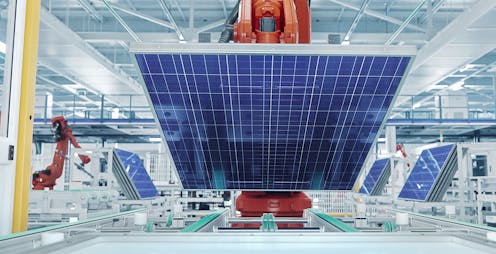
Australia’s top economists are pressing Prime Minister Anthony Albanese not to ape US President Joe Biden’s “think big” approach to clean energy.
Biden’s so-called Inflation Reduction Act[1] – dubbed the largest climate investment[2] in US history – directs nearly US$400 billion (A$605 billion) in federal funding to support clean energy through tax breaks, grants and loan guarantees. Its goal is to halve US emissions[3] by 2035.
Among the biggest beneficiaries will be US firms producing hydrogen, wind turbines, solar cells and batteries.
In the lead-up to this year’s May budget, Albanese said that, like in the US, he wanted Australia’s government to be a partner[4] in the energy transformation, not just an observer.
He wanted to “think big”.
While Australia need not go “dollar-for-dollar” against the US and other nations in the scale of its spending, it could go “toe-to-toe” on the impact of its programs.
Not dollar-for-dollar, not toe-to-toe
Today, in a survey commissioned by the Economic Society of Australia and The Conversation, an overwhelming majority of Australia’s pre-eminent economists cautioned against special support for projects that will drive the energy transition. Instead, most backed grants to innovative firms across the entire economy.
The 44 leading economists who took part have been recognised by their peers[5] as Australia’s leaders in fields including economic modelling and budget policy.
Asked whether Australia should ape the US Inflation Reduction Act by subsidising firms in the same industries, provide access to credit for firms that would supply the US, or merely provide more grants to innovative firms across the entire economy, two-thirds[6] voted for supporting innovation across the economy.
Only four wanted Australia to copy the US.
Two of the experts surveyed declined to pick an option. Economic modeller Warwick McKibbin said labour market and tax reforms were the best ways to encourage new firms. Energy specialist Frank Jotzo said government support needed to deliver returns to the nation, not just prop up company profits.
McKibbin said any support for particular Australian businesses should be in the form of contingent loans[7], ensuring successful recipients with high cash flows paid back a proportion of their profits.
Mark Cully, a former chief economist with the federal Department of Industry, said there was no point in going head-to-head or toe-to-toe with the United States, the European Union or South Korea in doing things such as making batteries.
Supply the US revolution, don’t copy it
Cully said Australia was well placed to supply the resources those countries will need to develop green industries as well as to benefit from what they produce.
But Australian investment in research and development has been falling as a share of GDP for a decade, endangering productivity. The public component of this investment is now just 0.5% of GDP, the least on record.
Funding should be directed to research and development across the economy through institutions such as the CSIRO and business-university linkages, steering clear of “picking winners[8]”.

Speaking before last week’s announcement of A$840 million[10] in government loans to support a rare earths mine backed by Australia’s richest person, Gina Rinehart, economic modeller Janine Dixon said Australia should do all it could to ensure the benefits of public investments stayed with the public rather than private companies.
Economist Saul Eslake said corporate rent-seeking[11] (businesses getting special favours) helped Australia slide from being one of the richest countries in the world at federation to being about 26th by the early 1990s, when governments became less supportive.
John Quiggin supported advancing loans to firms that supplied US projects. He said while it was less than optimal, the government was almost certain to support manufacturing, and this was better than building AUKUS submarines[12].
Consultant Rana Roy, who voted for no government support, said Australia was experiencing the biggest dive in living standards in half a century[13]. He said the government would be
better advised to spend the remaining months until the next election concentrating for once on the modest task of preventing a further collapse in Australian living standards.
The United States would shortly elect its next president and Congress. They might be much less well disposed to the Inflation Reduction Act, leaving Australia with little to respond to.
Impose conditions
Many of those surveyed reiterated their support for a carbon tax as the best way of cutting emissions. Many more bemoaned what they said was the futility of “picking winners”. Economist Stefanie Schurer said it had never been a good policy in the past, and would not be in the future, adding:
this remains true even if other countries do it.
While eschewing picking winners, economists Adrian Blundell-Wignall, David Byrne, Nicki Hutley and Lisa Magnani said a well-designed grants scheme could encourage investment if it ensured the recipients provided value for money.
Support should be temporary and come with conditions, as in the United States.
Individual responses. Click to open:
References
- ^ Inflation Reduction Act (home.treasury.gov)
- ^ largest climate investment (www.whitehouse.gov)
- ^ halve US emissions (www.anthropocenemagazine.org)
- ^ partner (www.pm.gov.au)
- ^ recognised by their peers (esacentral.org.au)
- ^ two-thirds (public.flourish.studio)
- ^ contingent loans (theconversation.com)
- ^ picking winners (www.afr.com)
- ^ AAP (photos.aap.com.au)
- ^ A$840 million (www.afr.com)
- ^ rent-seeking (www.investopedia.com)
- ^ AUKUS submarines (www.abc.net.au)
- ^ biggest dive in living standards in half a century (theconversation.com)
Authors: Peter Martin, Visiting Fellow, Crawford School of Public Policy, Australian National University