Scrap the West Australian GST deal set to cost $40 billion – leading economists
- Written by: Peter Martin, Visiting Fellow, Crawford School of Public Policy, Australian National University
Australia’s top economists overwhelmingly want Prime Minister Anthony Albanese to scrap a special deal with Western Australia that’s set to deliver it an extra A$40 billion in Commonwealth funding by the end of the decade.
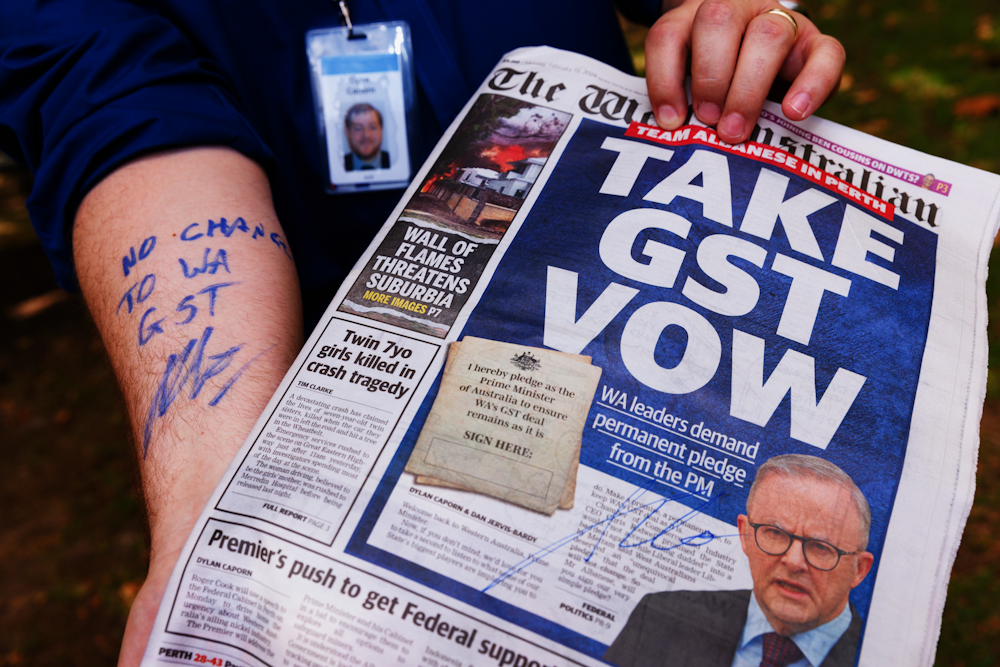
Albanese pledged to maintain the special treatment for Western Australia in a visit to Perth in February. He even signed a promise on a newspaper front page and a reporter’s arm[1] with a marker pen.
The deal was struck in 2018 by the then Western Australian premier, Mark McGowan, and then federal treasurer, Scott Morrison. It gives Western Australia a much greater share of the centrally collected goods and services tax than it is entitled to under the formula administered by the Commonwealth Grants Commission.
In place in various forms since Federation, the formula distributes funds in such a way as to ensure each state and territory would be able to deliver comparable services[3] if it made a similar effort to raise revenue from its own resources. It has been used to distribute GST collections since 2000.
For most of the past 100 years the formula has delivered more to the smaller states (including Western Australia) than would be expected on the basis of population, and less to the larger states of New South Wales and Victoria.
In the leadup to 2018, the mining boom changed that. The amount of GST delivered to Western Australia was pushed down to only 45% of what it would have got if the GST was split on the basis of population, in recognition of its much greater ability to raise revenue.
Morrison and McGowan’s deal phased in a floor under how much of the GST each state could get. In June it will climb to 75%[4] of what the state would get on the basis of population, and from 2026 to no less than the strongest of Victoria and NSW get, no matter how strong the state’s economy.
Haul of $30 billion to $50 billion
The extra payments to Western Australia will initially be funded from general Commonwealth tax revenue, rather than by cutting GST payments to other states.
Estimates of the cost by 2030 range from $30 billion[5] to $50 billion[6]. Independent economist Saul Eslake puts the cost at $39.2 billion[7], assuming the iron ore price falls in line with budget assumptions.
Beyond 2029‑30, any extra payments to Western Australia will come from the GST total at the expense of other states[8].
Asked whether the long-standing method of distributing GST revenue in accordance with need and ability to pay is broadly the best one, 25 of the 38 top economists who responded to the Economic Society of Australia poll said yes.
Ten said no, five of them saying it would be better to move towards a system where revenue was distributed on the basis of population or gross state product.
Asked whether the 2018 changes that advantaged Western Australia should be kept or scrapped, 28 of the 38 wanted them scrapped.
Only four wanted them kept.
The 38 experts who took part are recognised by their peers as leaders in fields including tax and budget policy. Two are from Western Australia.
Several observed that the natural resources with which Western Australia is endowed are a matter of luck, “even acknowledging that it takes skill and effort to extract them”.
Sue Richardson from the University of Adelaide argued that minerals were a national rather than a local resource and it undermined the integrity of the nation to have the benefits from mining them concentrated in the part of the nation in which they sat.
Read more: It's time to end Western Australia's $4 billion-per-year GST bonus[9]
Eslake said that even if Australia had no state governments and just one central government, as did Japan and New Zealand, it would still make sense to distribute resources to the parts of the nation with the greatest need in much the same way as the Grants Commission has traditionally done.
Consultant Rana Roy said that distributing resources away from the rich states in order to make the poorer states more liveable was actually in the rich states’ best interests.
“Paris would not benefit if an impoverished rest-of-France were to decamp to Paris,” he said. “And London would not benefit if an impoverished rest-of-Britain were to decamp to London.”
Tasmania’s Hugh Sibly added that Australians move between states and many retire in a different state to the one in which they paid taxes, giving the entire nation an interest in ensuring all parts of the nation were liveable.
Equalisation good, but complex
Others surveyed said the calculations used to deliver what was once known as “full equalisation” and since 2018 has been known as “reasonable equalisation[10]” were complicated – “almost farcical” – and should be replaced by something simpler, even if it made the system less fair.
One suggestion was that GST revenue should be allocated on the basis of the size of each state’s economy. Another was that it be allocated on the size of each state’s population, with top-up grants used to meet particular needs.
Former OECD official Adrian Blundell-Wignall said the needs of Indigenous Australians in particular should be addressed directly rather than by GST distributions as the governments that got GST money on the basis of their high Indigenous populations did a very poor job of spending it on those populations.
Two of the economists surveyed suggested a Commonwealth resource tax of the kind promoted by former Treasury head Ken Henry who said earlier this month Australia should stop revering plunder and dumb luck[11], and abandon its “finders keepers” approach to minerals.
The Productivity Commission will review the Western Australian deal in 2026[12].
Individual responses. Click to open:
References
- ^ reporter’s arm (www.theguardian.com)
- ^ Richard Wainwright/AAP (photos.aap.com.au)
- ^ comparable services (www.cgc.gov.au)
- ^ 75% (ministers.treasury.gov.au)
- ^ $30 billion (www.smh.com.au)
- ^ $50 billion (www.afr.com)
- ^ $39.2 billion (taxpolicy.crawford.anu.edu.au)
- ^ at the expense of other states (ministers.treasury.gov.au)
- ^ It's time to end Western Australia's $4 billion-per-year GST bonus (theconversation.com)
- ^ reasonable equalisation (ministers.treasury.gov.au)
- ^ plunder and dumb luck (theconversation.com)
- ^ 2026 (www.cgc.gov.au)
Authors: Peter Martin, Visiting Fellow, Crawford School of Public Policy, Australian National University