Cairns Esplanade Lagoon — the stage where Cairns comes to life
- Written by: The Times
“All the world's a stage.”
Shakespeare wasn't writing about Cairns when he penned that famous line in As You Like It.
But stand beside the Cairns Esplanade Lagoon on a beautiful sunny day and the analogy seems remarkably appropriate.
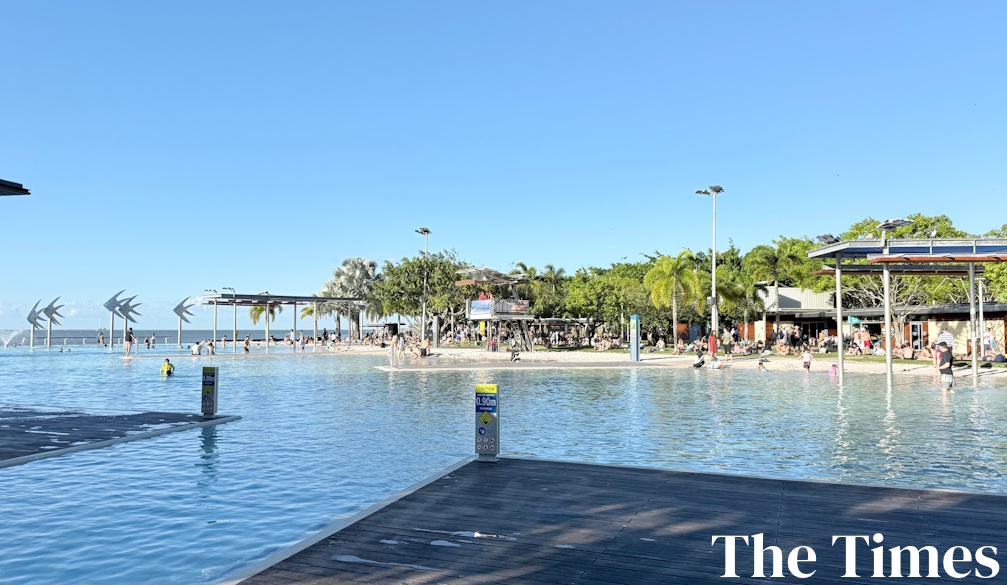
The Lagoon is Cairns' stage.
The cast changes constantly.
Children splash through the water.
Parents supervise from the edge.
Backpackers lie on the grass.
Travellers arrive with towels over their shoulders.
Locals meet friends.
Joggers pass.
People read books beneath the trees.
Couples wander along the Esplanade.
Someone is eating lunch.
Someone else has nowhere in particular to be.
And beyond all of them is the tropical Cairns waterfront.
The Lagoon itself is impressive.
But the Lagoon is not really the story.
The people are.
Every city needs a stage
Cities need places where people naturally come together.
Sometimes it is a square.
Sometimes a beach.
Sometimes a park.
In Cairns, it is difficult to think of anywhere that performs that role better than the Esplanade Lagoon.
Nobody has to organise the gathering.
There is no event.
No admission ticket.
No invitation.
People simply arrive.
On a sunny day, particularly when Cairns is busy with visitors, the result can feel like a constantly changing performance.
Sit there for an hour and Cairns passes in front of you.
Travellers become part of Cairns
This is what distinguishes the Lagoon from a conventional tourist attraction.
You don't merely visit it.
You join it.
A traveller arriving from Sydney, Melbourne, Tokyo, London or Auckland doesn't stand behind a barrier watching something happen.
They put down their towel and become part of the scene.
For an afternoon, there is little distinction between visitor and local.
Everyone is sharing the same water, lawns, sunshine and waterfront.
That is a rare quality in a tourism destination.
The cast changes throughout the day
Go early in the morning and you see one Cairns.
People exercise along the Esplanade.
The temperature is gentler.
The city is waking.
Later the families arrive.
Then the travellers.
As the tropical day warms, the water becomes increasingly irresistible.
By afternoon, on the right day, the entire precinct can be alive.
Then the light begins to soften.
People leave the water.
Some return to hotels.
Others head towards restaurants and bars.
The stage remains.
Only the cast changes.
Tomorrow another performance begins.
And admission is free
Perhaps that is the best part.
Cairns has created one of its most recognisable attractions and then opened the doors to everybody.
There is no distinction between somebody staying in an expensive waterfront hotel and a backpacker carefully managing a daily budget.
The local family belongs there.
So does the international visitor.
So does the retiree sitting under a tree watching everyone else.
Public spaces work best when people feel they belong in them.
The Cairns Lagoon achieves exactly that.
The pool isn't the attraction
Of course, technically, the Lagoon is the attraction.
But watch it closely and you realise something else.
An empty Lagoon would simply be an impressive piece of public infrastructure.
People give it life.
Children create the noise.
Travellers create the international atmosphere.
Locals give it authenticity.
Families turn it into a community space.
The surrounding walkers, runners and spectators connect it with the rest of the Esplanade.
The physical Lagoon provides the stage.
Cairns provides the performance.
Cairns Times View
There are bigger swimming pools.
There are more luxurious resort pools.
There are more spectacular Australian beaches.
But that isn't the point.
The Cairns Esplanade Lagoon succeeds because it has become something more important than a place to swim.
It is where people gather.
Where travellers encounter locals.
Where children play.
Where backpackers spend an inexpensive afternoon.
Where residents meet friends.
Where somebody can sit beneath a tree for an hour and watch an entire tropical city move around them.
Shakespeare wrote that all the world's a stage.
In Cairns, on a sunny day, you could be forgiven for thinking he had the Esplanade Lagoon in mind.
The Lagoon is the stage.
The people of Cairns — permanent and temporary — provide the show.
Find out more at https://thecairnstimes.com.au/guides-articles/39388-cairns-esplanade-lagoon-the-centre-of-the-universe-on-a-sunny-day