

If the government is re-elected it may be in spite of Scott Morrison rather than because of him
- Written by: Michelle Grattan, Professorial Fellow, University of Canberra
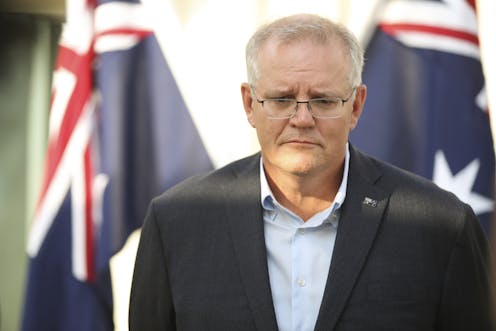
When Scott Morrison fronted the travelling media at a stopover in Dubai on his way home, he looked drained. Here was a man in need of a steaming hot bath, and a big political reset.
He’s presumably had the opportunity for the former; he and his advisers will be mulling over the latter for a long while yet. It’s not an easy assignment, especially when it involves issues of integrity.
The “character” question is important in politics. In recent political history, it was part of the downfall of then Labor leader Mark Latham, who had appeared a strong prospect in the lead-up to the 2004 election.
Morrison has long been regarded as a slippery political player. The imbroglio with the French, in which Emmanuel Macron branded him a liar and he responded with a leaked Macron text, has further tarnished Morrison’s personal reputation – even accepting Australians won’t be inclined to side with France.
Labor is banking on these events playing into the negatives about Morrison that are already in some voters’ minds. Anthony Albanese said: “The only thing that the prime minister has accomplished on this trip is proving that he can’t be trusted”.
To adapt a line from Morrison’s climate policy mantra, the issue is not the “if” or “when” he needs to move forward, but the “how”.
With next year’s election rushing towards him, Morrison personally is no longer a clear asset for the government, as he was in 2019. It may be that, if the Coalition wins another term, it will be more in spite of him than because of him.
The Coalition normally wants “trust” to be a part of its pitch to voters. But how to do this, when the tag “liar” has been pinned onto its leader?
It’s difficult, although not impossible on the history. Immediately before he called the 2004 election, John Howard’s integrity had been freshly disputed in a hangover from the 2001 “children overboard” affair. That didn’t stop him making “trust” the centrepiece when he announced the poll. “Who do you trust to keep interest rates low?” he asked.
Read more: View from The Hill: A battered Scott Morrison proclaims it's time to 'move on'[1]
“Trust” can operate at more than one level. A voter might regard a leader as someone loose with the truth, but still trust him or her over the alternative to manage the economy or national security. It becomes a matter of which “trust” issue weighs more heavily with the electorate.
On the economic front, this government can expect to have a strong story for its election pitch. The September-quarter numbers, when they come, will show the economy having gone backwards because of the lockdowns, but the quarters that follow are looking good.
Reserve Bank Governor Philip Lowe said this week: “As vaccination rates increase even further and restrictions are eased, the economy is expected to bounce back relatively quickly”. Growth of 3% is forecast over 2021, with 5.5% and 2.5% over the following two years. Lowe did add the obvious uncertainty – “the possibility of a further setback on the health front”.
The government can argue that, in economic terms, it sustained the community through the pandemic and therefore can be trusted on economic management.
But it may regard the “trust” ground in general as too treacherous, especially as linking “trust” and “politicians” raises a horse laugh in the community these days. “Who do you regard as more competent to manage the economy?” might avoid the hazards of having Morrison campaigning on “trust”.
The prime minister no doubt would like to rope in “national security” as a pillar of his election pitch and he would have thought the trilateral AUKUS agreement with the United States and the United Kingdom provided the ideal platform.
But, important as AUKUS is, relying on it in political terms has become more problematic. Not only does that take Morrison back to the fracas with the French, but there are increasing questions over the much-vaunted promise of nuclear-powered submarines.
All we have is an 18-month consultation process for these boats. We don’t know whether the design would come from the US or the UK. We do know the first sub wouldn’t appear for nearly two decades.
Given the Coalition’s abysmal performance over most of its term on submarines, some of the initial shine has gone off this deal, although it retains the public support of Labor.
Read more: View from The Hill: How will Macron's 'pants on fire' claim about Morrison play in the focus groups?[2]
More generally, Labor is sticking close to the government on security issues, denying it a fight.
Ironically, the issue that was predicted to cause Morrison trouble on his trip – the government’s lacklustre commitment on climate policy for COP26 – turned out to be the least of his problems.
Australia’s policy didn’t impress, but that was overshadowed by the more general and important disappointments at the conference.
So, the political strategists will now be asking, where does this leave the climate issue for the election?
Still potent, one would guess, but lacking some of the sharpness it had before Glasgow – both because that focal point will have passed and because the conference, which is still running, isn’t as ground-breaking as many hoped.
Labor would be savvy to position its climate policy as somewhat more ambitious than Morrison’s but not too much more.
On the government side the Nationals, having reluctantly climbed on board for net-zero in 2050, are already feeling heat in Queensland. They need the government to pull out all stops to announce soon the trade-offs they were promised.
Morrison’s troubles strengthen the case for him to wait until May for the election and launch it off the back of an April budget.
Treasurer Josh Frydenberg pointed on Thursday to an expected pre-poll budget. Asked on Sky to confirm there’d be a budget before the election he said, “Well, the prime minister’s spoken in those terms”.
Read more: 'I don't think, I know' – what makes Macron's comments about Morrison so extraordinary and so worrying[3]
This would be the third election in a row that effectively started with a budget. That worked for Morrison in 2019; it didn’t go so well for Malcolm Turnbull in 2016, when he lost a swag of seats.
A budget – if received well – can usefully frame the campaign. If the economic outlook is rosy, as it looks like it may be, a pre-election budget can emphasise that. It can be used to put new policy in the most positive light (the wrinkles may only emerge later).
Another budget would give more prominence to Frydenberg, which would be an advantage if Morrison is tracking as damaged.
An April budget could also be a challenge for Labor, potentially forcing it into a more reactive position.
But while the arguments are strong for using a budget as the campaign’s start, there can be risks – one of them being that if there’s a sudden change of circumstances the government can’t delay – it has run out of time. And as Morrison’s trip showed so graphically, politics is always about the unexpected.
References
- ^ View from The Hill: A battered Scott Morrison proclaims it's time to 'move on' (theconversation.com)
- ^ View from The Hill: How will Macron's 'pants on fire' claim about Morrison play in the focus groups? (theconversation.com)
- ^ 'I don't think, I know' – what makes Macron's comments about Morrison so extraordinary and so worrying (theconversation.com)