

Why the Australian government must listen to Torres Strait leaders on climate change
- Written by: Eddie Synot, Lecturer, Griffith Law School, Griffith University
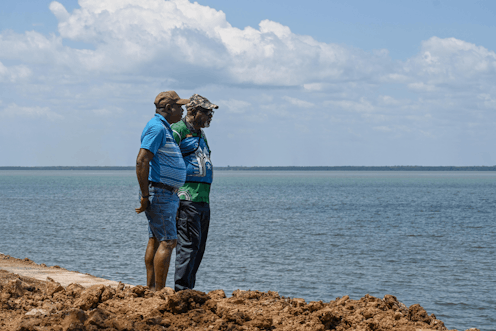
Last month, First Nations leaders Pabai Pabai and Paul Kabai filed a landmark class action[1] against the Australian government to protect communities in the Torres Strait from climate change.
In the Torres Strait, First Nations communities are facing an existential threat[2] as the planet warms. Rising seas are already inundating infrastructure and cultural sites, and some islands may be uninhabitable by the end of the century causing devastating harm to Torres Strait Islander Peoples and Ailan Kastom culture.
Mr. Pabai and Mr. Kabai have seen the impacts first hand. They have filed their class action to protect over 65,000 years of connection to land. Mr. Kabai has described[3] the class action as answering their responsibility to community and culture.
We have a cultural responsibility to protect our communities, our culture and spirituality from climate change – for our ancestors and future generations.
Mr. Pabai and Mr. Kabai are part of a proud history of Torres Strait Islander Peoples fighting for their rights through the courts. They draw on the legacy of Eddie Mabo and his co-plaintiffs James Rice and David Passi, who took on the government and established that terra nullius was a lie[4], paving the way for Native Title recognition as we know it today.
Mr. Kabai and Mr. Pabai are also part of the foundational tradition of First Nation stewardship of land and water. As Traditional Owners, their knowledge and protection of Country is vital to tackling climate change.
Indigenous Peoples have always known this. Our communities have adapted and thrived together by caring for country for countless generations. The scientific community has only recently caught up.
In 2019, the Intergovernmental Panel on Climate Change[5] recognised Indigenous Peoples, our knowledge and rights to land and water are key to tackling climate change.
Pabai and Kabai’s case
In their class action, Mr. Pabai and Mr. Kabai will argue the Australian government has a duty to protect the people, islands, and culture of the Torres Strait. The duty arises from the common law of negligence, the Torres Strait Treaty[6] (between Australia and Papua New Guinea, providing protection for the way of life of traditional peoples of the Torres Strait Protected Zone), and the Native Title rights of Torres Strait Islander Peoples.
The legal rights Torres Strait Islander Peoples hold as Traditional Owners of their lands and waters are central to Mr. Kabai and Mr. Pabai’s case. As is their deep spiritual and personal connection to the islands.
Mr. Kabai has further detailed[7] that if the government’s climate failure continues they will lose everything.
Becoming climate refugees means losing everything: our homes, our culture, our stories and our identity […] If you take us away from this island then we’re nothing. It’s like the Stolen Generation, you take people away from their tribal land, they become nobodies.
The Australian government’s responsibility to Torres Strait Islander Peoples comes from the particular vulnerability of their communities to climate harms like sea level rise. Similar arguments[8] have been made and won by the Sami people in Norway to protect their rights as part of climate change mitigation. Although in different legal and political contexts, both Indigenous rights and climate action are entrenched, structural priorities.
Mr. Pabai and Mr. Kabai will argue the government’s failure to reduce emissions will extinguish the Native Title rights of Torres Strait Islander Peoples as their traditional lands are lost beneath rising seas.
In court, they will urge the government to take pre-emptive steps to stop climate change impacts from destroying their islands – and with them, over 65,000 years of custom and culture protected by Native Title.
The government’s responsibility to act is also said to come from legal protections provided by the Torres Strait Treaty. Australia entered into the Treaty with Papua New Guinea in 1978, after grassroots political pressure from Torres Strait Islander leaders like Getano Lui Snr.
The Treaty created a protected zone to acknowledge and protect the traditional way of life of Torres Strait Islander Peoples and requires the Australian government to prevent damage to the marine environment of the Torres Strait.
These protections exist to preserve the deep spiritual connection First Nations communities have to their islands and waters.
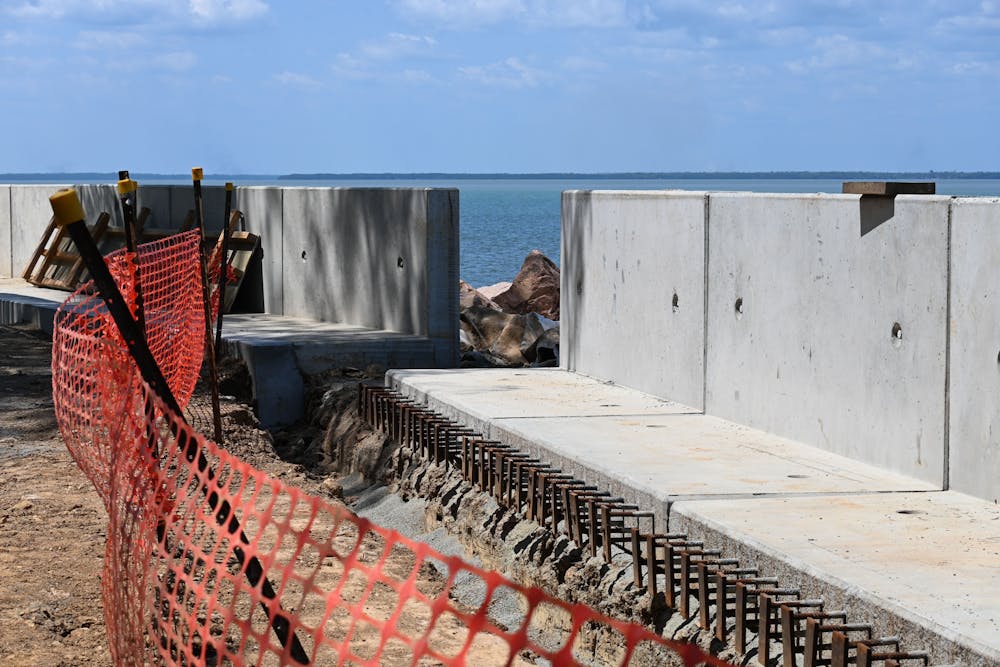 A concrete seawall in the Torres Strait protecting against rising sea levels.
Talei Elu
A concrete seawall in the Torres Strait protecting against rising sea levels.
Talei Elu
The importance of this connection to Country has been recognised by the High Court. In 2019, the court found the Northern Territory government was responsible for spiritual hurt[9] caused to Ngaliwurru and Nungali native title holders by the building of roads and infrastructure on their traditional lands.
It is this combination of legal rights – unique to Torres Strait Islander Peoples – that Mr. Pabai and Mr. Kabai will rely on to ask the court to create a new duty of care.
Read more: What climate change activists can learn from First Nations campaigns against the fossil fuel industry[10]
Recent developments
Earlier this year, the Federal Court found[11] a novel duty of care not to cause climate harm to young people. The Court found that the minister for the environment had a responsibility to take reasonable care to avoid harm to children caused by greenhouse gas emissions when exercising her power to approve new coal mining.
Mr. Pabai and Mr. Kabai’s case is the first of its kind because it argues a far broader case: that the Australian government has a duty to protect the Torres Strait from climate harm.
While this may sound ambitious, these kinds of cases have worked before. Most notably, in the Netherlands, where the Urgenda Foundation[12] and 886 people took the Dutch government to court for climate inaction – and won.
The Urgenda Foundation[13] has partnered with Mr. Pabai and Mr. Kabai on their case, and the circumstances are similar. Both communities live on land perilously exposed to rising sea levels and face severe harm from climate change.
Read more: If governments fail to act, can the courts save our planet?[14]
A legacy of nation shaping
First Nations communities have a history of bringing legal cases vital to the development of Australian law. Often against the odds.
Mabo’s legal victory placed the Torres Strait at the centre of a transformation in the way the Australian nation places itself in a long history of Indigenous ownership and connection. Mr. Kabai and Mr. Pabai are inspired by that legacy.
As world leaders meet in Glasgow for the COP26 climate summit, billed as a “last chance” for real climate action, Mr. Pabai and Mr. Kabai are asking the Australian government to step up and stop causing harm.
Their class action could prevent extreme climate harm for all Torres Strait Islander Peoples, and all Australians.
It is a vitally important case. It is also an action taken by traditional owners that highlights our continued commitment to country over countless generations, a commitment that is a proven practice of providing for all of existence.
References
- ^ filed a landmark class action (climatecasechart.com)
- ^ existential threat (theconversation.com)
- ^ described (www.gratafund.org.au)
- ^ terra nullius was a lie (australianstogether.org.au)
- ^ Intergovernmental Panel on Climate Change (ipccresponse.org)
- ^ Torres Strait Treaty (www.tsirc.qld.gov.au)
- ^ detailed (www.sbs.com.au)
- ^ Similar arguments (www.theguardian.com)
- ^ responsible for spiritual hurt (www.hrlc.org.au)
- ^ What climate change activists can learn from First Nations campaigns against the fossil fuel industry (theconversation.com)
- ^ Federal Court found (theconversation.com)
- ^ Urgenda Foundation (www.urgenda.nl)
- ^ The Urgenda Foundation (www.urgenda.nl)
- ^ If governments fail to act, can the courts save our planet? (theconversation.com)