

Is Canberra having a #metoo moment? It will take more than reports of MPs behaving badly for parliament to change
- Written by: The Conversation
Sex and politics is a well-established theme[1] of political life.
Often the debate comes back to whether or not politicians deserve private lives[2]. The short answer is yes, of course. But this question is also misleading.
Too often the scandals arise out of political workplaces. While it might be Liberal Party ministers in the spotlight this time[3], this is not a problem exclusive to the Coalition. It is pervasive across political systems in Australia[4] and worldwide[5].
Amid fresh allegations of MPs behaving badly[6], we need to look past the personal drama of each individual story and consider what they tell us about the wider structures in which politicians and their staff operate.
Minister-staff dynamics
Political staff are not public servants. They are employed under separate legislation[7] and are hired and fired at the discretion of their boss — the minister, shadow minister or MP.
Staffers’ duties are poorly defined, and can range from emotional support[8] to high level policy work[9]. Their employment can be terminated with no notice (although this is currently under review[10] in the latest enterprise bargaining agreement).
Read more: Porter rejects allegations of inappropriate sexual behaviour and threatens legal action after Four Corners investigation[11]
There is little oversight over who MPs appoint, with involvement from party leaders typically viewed as interference[12]. Indeed, there is little oversight of the work of political advisers generally — they cannot be summoned to appear before parliamentary committees.
Theoretically, ministers are responsible for their staff, but as we increasingly see, advisers can also be shields for their ministers, resigning [13] when things go wrong.
While it may not be illegal or even immoral, the issue at stake here is a power imbalance. It is hard to argue sexual relations within this work environment could meet our modern standard of a mutually consensual relationship. Even if things start well, what happens if they end badly?
Political advisers turn into politicians
What happens in political offices matters for many reasons. Beyond creating safe workplaces, it also has an impact on who rises through the political ranks.
Evidence from across Westminster systems[14] shows politicians increasingly have a background in political advising[15] before they are elected.
 Many MPs do time as political advisers before they are elected.
www.shutterstock.com
Many MPs do time as political advisers before they are elected.
www.shutterstock.com
Emerging evidence also suggests a stint as an adviser is increasingly[16] associated with the probability[17] of selection to safe seats and, later, ministerial office.
Why? Because politics is a networks[18] game. And as politics has become more professionalised, the skills political staff obtain are seen as more important than skills gained via community organising or pathways through party membership.
We already know this has a disproportionate impact on women. Women were less likely to gain experience via their party machines and are less likely to be promoted to the most senior ranks[19] of political offices.
Read more: Why a code of conduct may not be enough to change the boys' club culture in the Liberal Party[20]
The type of work they do in political offices tends to be of a lower status, less strategic and with less access to ministers. Put another way, they are less likely to get the valuable experience they require to move forward in their careers and less likely to have seniority and power in the office.
Adding any unwanted sexual advances, or relationships which fail, place yet another barrier for young female staff. This was reflected in the case of two Liberal staffers who came forward with claims of sexual assault[21] in 2019.
Parliament House is a workplace
It is true federal parliament is an atypical work environment: it is more intense than most and is more likely to breed a dimension of co-dependence with support staff than most other professions.
But parliament’s status as the seat of government does not make it “special” and therefore, beyond community standards.
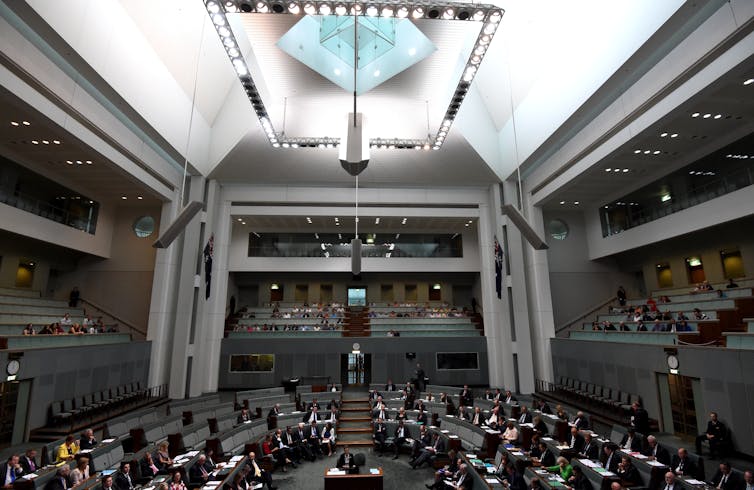 Parliament House is an atypical work environment, but it still needs to meet community standards.
Mick Tsikas/AAP
Parliament House is an atypical work environment, but it still needs to meet community standards.
Mick Tsikas/AAP
If anything, public expectations suggest politicians are held to a higher standard than most managers. This is because there is a recognition politicians are disproportionately powerful and influential. MPs regularly affirm their legitimacy by claiming to represent everyday Australians. This means they need to reflect community standards.
This trade-off between ministers’ privileges and responsibilities are reflected in the Statement of Ministerial Standards[22] which begins with two principles:
The ethical standards required of Ministers in Australia’s system of government reflect the fact that, as holders of public office, Ministers are entrusted with considerable privilege and wide discretionary power.
In recognition that public office is a public trust, therefore, the people of Australia are entitled to expect that, as a matter of principle, Ministers will act with due regard for integrity, fairness, accountability, responsibility, and the public interest, as required by these Standards.
Importantly, the same dynamics that may result in sexual harassment for some staff, may also result in bullying for others. This is because the core issue is the asymmetry of power in the ministerial-staffing relationship, compounded by the intensity of the work environment and complicated by gender relations. All staff deserve better.
Currently, an inadequate complaints process, run by the Department of Finance[23], makes it difficult for staff to come forward if they feel they have been mistreated at work. It has only recently added sexual harassment and the complaints procedures are opaque.
There needs to be clearer and more effective mechanisms for all staff to seek support and redress.
What could we learn from around the world?
Both the United Kingdom and Canada have introduced new complaints mechanisms. The Canadian parliament has adopted a code of conduct[24] and a complaints procedure. The UK Parliament has a behaviour code[25] and complaints hotline.
However, both schemes[26] have come in for criticism[27], ultimately because they do not fully address the imbalance between MPs and complainants.
This points to the fact that too much of the emphasis is on women (and junior staff) to cope, adapt or seek out resolutions after something has already happened.
Really, what is required is a deeper cultural change that sees parliament treated like any other workplace.
What happens now?
Is this Canberra’s #metoo moment? We should not get our hopes up.
Read more: #MeToo has changed the media landscape, but in Australia there is still much to be done[28]
Without effective enforcement of the current ministerial code of conduct, which prohibits relationships with their staff, an adequate complaints process that does not disadvantage complainants and clear leadership that signals the need to shift the culture within parliament, it may not be.
After all, can Australians trust their politicians if there appears to be one rule for some and a different rule for others? Everyone needs to abide by, and be seen to abide by, the same rules and standards.
References
- ^ well-established theme (www.nytimes.com)
- ^ deserve private lives (theconversation.com)
- ^ spotlight this time (theconversation.com)
- ^ Australia (www.theguardian.com)
- ^ worldwide (www.parliament.uk)
- ^ MPs behaving badly (www.abc.net.au)
- ^ separate legislation (maps.finance.gov.au)
- ^ emotional support (www.tandfonline.com)
- ^ high level policy work (www.tandfonline.com)
- ^ under review (maps.finance.gov.au)
- ^ Porter rejects allegations of inappropriate sexual behaviour and threatens legal action after Four Corners investigation (theconversation.com)
- ^ viewed as interference (www.smh.com.au)
- ^ resigning (www.afr.com)
- ^ Westminster systems (www.amazon.com.au)
- ^ advising (www.tandfonline.com)
- ^ increasingly (journals.sagepub.com)
- ^ probability (academic.oup.com)
- ^ networks (academic.oup.com)
- ^ promoted to the most senior ranks (journals.sagepub.com)
- ^ Why a code of conduct may not be enough to change the boys' club culture in the Liberal Party (theconversation.com)
- ^ claims of sexual assault (www.smh.com.au)
- ^ Statement of Ministerial Standards (www.pmc.gov.au)
- ^ run by the Department of Finance (maps.finance.gov.au)
- ^ code of conduct (www.ourcommons.ca)
- ^ behaviour code (publications.parliament.uk)
- ^ both schemes (www.theguardian.com)
- ^ criticism (theconversation.com)
- ^ #MeToo has changed the media landscape, but in Australia there is still much to be done (theconversation.com)